Shock and Awe

The Greek crisis spread further last week, not only to Portugal and Spain, but in addition to battering global equity markets, contagion spread to bank credit spreads, OIS-libor and emerging market debt. In response, European Union finance ministers have rushed to “shock and awe” the markets by formulating a “crisis mechanism” package with the International Monetary Fund (IMF). The package includes loan guarantees and credits worth as much as EUR 750 billion. The support package can be added to the EUR 110 billion loan package announced last week.

In addition, the US Federal Reserve (Fed) announced the authorisation of temporary currency swaps through January 2011 between the Fed, European Central Bank (ECB), Bank of Canada (BoC), Bank of England (BoE) and Swiss National Bank (SNB) in order to combat in the “the re-emergence of strains” in European markets. Separately, the ECB will conduct sterilised interventions in public and private debt markets, a measure that was hoped would be announced at the ECB meeting last week, but better late than never. The ECB did not however, announce direct measures to support the EUR.

The significance of these measures should not be underestimated and they will go a long way to reducing money market tensions and helping the EUR over the short-term. Indeed, recent history shows us that the swap mechanisms work well. The size of the package also reduced default and restructuring risks for European sovereigns. However, the risk is that it amounts to a “get out of jail free card” for European governments. A pertinent question is whether the “crisis mechanism” will keep the pressure on governments to undertake deficit cutting measures.

The Greek crisis has gone to the heart of the euro project and on its own the package will be insufficient to turn confidence around over the medium term. In order to have a lasting impact on confidence there needs to be proof of budget consolidation and increasing structural reforms. Positive signs that the former is being carried out will help but as seen by rising public opposition in Greece, it will not be without difficulties whilst structural reforms will take much longer to implement. Confidence in the eurozone project has been shattered over recent months and picking up the pieces will not be an easy process.

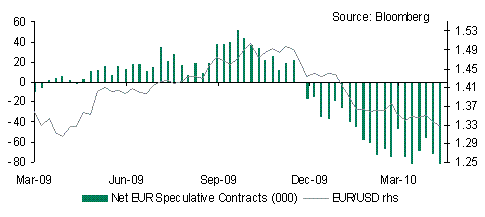
Some calm to markets early in the week will likely see the USD lose ground. There was a huge build up of net USD long positioning over the last week as reflected in the CFTC IMM data, suggesting plenty of scope for profit taking and/or offloading of USD long positions. In contrast, EUR positioning fell substantially to yet another record low. Some short EUR covering is likely in the wake of the new EU package, but EUR/USD 1.2996 will offer tough technical resistance followed by 1.3114.

The EU/IMF aid package will help to provide a strong backstop for EUR/USD but unless the underlying issues that led to the crisis are resolved, EUR/USD is destined to drop further. Perhaps there will be some disappointment for the EUR due to the fact that the package of support measures involves no FX intervention. This could even limit EUR upside given that there was speculation that “defending the EUR” meant physically defending the currency. In the event the move in implied FX volatility over the last week did not warrant this.
Pandemonium and Panic

Pandemonium and panic has spread through markets as Greek and related sovereign fears have intensified. The fears have turned a localized crisis in a small European country into a European and increasingly a global crisis.  This is reminiscent of past crises that started in one country or sector and spread to encompass a wide swathe of the global economy and financial markets such as the Asian crisis in 1997 and the recent financial crisis emanating from US sub-prime mortgages.  

The global financial crisis has morphed from a credit related catastrophe to a sovereign related crisis. The fact that many G20 countries will have to carry out substantial and unprecedented adjustments in their fiscal positions over the coming years means the risks are enormous as Greece is finding out. The IMF estimate that Japan, UK, Ireland, Spain, Greece, and the US have to adjust their primary balances from between 8.8 in the US to 13.4% in Japan. Such a dramatic adjustment never been achieved in modern history.

Equity markets went through some major gyrations on Thursday in the US, leading to a review of “unusual trading activity” by the US Securities and Exchange Commission in the wake of hundreds of billions of USDs of share value wiped off in the market decline at one point with the Dow Jones index recording its biggest ever points fall before recouping some of its losses. Safe haven assets including US Treasuries, USD and gold have jumped following the turmoil in markets whilst risk assets including high equities, high beta currencies including most emerging market currencies, have weakened. Playing safe is the way to go for now, which means long USDs, gold and Treasuries.

There is plenty of expectation that the G7 teleconference call will offer some solace to markets but this line of thought is destined for disappointment. Other than some words of comfort and support for Greece’s austerity measures approved by the Greek government yesterday, other forms of support are unlikely, including intervention to prop up the EUR. The ECB also disappointed and did not live up to market talk that the Bank could embark on buying of European debt and it is highly unlikely that the G7 will do so either. Into next week it looks like another case of sell on rallies for the EUR.   Remember the parity trade, well it’s coming back into play. 

Aside from the turmoil in the market there has been plenty of attention on UK elections. At the time of writing it looks as though the Conservatives will win most seats but fall short of a an overall majority. A hung parliament is not good news for GBP and the currency is likely to suffer after an already sharp fall over the last few days. GBP/USD may find itself back towards the 1.40 level over the short-term as concerns about the ability of the UK to cut its fiscal deficit grow. A warnings by Moody’s on Friday that the “UK can’t postpone fiscal adjustments any longer” highlights the risk to the UK’s credit ratings and to GBP.

Risk Aversion Back With A Vengeance

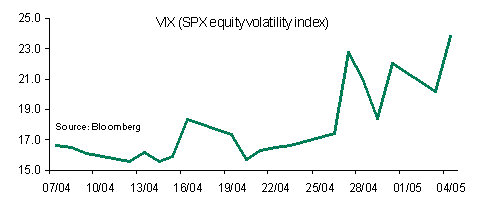
Risk aversion is back with a vengeance as reflected in the rise in equity volatility (VIX), drop in equity markets and rally in US Treasuries.  European peripheral debt markets sold off despite the EU/IMF aid package for Greece, whilst EUR/USD slid below 1.3000.  Various rumours dealt a blow to markets including talk of a sovereign ratings downgrade and a EUR 280 billion bailout for Spain.   The message is clear.  This situation is becoming increasingly dire by the day.  Europe is in big trouble and the whole euro project is under threat of unravelling.  

Concerns about parliamentary approvals, implementation/execution risk, prospects for relatively weaker growth in Europe, as well as contagion to Spain and Portugal, has tempered any enthusiasm towards the EU/IMF bailout package.  In addition, despite the large size of the EUR 110 billion loan package there are growing worries that it will be insufficient to cover Greece’s funding requirements over the next three years.  All of this implies that the EUR will remain under pressure for some time yet.  I have previously spoken about a drop to around EUR/USD 1.25 but the risk is for a much sharper decline is growing.

The USD is the clear winner, spiking to its highest level since May 2009 and is looking well set to consolidate its gains over the short-term despite the fact that net aggregate USD speculative positioning has already reached its highest level since September 2008 (according to the CFTC Commitment of Traders IMM data) in contrast to EUR positioning, which is at a record low.  This is unlikely to stand in the way of further downside for EUR/USD, with the next technical support level seen at 1.2885, which would match the previous lows see in April 2009.

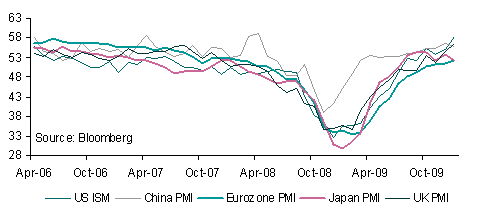
A combination of worries including contagion to Spain and Portugal, policy tightening in China, debt concerns in the UK and Japan, all threaten to undo the positive message from recent positive economic data including further strengthening in Purchasing Managers Indices globally.   The immediate attention remains on Greece and growing scepticism about the ability of Greece to carry out austerity measures in the face of rising domestic opposition, including a nationwide strike today. 

The rout in US and European markets will spill over to Asia, putting equity markets and Asian currencies under pressure.  Another risk currency to suffer is the AUD, which has dropped sharply following the Reserve Bank of Australia (RBA) meeting, in which the Bank indicated that rates were close to peaking.  Speculative positioning has dropped for the past two weeks as longs are taken off but AUD/USD weakness is set to be temporary, with buyers likely to emerge around near term support seen around 0.9001.

Greece Bailed Out, Euro Unimpressed

After much debate eurozone ministers along with the International Monetary Fund (IMF), finally announced an emergency loan package for Greece amounting to  EUR 110 billion. In return for the bailout Greece agreed to enhanced austerity measures. The good news is that the package covers Greece’s funding requirements until 2012, and is sufficient to avoid debt restructuring and default. The loan package has also removed uncertainty ahead of bond redemption on May 19th.

One aim of the package was to prevent contagion to other eurozone countries, especially Portugal and Spain, where there has been growing pressure on local bond and equity markets. However, the path ahead is strewn with obstacles and it is too early to believe that the package has ensured medium term stability for the EUR.

The challenges ahead are two-fold, including both the implementation of the measures in Greece in the face of strong domestic opposition and the approval of the loans by individual country parliaments within the eurozone, both of which are by no means guaranteed.

The toughest approval process is likely to be seen in Germany where the government will face a grilling in parliament and a challenge in the constitutional court ahead of official approval of the package. European Union leaders are scheduled to meet on May 7th to discuss the parliamentary approval of loans to Greece whilst German officials meet on the same day.

Implementation risk is also high. Although the Greek government appears to be sufficiently committed, opposition within Greece is growing; various strikes planned over coming days. Aside from union opposition, the scale of the budgetary task ahead is enormous, having never been undertaken on such a large scale in recent history. The sharp decline in growth associated with the austerity measures will make the task even harder.

The EUR bounce on the news has been limited, with the currency failing to hold onto gains. The announcement seems to have triggered a “buy on rumour, sell on fact” reaction, with the size of the loan package falling within the broad estimates speculated upon over the last week. The lack of EUR bounce despite the fact that going into this week the CFTC Commitment of Traders report revealed record net short speculative positioning in EUR/USD, reveals the extent of pessimism towards the currency.

The EUR may benefit from a likely narrowing in bond spreads between Greece and Germany. Given that sovereign risk is being increasingly transferred from the periphery to the core, the net impact on bond markets may not be so positive for the EUR. Over the short-term there will be strong technical resistance on the upside around EUR/USD 1.3417 but more likely the currency pair will target support at around 1.3114.

The Herculean task ahead for the Greek government suggests that markets will not rest easy until there are credible signs of progress. Investors would be forgiven for having a high degree of scepticism given the degree of “fudging” involved in the past, whilst Greek unions will undoubtedly not make the government’s task an easy one by any means. Such scepticism will prevent a sustained EUR recovery and more likely keep the EUR under pressure.

As noted above the divergence in growth for the eurozone economy between Northern and Southern Europe will make policy very difficult. Moreover, the EUR is set to suffer from an overall weak trajectory for the eurozone economy, relative to the US and other major economies. The widening growth gap with the US will also fuel a widening in bond yield differentials, a key reason for EUR/USD to continue to decline to around or below 1.25 by the end of the year.