Q2 Economic Review: Double-Dip Recession or Prolonged Recovery?

I was recently interviewed by Sital Ruparelia for his website dedicated to “Career & Talent Management Solutions“, on my views on my view on the Q2 Economic Review: Double-Dip Recession or Prolonged Recovery?

Sital is a regular guest on BBC Radio offering career advice and job search tips to listeners. Being a regular contributor and specialist for several leading on line resources including eFinancial Careers and Career Hub (voted number 1 blog by ‘HR World’), Sital’s career advice has also been featured in BusinessWeek online.

Please see below to read my article

Since we last discussed the economic outlook at the end of quarter 1, much has happened and unfortunately there has not been a great deal of positive news. I retained a cautiously optimistic outlook for economic recovery for the Q1 Economic Review: elections, recovery and underemployment discussion article, but highlighted that recovery would be a long and drawn-out process, with western economies underperforming Asian economies.

The obstacles to recovery discussed then continue to apply now, including consumers paying down debt, high unemployment, tight credit conditions and weak confidence.

Click here to read the rest…

ECB, BoE and RBA in the spotlight

Double-dip fears are the pervading influence on market psychology at present even as European sovereign concerns appear to be easing. Friday’s release of the June US jobs report did little to alleviate such concerns but the headline payrolls number was less negative than the indications provided by other jobs data.

Growth fears have in particular been centred on the US in the wake of a run of disappointing data, These new found concerns have somewhat tarnished the USD’s ability to benefit from safe haven buying as risk aversion increases, as reflected in the 4.5% drop in the USD index since its high on 7th June. The prospects for the USD do not look too much better this week, but the drop is more likely a correction rather than a renewed weakening trend.

Having navigated its way through the European Central Bank’s (ECB) 12-month liquidity payback, various debt auctions, and Germany’s presidential election last week the EUR may find itself with less obstruction in its path but will nonetheless, likely struggle to make much headway this week. EUR speculative positioning, as indicated by the CFTC IMM data, reveals that there has been little short covering over the last couple of weeks, suggesting speculative sentiment remains negative.

Nonetheless, the rebound in EUR/USD has been impressive since its low around 1.1876 about a month ago and not just against the USD, with EUR making up ground on various crosses too including CHF and GBP. Easing sovereign concerns will have helped but there are plenty of downside risks ahead as austerity measures begin to bite and growth divergence becomes more apparent.

The ECB council meeting on Thursday is unlikely to give much direction for the EUR, with the meeting likely to pass with an unchanged rate decision and no change in economic assessment. There will be more attention on whether EUR/USD can maintain a toe hold above the psychologically important 1.2500 level, which I suspect may prove tough to hold this week.

The Reserve Bank of Australia (RBA) also announces its rate decision (Tuesday) and will likely pause in tightening cycle. Recent data have remained positive, especially with regard to the labour market. The RBA will wait for the Q2 CPI data on July 28th before deciding on the next policy move, with jobs data on Thursday also likely to provide further clues. AUD/USD may struggle in the current environment where growth worries are prevalent, and the currency is likely to find it tough going over the coming weeks.

Finally, the Bank of England (BoE) meets this week too but like the ECB and RBA no change is likely. Although we will have to wait a couple of weeks for the minutes of the meeting it seems highly unlikely that MPC members will vote for a hike aside from Sentance who has espoused a more hawkish stance. Notably GBP speculative short positions have been scaled back over recent weeks as sentiment for the currency turns less negative but GBP gains against the USD will be more limited this week, with renewed GBP upside against the EUR more likely.

Double-dip fears pressure USD

Markets have found it hard to decide whether to sell the USD due to weaker economic data or buy it on higher risk aversion, but the moves overnight were clear; the USD sold off sharply in the wake of a run of soft data releases. Four separate US releases came in below consensus yesterday, with the June ISM, jobless claims, pending home sales and domestic vehicle sales, all disappointed to varying degrees, especially pending home sales, which dropped an astonishing 30% in June.

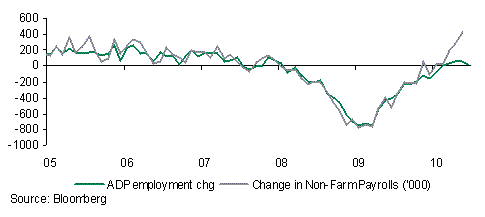
The news could have been much worse today, with the release of the US June jobs report. Following the 13k increase in the June ADP employment count the consensus forecast for nonfarm payrolls looked way too optimistic; consensus expectations were for a 130k drop in payrolls according to Bloomberg, with estimates ranging from 0 to -250k. In the event payrolls dropped by 125k and the unemployment dropped to 9.5%, an outcome that was not as bad as feared.
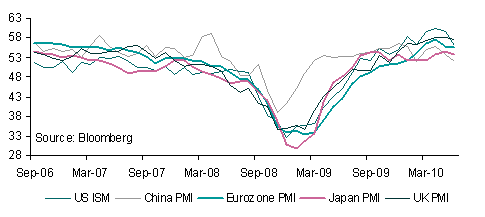
It was not just the US ISM that slipped, but a host of global purchasing managers indices (PMIs) weakened in June including China and India, supporting the view that economic activity will lose momentum in H2 2010. Before we all get too carried away it is worth noting that most manufacturing surveys are coming off a high level.
Nonetheless, for once it wasn’t European concerns that sparked an increase in risk aversion as eurozone banks borrowed less than feared from the ECB, and the Spanish bond tender passed off relatively well, factors that helped EUR/USD jump above 1.25000. Although I remain bearish on the prospects for the EUR over coming months, there may be some further near term upside, with EUR/USD 1.2675, the next resistance level in focus.

As a consequence of US double-dip fears, risk aversion remains at a high level, with US bond yields and commodity prices dropping sharply, leaving commodity currencies sharply lower. In the current environment the USD is likely to be sold on rallies.

On the commodity currency front, AUD/USD may find some relief from the news of a compromise on a proposed mining tax, but the weight of risk aversion will limit any rebound, with my preference to play AUD upside versus NZD. The main concession from Australian Prime Minister Gillard reduce was to reduce the tax to 30% for iron and coal, whilst retaining the 40% tax for oil and gas projects. The agreement likely increases the chance of an election in Australia in the next couple of months as Gillard capitalises on a popularity bounce. Fresh elections could be another factor that limits AUD upside over coming weeks.