JPY retracement, CHF pressure

Risk assets rallied overnight, the USD weakened and US Treasury yields rose. There was little new in terms of economic news, with only NAHB March homebuilders confidence of note, which came in slightly weaker than expected. The bigger driver for markets was the news that Apple Inc. will pay around USD 45 billion in dividends and share buybacks over the next 3-years.

Today sees a crop of second tier releases including housing starts and building permits in the US and inflation data in the UK while there will also be attention on a speech by Fed Chairman Bernanke. Risk assets will remain supported but I continue to see consolidation for markets in the near term.

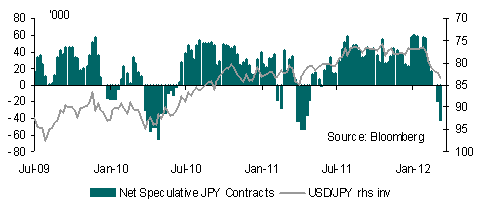
USD/JPY has retraced lower as warned last week. My quantitative models suggest scope for even more of a correction lower, with a drop below 83.00 on the cards in the short term. While the upward move in the currency pair was built on a widening in the US yield advantage over Japan, the move looks overdone. Nonetheless, any pullback will offer better levels to initiate long USD/JPY medium term positions.

Clearly the market believes that the JPY will weaken further given the build up in JPY short positions over recent weeks, with shorts at their highest since April 2011. February trade data to be released on Thursday will provide further fuel for JPY bears given the persistence of a trade deficit and weakness in exports.
Following the bounce in EUR/CHF last week the currency pair has dropped back into its recent tight range around the 1.2050-1.2070 area. Strong warnings by the Swiss National Bank at its policy meeting did not lead to any follow through on the CHF. I expect a gradual drift higher in EUR/CHF over coming weeks in line with the incremental change in sentiment for the Eurozone as Greece slips from the radar.

Official pressure for CHF weakness will remain intense given the deterioration in economic data as likely to be revealed in today’s release of Q4 industrial production. Nonetheless, the SNB will be wary of confronting the market in terms of FX intervention to weaken the CHF despite its verbal warnings. Meanwhile USD/CHF remains highly sensitive to gyrations in the USD index given its strong correlation, suggesting some consolidation in the short term as the USD pulls back.
Consolidation

The overall tone to markets remains a positive one. Core bonds (Treasuries, bunds) have taken on a bearish tone in the wake of strengthening economic data and have established the usual bullish equities / bearish bonds relationship. Meanwhile volatility measures both in equity and currency markets have dropped to historically low levels.

The USD has been propelled by higher US bond yields but looks vulnerable as US Treasuries consolidate in the short term. Data this week is fairly light, suggesting that direction will be limited as only housing data in the US and purchasing managers’ indices in Europe will be of interest. Overall, the start to the week will see markets in consolidation mood.

The USD index had made up plenty of ground since hitting its lows around 78.095 at the end of February. Higher US bond yields in the wake of strengthening economic data and receding expectations of more Fed money printing have boosted the USD. Nonetheless, US Treasuries appear to be consolidating their losses (ie yields have failed to push higher recently), limiting the ability of the USD to strengthen further.

Data releases in the US this week will be mainly centred on the housing market and are unlikely to be strong enough to warrant a further strengthening in the currency. Much will also depend on gyrations in risk. My Risk Barometer has moved into ‘risk loving’ territory, which plays negatively for the USD versus many high beta currencies. The USD will struggle to make further gains in the short term.

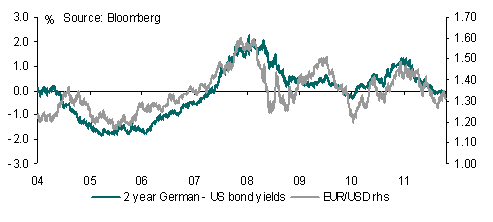
The agreement to furnish Greece with a second bailout gave the EUR no help whatsoever. Instead, higher US Treasury yields relative to bunds dealt the EUR a strong blow and the currency came dangerously close to dropping below the 1.3000 psychologically important level versus USD. Even a narrowing in peripheral bond spreads against the core has failed to give the EUR a lift. Further EUR losses will be limited over coming days but only because US yields have not pushed higher.

Nonetheless, the technical picture has turned bearish and any relief could prove temporary. A mixed batch of data releases including ‘flash’ purchasing managers’ indices which overall will reveal the composite PMI below the 50 boom/bust level for a second month in a row, will not be particularly helpful for the EUR. EUR/USD is likely to be stuck in a 1.2974 – 1.3291 range over coming sessions.

GBP on a rollercoaster, NOK to bounce back

GBP has had a rollercoaster ride both against the USD and the EUR. On balance, it has fared better than the EUR vs. USD. News that Fitch ratings put the UK’s AAA ratings on negative watch had little impact although it may yet restrain GBP. If anything the news will likely help UK Chancellor Osborne formulate a relatively austere budget next Wednesday. Unlike the beleaguered JPY, GBP has not suffered from a widening in the yield differential with the US.

In fact 2-year UK Gilt yields have echoed the rise in US 2-year bond yields over recent days. This suggests that GBP ought to face less downward pressure compared to other currencies. Although I continue to see further GBP strength against the EUR over the medium term, the near prospects look volatile. Instead, I suggest playing a GBP positive view via the AUD.

It is worth commenting, albeit belatedly, on the outlook for the NOK following the surprise decision by Norway’s central bank, Norges Bank, which cut its policy rate by 25bps on Wednesday. Does it significantly change the outlook for the NOK? I believe it doesn’t and the recent drop in the NOK will provide a good opportunity to reinstate long positions.

Although the central bank may ease policy once again over coming months this will not undermine the NOK given that the influence of interest rate differentials on the currency is limited. Moreover, lower interest rates threaten to push already high property prices even higher suggesting that the Norges Bank may have limited room to cut rates further. Elevated oil prices continue to provide solid support for the currency and unless oil prices correct lower, the NOK will remain well supported versus EUR, with a drop to around 7.45 on the cards.

Posted in FX, Norway, UK. Tags: , , , , , . 1 Comment »

Euro and Swiss franc under pressure

Positive momentum in risk assets slowed, with higher core bond yields in the US and Europe weighing on sentiment. The USD in particular has been buoyed by higher US bond yields, with the move in line with my long held medium term view of a firmer yield led gain in the USD. Commodity prices in contrast have come under growing pressure, with gold and copper prices sliding in particular. Risk measures continue to improve including my risk barometer, suggesting that the overall tone to risk assets will remain positive.

The main focus today will be on a plethora of US data releases including industrial production, Philly Fed and Empire manufacturing confidence while in Europe attention will be on Spanish and French bond auctions. US data will likely remain upbeat, while the auctions should be well received.

EUR has pulled back sharply over recent not just against the USD but also on the crosses, with EUR/GBP finally playing some catch up yesterday. It’s interesting that the drop in the EUR has occurred despite generally improving conditions for peripheral Eurozone as reflected in narrowing yield spreads between peripheral countries and Germany.

The bottom line is that the EUR is suffering from a widening in the US / Europe (Germany) bond yield differential as it is becoming increasingly clear that the US economy will strongly outperform the Eurozone economy this year. As noted at the beginning of the week EUR/USD was set to drop to below support around 1.3055. Having hit this level, strong support around the 1.2974 level moves into sight.

Ahead of today’s quarterly Swiss National Bank meeting at which no change in policy is widely expected, EUR/CHF has taken a sharp lurch higher, finally moving away from around the 1.2050 level it has been trading at over recent weeks. While I am bearish on the CHF over the medium term further upside in EUR/CHF will be limited over the short term given that the move in the currency is at odds with interest rate differentials which have actually narrowed between the Eurozone and Switzerland. Technical resistance around 1.2298 will cap gains over coming sessions.

As for USD/CHF the picture remains a bullish one, with general USD strength driven by higher yields, pushing the currency pair higher. I look for a test of resistance around 0.9393 over coming sessions.

USD boosted by bond yields, AUD vulnerable

The USD rallied further overnight helped by a Fed FOMC statement that was less downbeat than in January, with no hint of any further quantitative easing. In combination with a solid February retail sales report and upward revisions to December and January, US bond yields pushed higher. US 2-year Treasury yields hit their highest since the beginning of August 2011, which given the strong correlation with the USD, provided further support to the currency.

The highest FX sensitivity to yield differentials is found in JPY, AUD, SEK, and CAD over the past 3-months. However, among these US yields have only widened against Japan over recent days meaning this currency is the most vulnerable. For the other currencies their yields have actually been widening against the USD. Over the near term, the USD is set to remain well supported, especially as data releases over the rest of the week will maintain the tone of strengthening economic activity.

AUD looks increasingly vulnerable to further short term slippage. At least partly explaining the recent drop in AUD/USD is a narrowing in Australia’s yield advantage over the US. A spate of weaker data over recent weeks has helped to undermine the currency including Q4 GDP data which revealed a far slower pace of growth than had been expected. Weak jobs data reinforced the view that the economy is spluttering.

The net result is that Australian interest rate futures have rallied and implied yields have dropped in contrast to the US where futures have sold off in the wake of strengthening economic data. The casualty of all of this is the AUD and it appears that further downside risks are in store for the currency. Indeed my quantitative models show that the AUD continues to trade well above its short term ‘fair value’. For those wanting to take medium term long positions in the AUD I would suggest rebuilding longs around 1.03-1.04 versus USD.