Europe’s crunch time

It’s crunch time for EU leaders and the European Central Bank (ECB). The ECB under the helm of Mario Draghi is steadfastly refusing to provide further assistance to the Eurozone periphery either directly via lower interest rates or securities market purchases or indirectly via another Long term refinancing operation (LTRO) . Any prospect of debt monetization as carried out already by other central banks including the Fed and Bank Of England is a definite non-starter. The reason for this intransigence is that the ECB does not want to let Eurozone governments off the hook, worrying that any further assistance would allow governments to slow or even renege upon promised reforms.

Whether this is true or not it’s a dangerous game to play. The fact that the previously unthinkable could happen ie a country could exit the Eurozone should have by now prompted some major action by European officials. Instead the ECB is unwilling to give ground while Germany continues to stand in the way of any move towards debt mutualisation in the form of a common Eurobond and/or other measures such as awarding a banking license to the EFSF bailout fund which would effectively allow it to help recapitalize banks and purchase peripheral debt. Germany does not want to allow peripheral countries to be let off the hook either arguing that they would benefit from Germany’s strong credit standing and lower yields without paying the costs.

To be frank, it’s too late for such brinkmanship. The situation in The Eurozone is rapidly spiraling out of control. While both the ECB and Germany may have valid arguments the bottom line is that the situation could get far worse if officials fail to act. As noted above there are various measures that could be enacted. Admittedly many of these will only buy time rather than fix the many and varied structural problems afflicting a group of countries tied together by a single currency and monetary policy and separate fiscal policies but at the moment time is what is needed the most.

It’s good to see that European officials are finally talking about boosting growth and realising that austerity is killing the patient. However, measures such as increasing trade, investment etc are all long term in nature. Europe needs action now before it’s too late. After years of keeping the Eurozone together by sheer force of political will rather than strong fundamental reasons lets hope that politicians in Europe begin to realize this before it’s too late. The lack of traction at this week’s EU summit was disappointing but with their backs to the wall ahead of Greek elections in mid June Germany and the ECB may be forced to give ground. In the meantime the beleaguered EUR looks destIned to remain under pressure.
GBP vulnerable, AUD downside limited

Finally after weeks of selling, risk assets perked up helped by China’s pledge to focus more on supporting growth and signs of cooperation between Germany and France, as leaders of both countries agreed to do ‘everything necessary’ to ensure Greece stays in the Eurozone.

Just what this will entail is not clear but reports suggest that European officials are formulating plans ahead of the EU Summit on Wednesday. Markets are by no means out of the woods and much uncertainty will remain ahead of Greece’s election in just less than a month.

GBP has dropped both against the USD and EUR. The currency has not been helped by some dovish tones from Bank of England MPC member Posen who last week suggested that his decision to withdraw his vote for more quantitative easing may have been ‘premature’. The renewed spectre of more QE will likely weigh on GBP over coming weeks.

The fact that the market has got itself very long GBP may also have contributed to some profit taking as some caution in being excessively long GBP sets in. UK inflation data today will likely play negatively for GBP too given the sharp slowdown expected to be registered in the April CPI inflation data.

My quantitative model for EUR/GBP reflects the potential risks to GBP over coming days, with the model output suggesting further downside risks to GBP. Technical resistance will likely be seen around the 0.8198 level.

AUD’s slide has been pretty dramatic over recent weeks. Despite a bounce overnight the currency has lost close to 9% of its value against the USD since the beginning of March, weighed down by rising risk aversion and China growth worries.

My quantitative model has been persistently calling for a drop in the AUD (a fact that I have highlighted previously). Interestingly the model now shows that the gap between the current level of AUD/USD and its short term ‘fair value’ estimate has almost closed, suggesting that the downside for the currency will be limited to around the 0.96-0.97 region.

The only caveat is that a stark deterioration in risk appetite from current levels would result in a sharper fall but for now we believe that a lot of the expected downward correction in the currency has already occurred. While I would not go and rush out to buy AUD just yet, taking a short position looks much less attractive.

Dollar firm, but beware of a short covering euro bounce

The USD has risen sharply since the end of April, benefiting from the ongoing turmoil in the Eurozone and rise in US Treasury yields (2-year). Markets have managed to brush US fiscal and political concerns under the carpet as focus centres on Europe. The USD also managed to shrug off a soft April retail sales report and a slightly more cautious set of FOMC minutes.

A recovery in April durable goods orders, new homes sales and a relatively stable reading for Michigan confidence should ensure that the USD’s upward trajectory remains unimpeded this week. Given the potential for continued uncertainty ahead of Greek elections in mid June, risk aversion and the USD are set to remain elevated.

In Europe, it’s all about Greece and the machinations ahead of fresh elections in mid June. The EUR shows little sign of stabilising ahead of these elections. Data releases will take a back seat although the calendar will be heavy. FX markets will have one eye on the May German IFO survey and the flash readings in purchasing managers indices. The PMI data will give no relief to the EUR, with the data consistent with growth contraction for the most part while the IFO is set to register a decline too.

Meanwhile, pressure on German Chancellor Merkel to accept measures that were previously vetoed at an informal EU summit on Wednesday has also heightened. Such measures include direct recapitalisation of banks and/or unlimited purchases of peripheral country debt by the ECB and through the Eurozone rescue fund.

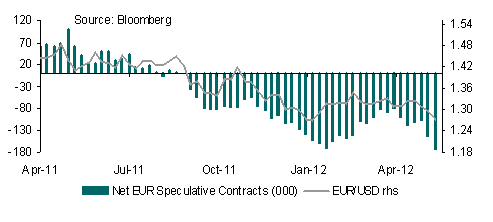
Admittedly the large extent of short market positioning (the latest CFTC IMM report revealed an all time low for EUR positioning) means that the risk of a bounce is high in the event of any good news or perhaps in the wake of any renewed securities markets purchases by the ECB or fresh hints of a third LTRO. Whether there will actually be any good news is another question entirely.

USD/JPY has been relatively stable despite a rise in US bond yields compared to Japanese JGB yields, with rising risk aversion helping to keep the JPY firm. The Bank of Japan meeting this week has the potential to change the currency pair’s trajectory but is unlikely to do so. No action is expected at the policy meeting on Wednesday, leaving the JPY with a firm bias.

Trade data will provide some justification for a more bearish stance on the JPY, with another deficit set to be registered in April as export conditions remain weak. However, as usual the JPY will continue to ignore domestic economic data and focus more on relative yields and risk.

What would a Greek exit mean for the euro?

Excuse the lack of posts over recent days. I’m just finishing up a trip to London and am back in HK at the end of the week. I thought in the meantime it would be worth discussing the impact on the euro of a potential Greek exit.

The fact that European officials are openly talking about the prospects of a Greek exit from the Eurozone highlights just how drastic the situation has become. Much will depend on the outcome of new government in Greece in mid June following inconclusive elections recently. Even fresh elections in mid June does not mean that it will be any easier to form a government, leaving the option of a euro exit firmly on the table.

If Greece was to leave the Eurozone there would be a significant amount of confusion in FX markets. It is not obvious that the EUR would strengthen. It could be argued that the departure of Greece would eliminate the weakest link in the chain thus allowing the EUR some relief. Should Greece default on its debt and leave the Eurozone it would not have a marked direct impact on the Eurozone economy but the biggest risk is the financial contagion to other Eurozone countries.

A Greek exit would imply a new currency (Drachma) for the country, a separate monetary policy etc. However, any competitive gain from a weaker currency would be lost in a huge increase in inflation while the local corporate sector would be forced to default en mass on any EUR debt that they hold. Confidence in the new currency would be weaker leading to an exodus of capital further strengthening the EUR.

Admittedly the Eurozone would be stronger without Greece but it would not be long before market attention turned to Portugal and Ireland and even Spain as the next candidates for exit. Indeed, a Greek exit would set a precedent that did not exist previously. It would imply a significant increase in volatility for the EUR given the uncertainty it would create for other Eurozone members. Any rally in the EUR that would be experienced following a Greek exit would therefore be very short lived.

Ultimately for the EUR to experience a sustained strengthening it would require some sign that policy makers are addressing growth concerns as well as progress on austerity and deficit reduction. The formation of a common Eurobond, increased spending on investment projects to enhance productivity, reform of labour markets and a bolstering of the firewall around other peripheral countries would help confidence.

However, this is a long way off and the EUR is likely to suffer for some months to come as growth worries and peripheral country tensions persist. The downside risks to the EUR are clearly opening. The fact that the market is very short EUR already may limit the pace of decline but not stem it. There may be some stabilisaiton of the EUR towards year end assuming Eurozone officials get their act together.

However, in the interim the situation could become far more dire. If Greece were to exit, the prospects of further financial contagion would result in more and not less pressure on the EUR, leading to a potential drop to around the mid 2010 lows just below 1.20. Even if Eurozone political and debt tensions subside I still believe the EUR will decline based on an unfavourable growth and yield differential trajectory but it is clear that the downside risks are much greater even with short market positioning, should the situation deteriorate. In this event, even the strong bids from official investors (namely Asian central banks and sovereign wealth funds) will pull back and the EUR could plunge sharply.

Euro grinding lower as officials talk about Greek exit

The week begins in sour mood although notably Asian market pressure was limited even in the face of ongoing Eurozone tensions. China’s cut in its RRR over the weekend helped to limit the damage to markets but there are still plenty of negatives to chew on. Notably European officials are openly discussing and even preparing for the possibility of a Greek exit from the euro, an outcome that has grown in probability as fresh elections loom in Greece.

FX markets have finally awoken from their stupor, with a spike in volatility and moves out of long worn ranges registered. The USD has extended its upward trajectory that began in this cycle on 27th April. The rally looks strong and sustainable but is built largely on the fact that the USD looks less ugly than some other currencies rather than on positive US economic developments.

Admittedly US recovery is taking shape but the data is not sufficiently strong to erase expectations of further Fed quantitative easing, a factor that will limit the ability of the USD to capitalise on weakness elsewhere. Data over coming days will not help to provide much clarity on the issues, with April retail sales likely to be soft and the Fed FOMC minutes unlikely to deliver much new information. Even so, risk aversion is intensifying, providing the USD with firm support, suggesting that the USD will continue to edge higher over coming days.

The EUR in particular has sustained a drop below the psychologically important 1.30 level, spelling more downside risks. Greek politics and the potential for fresh elections remain at the forefront of attention. A small amount of relief on upcoming Greek bond redemptions following the EU’s deliverance of EUR 4.2 billion funds will not be sufficient to offset political worries.

EUR will also find direction from the Eurogroup meeting of finance ministers meeting today who aside from Greek issues will also discuss the Spanish banking sector. Meanwhile, a meeting between French President and Hollande and Germany’s Chancellor Merkel will have the potential to move markets but the chances of a breakthrough on any fresh deal is limited.

Data releases will confirm Eurozone recession while the May German ZEW investor confidence survey is set to record a decline. All of this will not bode well for the EUR, with the currency set to grind lower over coming sessions. EUR/USD 1.2852 will be a crucial support level, a break of which will see EUR slide much further.