US/China Tensions Ratchet Higher

FX policy tension is a theme that looks to be making a come back. The potential for CNY revaluation continues to be hotly debated, with international pressure on China intensifying. For its part China continues to resist such calls, but growing speculation that the US will label China a “currency manipulator” in the semi-annual US Treasury report on 15 April suggests that the issue will remain very much on the radar screen.

Tensions have ratcheted higher in the wake of a proposed bill by US senators targeting countries with “fundamentally misaligned currencies” and those needing “priority action”. Any country that is targeted would then have a year to correct its currency or face a case at the World Trade Organisation. If China is labelled as a currency manipulator it could also result in anti dumping regulations.

Much of the increase in tension may be attributable to politicking ahead of the November mid-term Congressional elections but it is clear that the issue is not going away quickly. Chinese Premier Wen’s strong comments over the past weekend denying any need for revaluation of the CNY suggests that the stakes will get even higher over coming months.

It is looking increasingly difficult for the US administration to ignore Congress’ calls for stronger action on FX. Moreover, US President Obama’s pledge to double US exports within 5-years will require some USD weakness, but the USD will need to weaken against Asian currencies led by China and not just against the usual culprits such as the EUR.

There is little sign of this happening anytime soon as Asian central banks continue to intervene to prevent their currencies from strengthening. Nonetheless despite China’s insistence that it does not believe the CNY is undervalued China is likely to be edging closer to an eventual revaluation in the CNY sometime in Q2 2010 as it combined a stronger currency with higher interest rates and tighter lending to curb inflation. A stronger CNY will also spur other Asian central banks to allow stronger currencies.

A deterioration in the China/US relationship could have potentially significant FX implications. The latest US Treasury TIC report this week showed that China reduced its holdings of US Treasuries for the third straight month in January. Should China feel that it needs to retaliate against a more aggressive US trade or FX stance it could reduce its holdings of US Treasuries further.

All Eyes On Greece

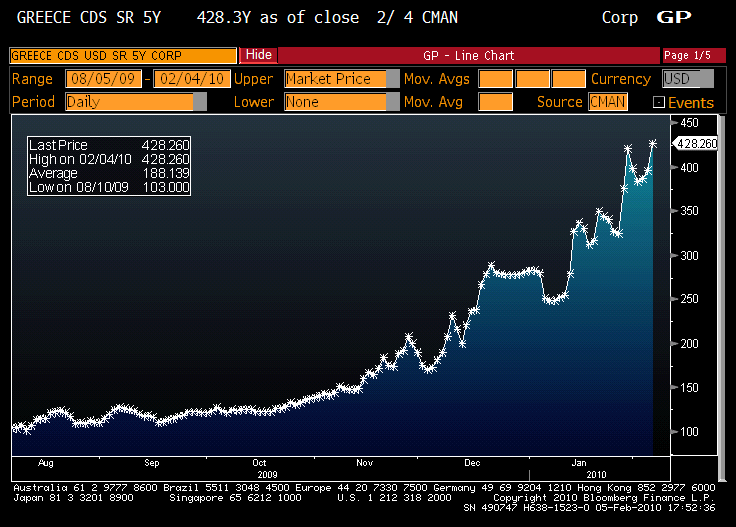
I remain a skeptic but market sentiment continues to improve, helped by firmer data and expectations that Greece’s woes are on the path to being resolved. Greece is expected to announce further austerity measures including further spending cuts and tax hikes, which will be aimed at appeasing EU concerns and passing the March 16th test set by the EU. This could pave the way for some form of debt guarantee scheme and a better reception to a likely sale of up to EUR 5 billion in 10 year Greek bonds.

These measures will allow the EUR to recover some of its recent losses in the short term after dropping to new 2010 lows against the USD around 1.3435, but gains are likely to be limited given the many uncertainties remaining including fiscal problems in other European countries and weak growth ahead. If EUR/USD can sustain a break above the 20-day moving average level around EUR/USD 1.3630 it will put the next resistance level of 1.3747 into target, which given record short EUR speculative positioning may happen quite quickly. I suggest rebuilding short EUR positions on a move to this level.

Commodity currencies continue to be favoured and despite only a brief spike following the RBA’s decision to hike interest rates yesterday AUD/USD has managed to traverse the 0.90 level and looks well placed to build on its gains helped by a firm 0.9% QoQ reading for Australian GDP in Q4. Nonetheless, AUD/USD 0.9147 looks like a near term cap on the currency. For bullish commodity currency trades the NZD may offer a little better value and short AUD/NZD may be the way to go from here. Note that NZD positioning is below the 3-month average according to positioning data. In contrast to the RBA, the Bank of Canada left interest rates unchanged, but its statement highlighted that the prospect of quantitative easing had receded, which has effectively lifted a weight off the shoulders of the CAD.

All of this leaves the USD on the back foot, with further direction coming from the US February ADP jobs report, ISM non-manufacturing survey and Fed’s Beige Book. The ADP data and ISM employment component will give further clues to Friday’s February US jobs report for a 50k drop in payrolls is expected. Service sector Purchasing Managers’ Indices (PMIs) will also be released across the eurozone and the UK and both are likely to sustain moves into expansion territory.

The rebound in EUR/USD was a trigger for further selling in USD/Asian currencies. Asian currencies remain highly correlated with local equity market performance and have benefited from a strong return of equity portfolio inflows over recent days. Only Vietnam has registered outflows this week, with South Korea and Taiwan registering the biggest inflows. Indeed, South Korea has seen the biggest inflows of portfolio capital compared to other Asian countries so far this year, with inflows of around $933 million.

There is not much data in the region to provide direction for Asian currencies today though the South Korean industrial production report will be closely watched. Despite a small monthly drop expected, output likely expanded at very healthy 40%+ pace annually. Overall, USD/Asians are likely to remain under downward pressure in line with the general pressure on the USD, but direction will continue to come from equity markets.

Calming the Tiger

As markets enter the year of the Tiger a somewhat calmer tone appears to be ensuing, with risk appetite edging higher helping equities and the beleaguered EUR to recover some lost ground.  US stocks were helped by a firmer than expected reading for the Empire manufacturing survey (to 24.91 in Feb) and a slight uptick in the US NAHB (National Association of Home Builders) index (to 17 in Feb) but consumer confidence remained weak as indicated by the decline in the weekly reading of ABC Consumer Confidence (-49).  

On the other side of the pond the better than expected February ZEW survey (a survey of investor confidence) in Germany (45.1) helped sentiment although it still recorded a decline from the previous month as Greek fiscal/debt concerns weighed on financial market participants’ confidence.  The bigger impetus came from comments by Greek Finance Minister Papaconstantinou who said there would be no need to for a bailout of the country.

Tensions over Greece eased further following news that tax collectors in the country called off a planned strike, helping to allay some concerns that unions will block planned spending cuts.   On the policy front, the EU Council ratified Greece’s plans but with strings attached, giving the country one month to present a report on the timetable for implementing budget cuts for 2010 and three months to outline policy measures required to cut the deficit below 3% by 2012.

Meanwhile, commodity prices have pushed higher helping currencies such as the AUD and NZD to strengthen.  Moreover, the AUD was boosted by more hawkish interest rate expectations following the release of the minutes of the latest RBA policy meeting which indicated that the Reserve Bank was merely pausing in its rate cycle.  Expectations of a rate hike in March increased as a result.

Overall, the recent rally in the USD is looking increasingly overdone and some reversal is likely over coming weeks.  The fact that market positioning has reached extreme levels in particular in the case of the EUR highlights scope for some recovery in the currency, especially now that the worst case scenario of a Greek default has passed.  The outlook for commodity currencies is even more bullish as risk appetite improves further.     

If anything, data today is likely to give further support to the recovery story, with US industrial production and housing starts expected to post healthy gains.  The Fed FOMC minutes may offer some additional insight into the debate over the implementation of exit strategies but there is unlikely to be much elaboration from the recent comments by Fed Chairman Bernanke in his speech to the US Senate in which he hinted that a rise in the discount rate is not far off.  

Risk currencies including many Asian currencies are likely to benefit from the improvement in risk appetite over the short term.  EUR/USD will likely strengthen as more short positions are covered but will face strong technical resistance around 1.3839.   Asian currencies have been resilient to the recent rise in risk aversion and this is likely to continue over the coming weeks.  As risk appetite recovers currency plays including long AUD/JPY , and even some further upside in EUR/USD look favourable.

Currency Tensions Intensify Ahead of G7

Portugal, Greece and Spain remain firmly in the spotlight but it may not be long before the light broadens to include UK, US and many other countries facing similar difficulties on the fiscal front. Portuguese, Greek and Spanish equities were smashed in the wake of growing concerns and sentiment looks like it will get worse before it gets any better.

Events in each of these countries are not helping matters. In Portugal, parliament began to vote on a bill on financial transfers to the regions, which could damage the ability of the government to reduce the deficit whilst speculation that the Prime Minister is about to resign has intensified. In Greece tax collectors have started a 48-hour strike as social unrest worsens in the wake of the implementation of deficit cutting measures.

Although European officials pour cold water on the idea that the whole EMU Project could unravel bond markets are not taking any chances whilst the EUR looks destined to languish at ever weaker levels until there is a semblance of calm. Meanwhile. the European Central Bank (ECB) has clearly stated that does not want to get involved.

The G7 meeting in Canada will move rapidly into focus this weekend, with a joint press conference expected on Saturday. Sovereign debt concerns and restrictions and banks will likely be addressed whilst the not insignificant matter of China’s currency will also likely be discussed.

US pressure on China to strengthen the CNY has increased as has tensions between the two countries following US arms sales to Taiwan and a scheduled meeting between President Obama and the Dalai Lama.

There is growing speculation that the upcoming US Treasury report in April will label China as a currency manipulator which could result in tensions ratcheting up to a higher level. China holds the cards given the US reliance on Chinese money but with mid-term elections looming in the US and Obama’s promise to double US exports within five years, US pressure on China will intensify as will likely resistance from China.

Selling Risk Trades On Rallies

Disappointing earnings as well as a weaker than expected outcome for data on the health of the US service sector (the ISM non-manufacturing index failed to match expectations, coming in at 50.5 in January versus consensus of 51.0) has weighed on markets, undoing the boost received from the generally positive manufacturing purchasing managers (PMIs) indices earlier in the week. It was not all bad news however, as earnings from Cisco Systems beat expectations Meanwhile US ADP jobs data fell less than expected, dropping 22k whilst data for December was upwardly revised. These are consistent with a flat outcome for January non-farm payrolls.

Various concerns are still weighing on confidence. Sovereign ratings/fiscal concerns remain high amongst these and although much has been made of the narrowing in Greek debt spreads, attention now seems to be turning towards Portugal. Greece is also far from being out of the woods, and whilst the European Commission accepted Greece’s economic plans the country would be placed under much greater scrutiny by the EC.

The US has not escaped either, with Moody’s warning that the US AAA credit rating would come under pressure unless more stringent actions were taken to reduce the country’s burgeoning budget deficit. The move follows the US administration’s forecast of a $1.565 billion budget deficit for 2010, the highest as a proportion of GDP since the second world war, with the overall debt to GDP ratio also forecast to rise further.

The current environment remains negative for risk trades and the pullback in high beta currencies has been particularly sharp over recent weeks. Sentiment for the NZD was dealt a further blow from a surprisingly weak Q4 jobs report in New Zealand. Unemployment rose to a decade high of 7.3% over the quarter whilst employment growth contracted by 0.1%. The pull back in wage pressures will also be noted by interest rate markets, as it takes some of the pressure off the RBNZ to raise rates anytime soon.

Data in Australia will not help sentiment for the AUD too. Australian retail sales dropped by 0.7% in December, a worse than expected outcome. The data will only serve to reinforce market expectations that the RBA will no hike interest rates as quickly as previously expected. Nonetheless, I would caution reading too much into the data, with real retail sales volumes rising by a solid 1.1% over Q4 whilst other data showed a strong 2.2% jump in building approvals.

The overall strategy against this background is to sell risk trades on rallies. There are still too many concerns to point to a sustained improve in risk appetite. Moreover, the market is still long in many major risk currencies. Asian currencies have so far proven more resilient to the recent rise in risk aversion however, a reflection of the fact that a lot of concerns are emanating from the US and Europe. However, Asian currencies will continue to remain susceptible to events in China, especially to any further measures to tighten policy.

Further USD strength against this background is likely, which could see EUR/USD testing support around 1.3748, AUD/USD support around 0.8735, and NZD/USD support around 0.6916.