The Good, The Bad And The Ugly

GOOD: Positive earnings. The biggest earnings news of the day was from Goldman Sachs reporting that profits almost doubled in Q1. Apple also beat estimates and its shares surged. 82% of US earnings have beaten expectation so far. There is still a long way to go in the earnings season but the growth/earnings story is helping to maintain the positive bias to risk trades. There will be plenty of attention on earnings, including AT&T, eBay, Morgan Stanley, Starbucks, Boeing and Wells Fargo.

Data releases remain upbeat, with the April German ZEW investor confidence survey beating consensus, whilst central banks delivered hawkish messages across the board including the Reserve Bank of Australia policy meeting minutes, which pointed to another interest rate hike in May. However, the biggest impact came from the Bank of Canada which unsurprisingly left rates at 0.25%, but removed the conditional commitment to keep policy on hold until the end of Q2, leaving a rate hike on June 1 very likely.

The CAD jumped on the back of the outcome, with USD/CAD dropping below parity. I continue to like CAD alongside the AUD and NZD and believe they will be the star performers over the coming months despite lofty valuations.    Near term targets for CAD, AUD and NZD vs USD are 0.9953, 0.9407, and 0.7195, respectively. 

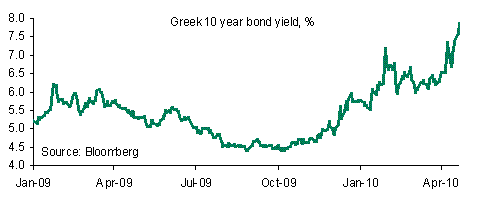
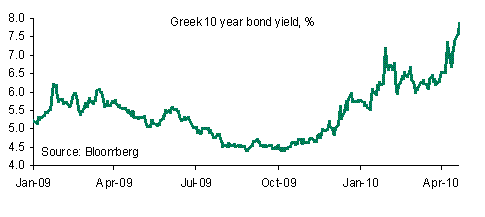
BAD: Talks between Greek officials and the IMF, ECB and EU on the conditions for a EUR 45 billion bailout loan will also be of interest although completion of talks could take weeks and in the meantime the situation is unlikely to improve, with Greece needing around EUR 10 billion to cover obligations by end May. Greek bond yields jumped to fresh record highs around 7.84% yesterday whilst the spread over German bunds also widened. Moreover, although Greece’s sale of EUR 1.95 billion in 13-week paper yesterday was heavily oversubscribed the, the yield was high at 3.65% which was far higher than the 1.67% yield at a similar sale in January.
In contrast to the likes of the CAD, AUD and NZD, the EUR is set to continue to suffer and as reflected in the widening in Greek bond spreads and high funding costs, Greek woes will keep plenty of pressure on the currency, with EUR/USD set to fall to support around 1.3300 in the short-term.

UGLY: UK regulator FSA will conduct a formal investigation of Goldman Sachs. The FSA will work closely with the US Securities and Exchange Commission SEC, which has accused the bank of Fraud though this has vehemently denied by Goldman Sachs. Although the negative market impact of the fraud case has been outweighed by good earnings and data the fallout is spreading. Some European politicians have even called for governments to stop working with the bank.
Shaking Off The Bad News

Markets managed to shake off the initial shock of the SEC’s fraud case against Goldman Sachs following news that the charge was not approved unanimously, but with a 3-2 vote. This was interpreted by some to imply that there was more of a political rather than economic bias behind the charge, with two Democrats voting for and two Republicans voting against and SEC Chairman Schapiro siding with the Democrats.

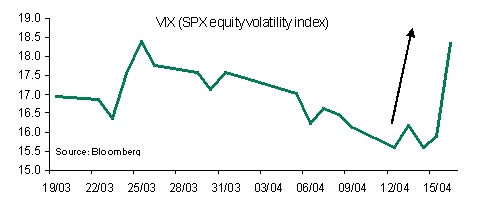
Stronger than forecast earnings from Citigroup and a bigger than expected 1.4% jump in US March leading indicators also helped to calm market nerves, with US equities closing higher and the VIX volatility index reversing some of its spike higher. Attention is still firmly fixed on earnings and with 121 S&P 500 companies due to release earnings this week including Apple, Goldman Sachs, Johnson & Johnson and Yahoo today.

Nonetheless, it is difficult to see sentiment improve too much against the background of ongoing worries about Greece as reflected in the renewed widening in Greek debt spreads yesterday. Moreover, the negative economic impact of the spread of volcanic ash from Iceland, and potential for more lawsuits related to CDOs from regulators as well as investors, against banks, will continue to act as a drag on market risk appetite.

Earnings have been positive so far into the season and as seen overnight, this is helping to counter market negatives, giving risk appetite some support. In turn, this will give risk currencies some relief but given the gyrations between positive and negative news it is difficult to see most currencies breaking out of recent ranges.

My overall bias is for positive earnings and data to overcome the negatives this week, leaving the likes of the AUD, NZD and CAD as well Asian currencies firmer. The EUR and GBP are likely to remain the weakest links, with both currencies set to retrace lower and EUR/USD finding plenty of sellers above 1.3500.

What To Watch This Week

Well so much for a “risk on” week. Market sentiment soured at the end of last week following The US Securities and Exchange Commission (SEC) civil action against Goldman Sachs, in which they accused the bank of fraud. The impact reverberated across markets and risk trades were pulled back as a consequence. Bulls shouldn’t be too downhearted though as the drop in risk trades followed several days of gains and part of the pullback could be attributed to profit taking.

Speculation of similar probes in Europe by financial regulators will cast a shadow over markets early this week. Nonetheless, direction will at least in part come from earnings. So far the run of earnings looks upbeat, with around 83% of the 48 S&P 500 companies reporting, beating analysts’ estimates. Overall profits are forecast to increase by around 30% from a year ago but are on track to easily beat this estimate. Bellwether names including IBM, Apple, Coca-Cola, Boeing, Microsoft, and AT&T report this week.

The meeting between Greek officials, ECB, IMF and EU has been delayed until Wednesday. There is little likelihood of Greece seeing any loan money soon as the need for parliamentary approval in some EU countries and upcoming regional elections in Germany on 9 May will put a spanner in the works. An issue of EUR 1.5bn of 3-month Greek debt tomorrow will act another test of market confidence but the recent widening in Greek debt spreads suggests a less positive reception than the previous sale.

There are also a few central bank meetings to contend with this week including Canada, Sweden, India, Philippines and Thailand. The only Bank likely to hike interest rates out of this bunch is the RBI in India with another hike expected, following closely on the heels of the March move. Canada and Sweden are unlikely to shift policy until at last after the end of Q2 whilst protests in Bangkok, Thailand, and the knock on impact on consumer confidence, have effectively sealed the case for no rate move there.

On the data front, attention will turn to US housing market activity. Markets will be able to gauge further clues to whether recovery in the housing market has stalled. An increase in both existing (Thu) and new home sales (Fri) in March is expected, which may allay some concerns although any improvement is likely to continue to fragile against the background of tight credit and high foreclosure levels.

In Europe, aside from the ongoing Greek sage, sentiment surveys will garner most attention, with the release of the German ZEW (Tue) and IFO (Fri) surveys as well as manufacturing and service sector purchasing managers indices (PMIs) across Europe. On the whole the surveys are likely to reveal some improvement as confidence.

Risk aversion will be slightly elevated at the beginning of this week but strong earnings and improving data will help to prevent too much damage. Consequently Risk currencies will start the week under pressure but any pullback will be limited. Given that speculative positioning in risk currencies such as the AUD, NZD and CAD is well above their three-month average according to the latest Commitment of Traders’ IMM data there will be some scope for profit taking. EUR speculative sentiment has seen some improvement but EUR/USD remains vulnerable to a further pull back to technical support around 1.3302 this week.

Why Buy Asian FX (Part 2)

The strength of portfolio capital inflows into Asia reflects the outperformance of Asian economies relative to Western economies. Whilst the US, Europe, Japan and UK have struggled to recover from recession and are likely to register only sub-par recovery over the coming months, Asian economies led by China are recovering quickly and strongly. This pattern is set to continue, leading to a widening divergence between Asian and G7 economic growth.

As growth strengthens inflationary pressures are set to build up and Asian central banks will likely raise interest rates more quickly than their G7 counterparts. Already some central banks have moved in this direction, with India, Malaysia, Philippines and Vietnam, having tightened policy. This will be followed by many other central banks in Asia over Q2 2010 including China. Even countries with close trade links to Asia, in particular Australia will rate hikes further over coming months, with Australian interest rates likely to rise to a peak of 5% by year-end.

Given that the US is unlikely to raise interest rates in 2010 higher interest rates across Asia will result in a widening in the interest rate differential with the US leading to more upside potential for Asian currencies as their ‘carry’ attraction increases relative to the USD. The most sensitive Asian currencies to interest rate differentials at present are the Malaysian ringgit (MYR), Thai baht (THB) and Philippines peso (PHP) but I believe that as rates rise in Asia, the sensitivity will increase further for many more Asian currencies.

Most Asian currencies have registered positive performances versus the USD in 2010 led by the MYR and Indonesian rupiah (IDR) and closely followed by the Indian rupee (INR), THB and South Korean won (KRW). The notable exception is China which has been unyielding to pressure to allow the CNY to strengthen. Even China is set to allow some FX appreciation although if the US labels China as a “currency manipulator” it could prove counterproductive and even result in a delay in CNY appreciation.

Looking ahead, the trend of strengthening Asian FX will continue likely led by the likes of the KRW and INR but with the MYR, TWD and IDR not far behind. Stronger growth, higher interest rates, strengthening capital inflows and higher equity markets will contribute to appreciation in Asian currencies over the remainder of the year.

What to watch

US February non-farm payrolls released at the end of last week put the finishing touches to a week that saw risk appetite continue to improve each day. There were no big surprises from the various central bank decisions including the RBA, BoE and ECB last week though Malaysia’s central bank did surprise by hiking 25bps. The RBA’s 25bps hike was a close call but in the event the Bank delivered a 25bps hike too.

Sentiment towards Greece has improved in the wake of the announcement of fresh austerity measures by the Greek government, which provoked a short covering EUR/USD rally from around 1.3435 lows though the EUR never really showed signs of embarking on the sort of rebound the massive short EUR speculative position had suggested.

US jobs report revealed that non-farm payrolls dropped by 36k and was all the more remarkable given the potentially very negative impact of severe weather distortions to the data. The data provides the setting for a firm start to the week in terms of risk appetite which will likely put the USD under a bit of pressure into the week.

This week’s events include central bank decisions in New Zealand and Switzerland. The RBNZ has already indicated that it sees no reason to raise interest rates in H1 and an unchanged decision will come as no surprise to the market. The NZD offers better potential for appreciation than the AUD in the short term and I suspect that a “risk on” tone at least early in the week will keep the Kiwi supported.

The SNB in Switzerland is also unlikely to offer any surprises in its rate decision with an unchanged outcome likely. It appears that the Bank has take a somewhat more relaxed tone to the strength of the CHF and any comments on the currency will be scrtunised for hints of intervention.

It probably isn’t much of a shock to expect Greece to remain in the spotlight this week as markets continue to deliberate whether Greece needs financial aid and if so, whether it will be provided by EU countries such as Germany and/or France, at least in terms of some form of debt guarantee.

Further tensions within Greece, with more strikes in the pipeline will test the resolve of the government to carry through austerity measures while likely acting as a cap on any EUR upside over coming days. I still think EUR/USD 1.3789 is a tough nut to crack.

Meanwhile, GBP/USD looks like it will find it tough going to gain much traction above 1.50 with political uncertainties in the form of a likely hung parliament as well as what looks like various efforts by the BoE officials to talk GBP down, likely to prevent an real recovery.