Australia released some solid data this morning, with both January retail sales (1.2% MoM versus 0.4% consensus) and trade data (AUD 1433 mn versus AUD 100 mn consensus) beating expectations. Following on from yesterday’s better than forecast Q4 GDP data the news gave a boost to AUD helping it to break 0.90 versus the USD. The data especially retail sales highlights the growing strength of the consumer in Australia and reaffirms that the next move in policy rates will be up. Taken together with a firmer tone to risk appetite and the relatively solid 7.5% official growth target set for China’s economy this year, AUD/USD is set to remain well supported.
 MarketWatch.com – MarketPulse
- Jobless claims fall to lowest level since mid-May
- Jobless claims stay low in latest week
- Consumer credit growth soars in December
- U.S. productivity slows down in fourth quarter while unit labor costs accelerate
- Beyond to buy rights to Buy Buy Baby brand and reunite it with Bed Bath & Beyond
- Trump asks Supreme Court to pause TikTok ban
- Amazon says it had best-ever Thanksgiving Holiday week with record sales and number of items sold
- U.S. stock futures and bond yields drop on reports Putin has updated nuclear doctrine
- Charter Communications announces buyout deal for Liberty Broadband at terms above its previous proposal
- General Motors unveils new all-electric Cadillac called the Vistiq with 300-mile range
No surprises from RBA
March 4, 2014 — Mitul KotechaAUD was restrained ahead of the RBA meeting overnight but the unchanged policy decision and accompanying statement are set to leave the currency unperturbed. As reflected in the uptick in the February TD Securities inflation reading yesterday to 2.7% YoY the central bank has limited room for easier policy despite weaker job market conditions. Moreover, the RBA appears to be less concerned about the level of the AUD, and despite noting that the AUD remains high by historical standards there was no comment today about expecting further declines in the currency. Overall the statement was similar to last month.
AUD has held up well even in the face of weaker Chinese data and will face little damage from today’s RBA outcome, with strong support around AUD/USD 0.8821 and resistance around 0.8990.
Geopolitical tensions to weigh on risk assets
March 3, 2014 — Mitul KotechaThere continues to be a disconnection between rising geopolitical risks as tensions between Russia and Ukraine intensify, and the performance of equity markets. US equities ended the week on a high note despite a bigger than expected downward revision to US Q4 GDP and risk sentiment overall remained supported according to our risk barometer. Other data were helpful for markets as February Chicago manufacturing confidence (PMI) and Michigan consumer confidence came in better than expected. The firmer tone to risk assets will not last, with risk aversion set to intensify today.
Markets continue to give US economic data the benefit of the doubt, downplaying the harsh weather impact on economic data. This is set to continue this week, with the release of a plethora of US data including January personal income and spending and February ISM manufacturing confidence, February vehicle sales, the Fed’s Beige Book, January trade balance and last but not least February non farm payrolls at the end of the week. All of the data will be hit by recent unseasonable US weather and therefore will look weak on balance, but markets will once again not fret a great deal.
There are several other key events this week that will garner market attention including central bank decisions from the Reserve Bank of Australia tomorrow, Bank of England, and European Central Bank on Thursday. Hopes that the ECB will easy monetary policy were dashed somewhat by a higher than expected reading for Eurozone HICP February inflation although there is still a possibility that some easing in liquidity conditions are announced. The RBA and BoE are not expected to change monetary policy settings this week.
AUD resilient, JPY downside risks
February 25, 2014 — Mitul KotechaAgainst the backdrop of concerns about Chinese growth and a weaker path for China’s currency, the AUD has failed to make any headway over recent days. Perhaps more interesting is the fact that AUD remains one of the best performing currencies despite such concerns. From a positioning perspective the market is still net short AUD, albeit less so over recent weeks, implying that there is still scope for short covering.
The rally in commodity prices over recent days will likely have helped the AUD but notably it’s the wrong commodities that are rallying. For instance, iron ore prices have dropped sharply. Nonetheless, improving risk appetite is giving AUD some relief and downside risks to the currency remain limited, with its resilience set to continue. Consequently AUD/USD is set to see strong buying interest on any dip to technical support around 0.927.
USD/JPY has been range bound over recent sessions failing to make any significant headway above the 102.50 level. The consolidation in US Treasury yields is a factor capping gains in USD/JPY but an improvement in risk appetite and gains in Japanese equity markets will likely help fuel some downside risks for JPY over the near term.
There are also signs that after several weeks of net inflows, Japan is finally beginning to register renewed outflows of portfolio capital which ought to add further downward pressure on the JPY. The fact that the speculative market remains net short JPY may limit the pace of JPY depreciation, however. It is difficult to see JPY volatility decline further from already very low levels but a break of current ranges may require a bigger move in US Treasury yields. We remain long USD/JPY at 102.39.
Remaining constructive on AUD
February 18, 2014 — Mitul KotechaIn contrast to the consensus view I remain rather constructive on the AUD. As reflected in the RBA minutes today the central bank has shifted its stance somewhat, effectively closing the door on further policy easing while finding it difficult to talk the currency lower as inflation pushes higher.
Separately although Chinese growing is slowing this year assuming that growth does not fall too far and too quickly the AUD is unlikely to suffer much from this source.
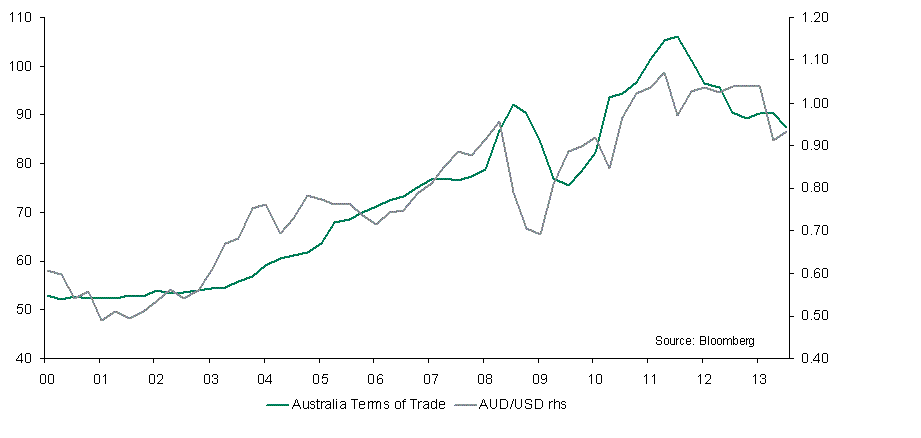
A lot bad news for AUD has been largely priced in. Firstly, the drop in AUD/USD has been consistent with the deterioration in terms of trade.
Secondly Australia’s broad basic balance position is quite healthy as strong direct investment and portfolio inflows counter a current account deficit.
Thirdly, even when looking at China’s growth trajectory the AUD is at a level which discounts this. Near term resistance for AUD/USD is seen around 0.9087.
Share this blog

 ECONOMETER