Sell Risk Trades On Rallies

It seems that every time there is a bounce in risk appetite it quickly dissipates as worries about growth, fiscal deficits, sovereign debt, etc, return to dent sentiment. This was again the case overnight as markets sold off late in the US session, with an early bounce in sentiment proving too fragile to last. This pattern of trading is set to persist for a long while yet, with the overall tone of selling risk trades on rallies remaining in place.

Fears over a double dip global recession have increased since the release of Friday’s disappointing US jobs report even if it is too early to pass judgment based on the basis of one month’s data. Coupled with worries about slowing growth momentum in China, hopes that slower growth in the eurozone could be counterbalanced by firm growth elsewhere are being dashed. The problem is that despite a strong quarter of growth for most economies in Q2 2010 the outlook for the second half of the year is far more uncertain.

European Union officials sought to calm worries about the potential for renewed fiscal crises in the future by agreeing to monitor national budgets more closely and at an earlier stage whilst introducing a wider range of sanctions on excessive deficits. Unfortunately this is akin to the idiom about closing the stable door after the horse has bolted. The steps aren’t going to help resolve the current crisis. Evidence of implementation, execution and results on the deficit cutting front will help however, but this is a process that will take months rather than days or weeks.

A couple of factors may have prevented the EUR from extending losses overnight. 1) Germany announced EUR 80 billion in spending cuts along with 15,000 public sector job cuts. Germany also is pushing for a financial transactions tax on tap of the bank levy. 2) European finance ministers finalised details of the EUR 440 bn Financial Stability Facility which aims to sell AAA rated bonds to make loans to eurozone countries. The only question is the approval process. The statement on the funds operations only said that “national legal procedures to participate in the facility are well on track”. EUR/USD is likely to range between 1.1826 and 1.2110 over the short-term.
Renewed concerns

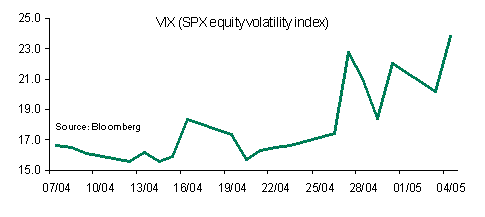
Despite some positive US data, with both the May ISM manufacturing index and April construction spending coming in stronger than forecast, market sentiment soured. The relative calm that was exhibited at the end of May is giving way to renewed fears as equity markets weaken, volatility increases and risk aversion intensifies. Risk trades are set to remain on the back foot, with the EUR likely to remain the weakest link. After testing support close to 1.2110 EUR/USD bounced but remains vulnerable to a fresh test of this level in the short-term.

A combination of concerns including rumours of ratings downgrades, with France the new target, Middle East tensions, weaker Chinese manufacturing activity and worries about increasing bank writedowns in Europe, have conspired to drag markets lower. The failure to stem the hue oil-leak in the US contributed to the malaise as the US government announced a criminal probe.

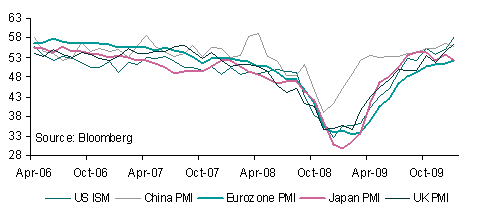
For the most part, data releases were unhelpful to risk appetite as the majority of global purchasing managers indices (PMIs) slipped in May, led by China. Only a few increased, including India and notably Ireland, whilst the Spanish and Greek PMIs fell. Although the US ISM index slipped the components looked positive, especially the employment component which moved higher, suggesting some upside potential for Friday’s May payrolls data for which we look for a 500k increase.

A picture of divergence appears to be growing in the eurozone, which will act as another source of pressure on the EUR. Germany’s outperformance is widening as reflected by the fact the German unemployment dropped to 7.7% in May in contrast to a rise in eurozone unemployment, to 10.1%. Moreover, Germany was the only country where its PMI was actually revised higher relative to the flash reading. There are also growing divisions within the European Central Bank (ECB), in particular towards the purchase of government bonds, with German ECB members particularly critical.

Capital Flowing Out of Europe

When investors’ concerns shift from how low will the EUR go to whether the currency will even exist in its current form, it is blatantly evident that there is a very long way to go to solve the eurozone’s many and varied problems. As many analysts scramble to revise forecasts to catch up with the declining EUR, the question of the long term future of the single currency has become the bigger issue. Although the EUR 750 billion support package was hailed by EU leaders as the means to prevent further damage to the credibility of the EUR, it has failed to prevent a further decline, but instead revealed even deeper splits amongst eurozone countries.

Although the European Central Bank (ECB) confirmed that it bought EUR 16.5 billion in eurozone government bonds in just over a week, with the buying providing major prop to the market, private buyers remain reluctant to renter the market. As a result of the ECB’s sterilised interventions bond markets have stabilised but the EUR is now taking the brunt of the pressure, a reversal of the situation at the beginning of the Greek crisis, when the EUR proved to be far more resilient. Reports that some large institutional investors have exited from Greek and Portuguese debt markets whilst others are positioning for a eurozone without Greece, Portugal and Spain, suggest that the ECB may have taken on more than it has bargained for in its attempts to prop up peripheral eurozone bond markets.

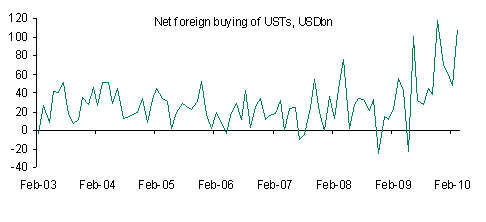
As was evident in the US March Treasury TICS report it appears that a lot of the outflows from Europe are finding their way into US markets. The data revealed that net long-term TIC flows (net US securities purchases by foreign investors) surged to $140.5 billion in March. The bulk of this flow consisted of safe haven buying of US Treasuries ($108.5 billion), although it was notable that securities flows into other asset classes were also strong especially agencies and corporate bonds, which recorded their biggest capital inflow since May 2008. Asian central banks also reversed their net selling of US Treasuries, with China investing the most into Treasuries since September 2009. Anecdotal evidence corroborates this, with central banks in Asia diversifying far less than they were just a few months ago.

This reversal of flows is unlikely to stop anytime soon. It is clear that enhanced austerity measures in the eurozone will result in weaker growth and earnings potential. This will play negatively on the EUR especially given expectations of a superior growth and earnings profile in the US. Evidence of implementation, action and a measure of success on the fiscal front will be necessary to begin the likely long process of turning confidence in the EUR around. This will likely take a long time to be forthcoming. EUR/USD has managed to recover after hitting a low of around 1.2235 but remains vulnerable to further weakness. The big psychological barrier of 1.20 looms followed by the EUR launch rate of around 1.1830.

Risk Aversion Back With A Vengeance

Risk aversion is back with a vengeance as reflected in the rise in equity volatility (VIX), drop in equity markets and rally in US Treasuries.  European peripheral debt markets sold off despite the EU/IMF aid package for Greece, whilst EUR/USD slid below 1.3000.  Various rumours dealt a blow to markets including talk of a sovereign ratings downgrade and a EUR 280 billion bailout for Spain.   The message is clear.  This situation is becoming increasingly dire by the day.  Europe is in big trouble and the whole euro project is under threat of unravelling.  

Concerns about parliamentary approvals, implementation/execution risk, prospects for relatively weaker growth in Europe, as well as contagion to Spain and Portugal, has tempered any enthusiasm towards the EU/IMF bailout package.  In addition, despite the large size of the EUR 110 billion loan package there are growing worries that it will be insufficient to cover Greece’s funding requirements over the next three years.  All of this implies that the EUR will remain under pressure for some time yet.  I have previously spoken about a drop to around EUR/USD 1.25 but the risk is for a much sharper decline is growing.

The USD is the clear winner, spiking to its highest level since May 2009 and is looking well set to consolidate its gains over the short-term despite the fact that net aggregate USD speculative positioning has already reached its highest level since September 2008 (according to the CFTC Commitment of Traders IMM data) in contrast to EUR positioning, which is at a record low.  This is unlikely to stand in the way of further downside for EUR/USD, with the next technical support level seen at 1.2885, which would match the previous lows see in April 2009.

A combination of worries including contagion to Spain and Portugal, policy tightening in China, debt concerns in the UK and Japan, all threaten to undo the positive message from recent positive economic data including further strengthening in Purchasing Managers Indices globally.   The immediate attention remains on Greece and growing scepticism about the ability of Greece to carry out austerity measures in the face of rising domestic opposition, including a nationwide strike today. 

The rout in US and European markets will spill over to Asia, putting equity markets and Asian currencies under pressure.  Another risk currency to suffer is the AUD, which has dropped sharply following the Reserve Bank of Australia (RBA) meeting, in which the Bank indicated that rates were close to peaking.  Speculative positioning has dropped for the past two weeks as longs are taken off but AUD/USD weakness is set to be temporary, with buyers likely to emerge around near term support seen around 0.9001.

Shaping up to be a “risk on” week

It’s most definitely turning into a “risk on” week. On the earnings front both JP Morgan Chase and Intel beat forecasts whilst data releases did not disappoint either. In particular, US retail sales came in much stronger than expected. The Fed’s Beige Book also gave markets some good news to chew on. The reports from the twelve Federal Reserve Districts noted that economic activity “increased somewhat” since the March 3rd report.

The positive tone will continue today with the release of the March industrial production data, expected to show a strong gain over the month (consensus 0.7%), whilst both the Empire State and Philly Fed manufacturing surveys are set to post small gains in April, consistent with strengthening manufacturing activity in the months ahead.

Fed speakers have also been helpful for market sentiment. Fed Chairman Bernanke sounded a little more upbeat on the economy but highlighted the “significant restraints” remaining in the US economy. Bernanke maintained the “extended period” of low rates statement despite some speculation that the Fed was verging on removing this. The net impact of the testimony, improved data and earnings and firmer risk appetite is to keep the USD on pressure. In contrast, commodity currencies including AUD, NZD and CAD, will benefit, both from firmer risk appetite and an upturn in commodity prices.

Despite the positive reception to Greece’s debt auction there is not a lot of faith in the ability of Greece to weather the storm. Reports that Greece will need far more funding than has been initially promised by the EU/IMF – potentially as high as EUR 90 billion over coming years – together with worries about selling the loan package to the public in Germany and other eurozone countries, as well EU comments that Portugal will need further fiscal consolidation, have not done much good for confidence. Technically EUR/USD will see plenty of resistance around 1.3692.

After Singapore’s move to tighten monetary policy via the SGD revaluation, and following close on the heels of India, Malaysia and Vietnam, attention has turned to who’s next in line. South Korea must be a prime candidate, especially following data yesterday revealing a drop in the unemployment rate. Of course, China is very much in the spotlight and is set to embark on monetary tightening measures as well as CNY revaluation soon.

India is set to move again as early as next week, with inflation data today likely to seal the case for another hike (consensus 10.37% in March). The risk remains however, that many Asian central banks are moving too slowly to curb building inflation pressures and may find that they ultimately need to tighten more than they otherwise would have done.

China’s heavy slate of data released will if anything fuel greater expectations of an imminent CNY revaluation as well as monetary tightening. China’s economy grew a very strong 11.9% in Q1, above already strong consensus expectations, whilst CPI rose 2.4% YoY in March.

The growth data alongside further evidence of accelerating real estate prices highlight the risks of overheating in the economy and the need to act quickly to curb inflation threats. Given this expectation, firm risk appetite, and more follow through from Singapore’s FX move, the outlook for other Asian currencies remains positive.