Euro grinding lower as officials talk about Greek exit

The week begins in sour mood although notably Asian market pressure was limited even in the face of ongoing Eurozone tensions. China’s cut in its RRR over the weekend helped to limit the damage to markets but there are still plenty of negatives to chew on. Notably European officials are openly discussing and even preparing for the possibility of a Greek exit from the euro, an outcome that has grown in probability as fresh elections loom in Greece.

FX markets have finally awoken from their stupor, with a spike in volatility and moves out of long worn ranges registered. The USD has extended its upward trajectory that began in this cycle on 27th April. The rally looks strong and sustainable but is built largely on the fact that the USD looks less ugly than some other currencies rather than on positive US economic developments.

Admittedly US recovery is taking shape but the data is not sufficiently strong to erase expectations of further Fed quantitative easing, a factor that will limit the ability of the USD to capitalise on weakness elsewhere. Data over coming days will not help to provide much clarity on the issues, with April retail sales likely to be soft and the Fed FOMC minutes unlikely to deliver much new information. Even so, risk aversion is intensifying, providing the USD with firm support, suggesting that the USD will continue to edge higher over coming days.

The EUR in particular has sustained a drop below the psychologically important 1.30 level, spelling more downside risks. Greek politics and the potential for fresh elections remain at the forefront of attention. A small amount of relief on upcoming Greek bond redemptions following the EU’s deliverance of EUR 4.2 billion funds will not be sufficient to offset political worries.

EUR will also find direction from the Eurogroup meeting of finance ministers meeting today who aside from Greek issues will also discuss the Spanish banking sector. Meanwhile, a meeting between French President and Hollande and Germany’s Chancellor Merkel will have the potential to move markets but the chances of a breakthrough on any fresh deal is limited.

Data releases will confirm Eurozone recession while the May German ZEW investor confidence survey is set to record a decline. All of this will not bode well for the EUR, with the currency set to grind lower over coming sessions. EUR/USD 1.2852 will be a crucial support level, a break of which will see EUR slide much further.
EUR bounces, GBP gains limited

Eurozone stress, particularly in Spain continues to act as a weight on market sentiment, with equity markets ignoring a relatively strong US retail sales report. My risk barometer remains at elevated levels and is unlikely to ease anytime soon, suggesting that a cautious tone towards risk assets remains warranted.

Mixed US data releases (firm retail sales but weak Empire Manufacturing) did little to help the USD overnight but the EUR managed to register gains despite ongoing Spanish worries. Fitch ratings stating that Italy’s austerity measures were credible and Moody’s noting that there would not be an imminent change in its ratings outlook for France may have helped the EUR which rose solidly from lows just below 1.30 versus USD.

I continue to see plenty of support for EUR/USD around this level. A heavy data slate today will give further direction but the news will not be so positive out of the Eurozone, with a small drop in the German April ZEW survey expected. Meanwhile, a subdued reading for US housing starts and small increase in industrial production will do little to perk the USD up.

There are plenty of data releases in the UK for markets to get their teeth into including inflation data today, Bank of England minutes tomorrow and March retail sales on Friday. Ahead of the data releases GBP continues to trade with a positive bias against the EUR but has failed to extend gains against the USD.

I do not expect the data to result in a significant change in GBP’s tone, with the MPC minutes in particular likely to reveal a divided view on the need for more quantitative easing. Although we look for a rebound in retail sales in March overall spending is only growing modestly.

After predicting the latest drop EUR/GBP my quantitative model reveals that there is limited scope for further gains in GBP versus EUR over the short term. I had also anticipated gains in GBP versus AUD but there is now limited room for further GBP upside.

Euro decline limited, AUD under pressure

EUR looks like it’s going nowhere fast, with the currency failing to break above 1.33 versus the USD. Nonetheless any drop will be limited as there will be plenty of support for EUR/USD around the 1.30 level. Such support may be required following the disappointing reading for the Eurozone March flash purchasing managers index (PMI) and renewed growth worries even in Germany.

Moreover, there have been plenty of scare stories about ongoing problems in the Eurozone, centring on Portugal and Spain and even speculation of a third Greek bailout being needed at some point.

However, the reality is that the market has reduced its attention on Eurozone debt issues for the time being. Once the latest bout of risk aversion passes, this ought to allowing the EUR some room to push higher, with my short term models highlighting the scope for EUR/USD to edge back towards 1.35 over coming weeks.

AUD has been pummelled this week, alongside its neighbour NZD. Growth worries in China compounded by a weaker than expected March China PMI has piled on the pressure, especially on AUD where economic conditions are increasingly linked with China. My quantitative models highlight ongoing short term downside risks to both AUD and NZD.

However, declines in these currencies will provide better levels to eventually buy as I remain bullish in the medium term even though my valuation metrics reveal that both currencies remain overvalued. My view is built on the prediction that risk appetite will improve further this year, a boon to high beta currencies such as AUD and NZD. Additionally as yield gains importance and carry trades gain attraction AUD will look particularly attractive.

Euro pain, Australian and New Zealand dollars vulnerable

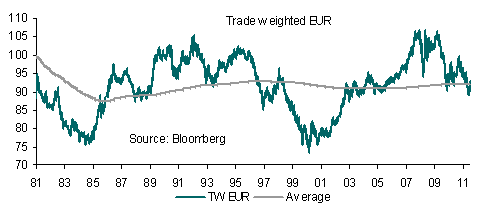
EUR appreciation has been painful for many, especially those looking for a turn in the currency over recent days. Unfortunately, for these investors, the EUR may yet strengthen further in the short term before any reversal is seen. Indeed, using valuations to justify a bearish view may not be a particularly strong argument at present given that the EUR trade weighted index is trading close to its historical average level while IMM data reveals that the speculative market remains significantly short EUR.

Additionally, my quantitative models reveal that the short term ‘fair value’ for EUR/USD is close to 1.40. While longer term fair value is undoubtedly much lower, it could take some time before the EUR declines to such levels. This is not encouraging news for EUR bears but there are some signs that the upmove in EUR/USD may not persist. Currently EUR/USD is trading above its 100-day moving average but since July last year, it has failed to remain above its 100 day moving average level for more than a few days.

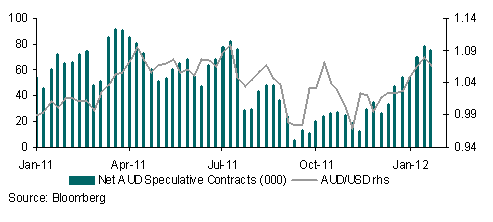
There are definite signs that commodity currencies are topping out. Both the AUD and NZD have failed to extend gains over recent weeks. Perhaps valuation concerns are finally begging to catch up with these currencies (both are close to 2 standard deviations from average purchasing power parity while my quantitative models reveals a divergence with short term fair value) while speculative positioning according to IMM data remains at high levels. AUD and NZD even look stretched relative to interest rate differentials.

A wider than forecast January trade deficit in New Zealand did not bode well for the NZD but near term direction for both currencies will still depend on the gyrations in risk appetite given the strong correlation that both AUD and NZD have with risk aversion. Notably the the improvement in risk appetite has stalled in February, leaving AUD and NZD exposed to lofty valuations.

USD in a lose-lose situation, AUD caution

News that Moody’s Investor service cut the debt ratings on six European countries while revising its outlook on the UK’s and France’s AAA rating to “negative” dampened sentiment for the EUR. Markets will likely trade cautiously ahead of tomorrow’s meeting of European Union Finance Ministers especially as it appears that at least Germany and Netherlands remain sceptical of Greece’s austerity plans, which could frustrate the approval of a second EUR 130 billion bailout package.

The USD is firmer overnight but still struggling to make headway in an environment of improving risk appetite. The fact that USD speculative positioning has dropped sharply to its lowest level since September last year highlights a major shift in USD sentiment. The USD is currently in a lose-lose situation helped neither by economic data or risk appetite. For example a healthy gain in January retail sales expected today, will help to boost risk appetite which in turn will help maintain pressure on the USD.

Encouragingly for the USD, 2 year bond yields have been rising since the start of February in line with firmer economic data. However, rather than giving the USD a boost (except vs. JPY) it has been outweighed by the fact that bond yields elsewhere have risen even more aggressively. The net result is that the prospects for the USD to strengthen further look somewhat restrained over the short term.

AUD has benefited from a firmer tone to risk appetite at the start of the week but for a currency in which speculative positioning is fast approaching all time highs I would be cautious of adding to long positions at current levels. Remaining one of the most sensitive currencies to gyrations in risk appetite the AUD will continue to be mainly driven by global events especially the Greek saga.

Nonetheless, there a few data releases at home that will capture market attention, in particular the January jobs report on Thursday. After a surprisingly large 29.3k fall in December a bounce is expected in January, with around a 15k increase likely. The report will provide clues to just how long the RBA will pause in its rate cutting cycle. I suspect that even a positive outcome will have a briefly positive impact on AUD, with the currency set to struggle to break above resistance around its 2012 high at 1.0845 versus USD.