Central banks fail to impress

Three central banks acted within a short time of each other to provide yet more monetary stimulus. However, the European Central Bank’s (ECB) 25 bps cut in its refi rate and deposit rate, China’s central bank, PBoC’s cut in interest rates and an additional GBP 50 billion of asset purchases by the Bank of England have failed to stimulate markets. This is a worrying development for policy makers especially as the drug of monetary stimulus has been a major factor spurring equity markets and risk assets since the global financial crisis began in 2008.

The lack of positive momentum emanating from the policy easing by central banks yesterday reflects the reality that the efficacy of further easing has now become very limited. Will a quarter percent rate cut from the ECB or yet another round of asset purchases from the BoE really make a difference at a time when core bond yields are already at extremely low levels and the demand for credit globally is very weak? Moreover, are policy makers really addressing the underlying problems in the Eurozone or elsewhere? I think the answers are obvious.

The same argument applies to the Fed if it was to embark on a third round of quantitative easing. Admittedly more Fed QE could weaken the USD and boost equities but would it really have a lasting impact? In any case I don’t think the Fed is on the verge of more QE following the recent extension of ‘Operation Twist’ which itself will do little more than have a psychological impact on markets. Today’s release of the June jobs report could give some further impetus to QE expectations if it comes in weak but I doubt this will occur.

One casualty of the cut in ECB rates was the EUR which dropped sharply, having not only given up its post EU Summit gains over recent days but extending its losses even further. This is perhaps an odd reaction considering that a rate cut was widely expected. ECB President Draghi’s warnings about the path ahead will have played negatively on the currency as well expectations of more stronger easing in the months ahead perhaps involving ECB QE.

I still stick to the view that European policy makers have at least put a short term floor under the EUR in the wake of the decisions at the EU Summit suggesting that further downside will be limited, with the 2012 low around 1.2288 likely to act as a short term floor for EUR/USD. Nonetheless, with many details of the plans announced in the Summit yet to be ironed out and implementation risks running very high a degree of market caution should be expected.
Progress at last in Europe

As last week progressed markets had been increasingly poised for disappointment at the EU Summit at the end of the week. Given such low expectations it was probably not so difficult to exceed them. In the event there was progress towards breaking the vicious cycle between banks and sovereigns. The immediate reaction to the announcements from the EU President was clearly positive, with risk assets rallying sharply. EUR/USD had rallied by over 2 big figures from a low just above 1.24 as a massive short squeeze helped propel it higher.

With their backs against the wall EU leaders finally agreed upon short term stabilisation measures as well as long term measures towards closer European integration. Under pressure from other leaders including French President Hollande, German leader Merkel obviously softened her stance to agree on some of these measures. The deal goes to show that leaders in Europe can act when needed or at least when desperate which is how they were after 13 hours of talks and the reality that bond yields in Spain and Portugal were at unsustainable levels.

Short term measures in particular utilising the EFSF / ESM bailout fund to recapitalize banks directly and the creation of a European banking supervisory body was a shot in the arm for Italian and Spanish bonds and the EUR. The dropping of the condition that EU governments be given preferred creditor status for loans to Spanish banks bodes well for peripheral Eurozone sovereign debt markets as it means that private investors will not be put at the back of the que in any debt restructuring.

While the measures mark an important step in the direction of providing clear resolutions to the Eurozone crisis there is a very long way to go. Admitedly the use of the bailout funds is positive but at some point markets will ponder the fact that while they could handle a bailout of Spain the funds are clearly insufficient to cope with a bailout of Italy should it be needed. If the steps announced at the EU summit lead to a sustained drop in peripheral country bond yields then the prospects of more bailouts will be limited but this is by no means guaranteed.

Whether the risk rally is sustained into next week depends in part on whether the European Central Bank responds with actions of its own by cutting interest rates or by indicating the use of other measures such as restarting its securities markets purchases program. The risk remains that the rally will likely fade as skepticism sets in again once again and more details are sought.

Europe’s crunch time

It’s crunch time for EU leaders and the European Central Bank (ECB). The ECB under the helm of Mario Draghi is steadfastly refusing to provide further assistance to the Eurozone periphery either directly via lower interest rates or securities market purchases or indirectly via another Long term refinancing operation (LTRO) . Any prospect of debt monetization as carried out already by other central banks including the Fed and Bank Of England is a definite non-starter. The reason for this intransigence is that the ECB does not want to let Eurozone governments off the hook, worrying that any further assistance would allow governments to slow or even renege upon promised reforms.

Whether this is true or not it’s a dangerous game to play. The fact that the previously unthinkable could happen ie a country could exit the Eurozone should have by now prompted some major action by European officials. Instead the ECB is unwilling to give ground while Germany continues to stand in the way of any move towards debt mutualisation in the form of a common Eurobond and/or other measures such as awarding a banking license to the EFSF bailout fund which would effectively allow it to help recapitalize banks and purchase peripheral debt. Germany does not want to allow peripheral countries to be let off the hook either arguing that they would benefit from Germany’s strong credit standing and lower yields without paying the costs.

To be frank, it’s too late for such brinkmanship. The situation in The Eurozone is rapidly spiraling out of control. While both the ECB and Germany may have valid arguments the bottom line is that the situation could get far worse if officials fail to act. As noted above there are various measures that could be enacted. Admittedly many of these will only buy time rather than fix the many and varied structural problems afflicting a group of countries tied together by a single currency and monetary policy and separate fiscal policies but at the moment time is what is needed the most.

It’s good to see that European officials are finally talking about boosting growth and realising that austerity is killing the patient. However, measures such as increasing trade, investment etc are all long term in nature. Europe needs action now before it’s too late. After years of keeping the Eurozone together by sheer force of political will rather than strong fundamental reasons lets hope that politicians in Europe begin to realize this before it’s too late. The lack of traction at this week’s EU summit was disappointing but with their backs to the wall ahead of Greek elections in mid June Germany and the ECB may be forced to give ground. In the meantime the beleaguered EUR looks destIned to remain under pressure.

Euro on the front foot

The G20 meeting of leaders in Mexico over the weekend did not make much progress in terms of increasing the size of the International Monetary Fund (IMF) or increasing support for the Eurozone. A decision on this has been delayed until the next meeting on 19-20 April. Instead attention has turned to the various bailout votes across Eurozone countries and discussions over increasing the firewall (by boosting the size of the bailout fund) around the Eurozone periphery. Germany continues to oppose any increase in the firewall. Sentiment will hinge this week on the outcome of these events rather than data releases.

The USD has come under growing pressure but this is as reflection of a stronger EUR rather than inherent USD weakness. Data releases in the US have continued on a positive track yet the USD has failed to benefit as higher US bond yields have been matched elsewhere. Business and consumer confidence measures over coming days are also likely to reveal some encouraging outcomes while the Beige Book will report improvement in economic activity but the USD will continue to be restrained.

The EUR is looking increasingly stretched from a fundamental perspective yet technical indicators show it to be on a stronger footing. EUR/USD will find strong resistance around the 1.3550 level and the currency could still stumble over coming days depending on the outcome of Wednesday’s ECB Longer term refinancinf operation (LTRO).

Various policy events will also help dictate EUR direction including national parliamentary votes on the Greek bailout and the EU Summit. Theoretically a large uptake by banks at the LTRO could result in more EUR liquidity and a weaker EUR but the reality is quite different. Improved sentiment in peripheral bond markets as LTRO funds are used to buy local debt are helping the EUR to push higher, with its short covering rally gaining more traction.

GPB has come under pressure in the wake of a stronger EUR, but we still expect EUR/GBP’s charge to falter. My quantitative models show that the currency pair is overbought and we will likely struggle to break above 0.85. If it does, EUR/GBP 0.8562 will prove to be a strong resistance level. UK data this week will likely give some support to GBP, with the manufacturing purchasing managers index (PMI) set to strengthen further. However, the release of a relatively dovish set of Bank of England (BoE) Monetary Policy Committee (MPC) minutes has helped to undermine GBP for the time being, meaning that any recovery will be limited in the near term.

Agreement at last!

Greek politicians finally agreed on further austerity cuts totalling EUR 3.3 billion in order to secure a second bailout package. European official discussions now centre on the details of the bail out package, targeting a cut in Greece’s debt to GDP ratio to 120%.

However, the fact European Finance Ministers have withheld more funds for Greece until the austerity measures begin to be implemented suggests further uncertainty on the horizon. A Greek parliamentary vote set to begin this weekend may see some progress but markets will trade cautiously ahead of the vote.

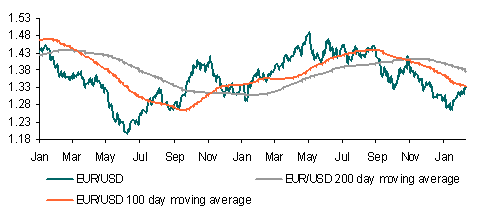
EUR/USD rallied to a high of around 1.3322 but failed to break above its 100 day moving average at 1.3332 following the agreement. As expected the ECB offered no help to the EUR, with market attention continuing to centre on the second 3-year LTRO on 29 February.

The fact that there are still various issues to be resolved means that upside for EUR will be limited in the short term. In any case the currency was already pricing in a lot of good news. EUR/USD will face major resistance around 1.3388.

Notably risk measures are edging higher once again, implying some pressure on risk assets in the near term. Markets today will digest the status Quo from the European Central Bank and an additional but expected injection of GBP 50 billion in quantitative easing from the Bank of England. December US trade data and February Michigan confidence are the only data of note suggesting limited price action ahead of the Greek parliamentary vote.