Spain moves to the epicentre

Risk appetite has continued to firm but caution prevails. Rumours overnight of a Eurozone bank rescue fund (later denied) helped sentiment, but the ECB’s rejection of plans to recapitalise Bankia in Spain via an injection of EUR 19 billion of sovereign bonds and a downgrade of Spain’s credit ratings, once again brought a dose of reality back to markets. Additionally a Xinhau news agency report that China has no plans to introduce a major stimulus package will also dampen sentiment. Against this background it is difficult to see any rally in risk being sustained.

Admittedly equity valuations look more compelling, with the price / earnings ratio on the S&P 500 below its long term average, but that does not mean that now is the time to buy stocks or risk assets in general. The USD remains the winner on the FX front and will continue to edge higher over coming days and weeks, with the currency interestingly verging on a close above its 100 month moving average.

Once again the EUR has failed to hold onto gains, with the currency making lower highs and lows, dropping below 1.2500 overnight. Even a firmer tone to equity markets and slightly better risk appetite has failed to provide any support to EUR as Greece passes the baton to Spain as the new epicentre of market attention. A new poll showing increased support for pro bailout parties in Greece has helped to alleviate Greece concerns slightly there.

Today’s data slate in Europe will come as little relief to the EUR. A further deterioration in economic confidence surveys in May will only serve to highlight the growing growth disparity between the Eurozone and US although the surprisingly large drop in May US consumer confidence was hardly encouraging. The data will leave the EUR vulnerable to further slippage and follow through below 1.2500, with a test of technical support around 1.2300 on the cards.

Like most other currencies the sensitivity of USD/SEK to risk aversion has increased over recent weeks. According to my calculations it has been one of the most highly correlated currency pairs with Risk Aversion over the past 3-months. This has been reflected in the drop in SEK against the USD which accelerated during May. However, USD/SEK has stabilised lately while EUR/SEK has dropped sharply.

A further drop to around 8.95 (trend line from beginning April) is on the cards in the near term but further SEK gains are unlikely unless risk aversion improves. On the positive side, Swedish economic data is at least perking up as reflected in the bigger than expected jump in May consumer confidence yesterday. GDP data today ought to confirm that the drop in growth in Q4 will not be sustained, which will to provide short term relief to the SEK.
Sell Euro into rallies

There was limited respite for markets in yesterday’s thin market trading, with any bounce in risk appetite sold into quickly. This is exactly the pattern of trading that is likely to take place over coming weeks as Greece remains in the spotlight while Spanish banking woes garner more attention.

Taken together with rising global growth worries (note the Baltic Dry Index is turning over again) suggests that it will be very difficult for markets to drag themselves out the quagmire. The lack of major data releases today, with only German inflation and US consumer confidence of note, suggests that there will be little for markets to take their minds off the Eurozone debt crisis.

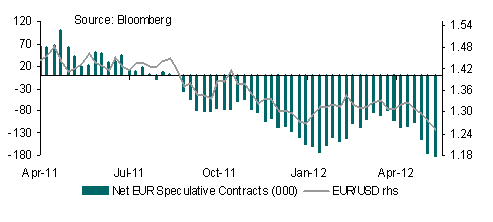
EUR/USD hit a high around 1.2625 helped no doubt by the fact that positioning was at record short levels. However, the bounce was quickly sold into leaving the EUR vulnerable to a drop below 1.2500 today. A renewed sell off in Spanish debt as banking sector concerns intensify dented any positive impact from weekend polls in Greece showing more support for pro bailout parties.

There is little on the data front today aside from German CPI leaving markets to continue to ponder on peripheral country woes. “Grexit’ fears have by no means been quelled as the reduction in bank deposits continues to show. EUR/USD will struggle to make any headway against this background, with further probing below 1.2500 likely in coming days.

The job of the Swiss National Bank has become increasingly tougher. Speculation of a ‘Grexit’ and continued flight of capital from Greece as well as other peripheral countries means that there is more prospect of upside for the CHF than downside versus EUR. The EUR/CHF 1.2000 floor has not deterred investors from parking such capital in CHF much to the chagrin of the SNB which has even warned about implementing capital restrictions.

Elevated risk aversion means that inflows of capital to Switzerland from the Eurozone periphery will persist. As a result EUR/CHF looks set to trade around the 1.2000 floor for some time to come, with the risk that the SNB has to increasingly buy EUR to protect the floor.

Calm start to the week

There will be some relief reverberating through markets at the news this weekend that Greek opinion polls show growing support for pro-bailout parties. While the Greek election is still some weeks off suggesting that uncertainty will not ease quickly this news will allay fears of a quick ‘Grexit”. The week will begin quietly, with holidays in the US, keeping market trading largely thin and within ranges.

However, there are plenty of data releases and events which will result in increased nervousness as the week goes on. Data this week will reveal further contrasts between the US and Eurozone, with sentiment gauges in the latter set to deteriorate further while consumer confidence in the former will improve. In turn, Eurozone asset underperformance including EUR weakness will remain in place.

The contrast in the outlook for the US and Eurozone has been reflected in a significant shift in speculative positioning. CFTC IMM data reveals an all time high in speculative US positioning but in contrast an all time low in EUR positioning. The USD is winning by being a less ugly currency than the EUR and for now the markets are content to ignore US problems. This is set to continue over coming weeks.

Key data and events this week include the Irish referendum on the fiscal pact on Thursday and the US May jobs report on Friday. Ahead of these there is some periphery supply, with Italy coming to the primary market today. Polls point to a ‘yes’ vote in the Irish referendum, perhaps unsurprising given the risks of losing access to funding if voters vote ‘no’.

In the US markets look for a 150k increase in payrolls though its worth noting that there are less clues this month given the early release date. This slow but steady improvement in jobs will not be particularly exciting but at the same time it will no do the USD much damage either.

Europe’s crunch time

It’s crunch time for EU leaders and the European Central Bank (ECB). The ECB under the helm of Mario Draghi is steadfastly refusing to provide further assistance to the Eurozone periphery either directly via lower interest rates or securities market purchases or indirectly via another Long term refinancing operation (LTRO) . Any prospect of debt monetization as carried out already by other central banks including the Fed and Bank Of England is a definite non-starter. The reason for this intransigence is that the ECB does not want to let Eurozone governments off the hook, worrying that any further assistance would allow governments to slow or even renege upon promised reforms.

Whether this is true or not it’s a dangerous game to play. The fact that the previously unthinkable could happen ie a country could exit the Eurozone should have by now prompted some major action by European officials. Instead the ECB is unwilling to give ground while Germany continues to stand in the way of any move towards debt mutualisation in the form of a common Eurobond and/or other measures such as awarding a banking license to the EFSF bailout fund which would effectively allow it to help recapitalize banks and purchase peripheral debt. Germany does not want to allow peripheral countries to be let off the hook either arguing that they would benefit from Germany’s strong credit standing and lower yields without paying the costs.

To be frank, it’s too late for such brinkmanship. The situation in The Eurozone is rapidly spiraling out of control. While both the ECB and Germany may have valid arguments the bottom line is that the situation could get far worse if officials fail to act. As noted above there are various measures that could be enacted. Admittedly many of these will only buy time rather than fix the many and varied structural problems afflicting a group of countries tied together by a single currency and monetary policy and separate fiscal policies but at the moment time is what is needed the most.

It’s good to see that European officials are finally talking about boosting growth and realising that austerity is killing the patient. However, measures such as increasing trade, investment etc are all long term in nature. Europe needs action now before it’s too late. After years of keeping the Eurozone together by sheer force of political will rather than strong fundamental reasons lets hope that politicians in Europe begin to realize this before it’s too late. The lack of traction at this week’s EU summit was disappointing but with their backs to the wall ahead of Greek elections in mid June Germany and the ECB may be forced to give ground. In the meantime the beleaguered EUR looks destIned to remain under pressure.

What would a Greek exit mean for the euro?

Excuse the lack of posts over recent days. I’m just finishing up a trip to London and am back in HK at the end of the week. I thought in the meantime it would be worth discussing the impact on the euro of a potential Greek exit.

The fact that European officials are openly talking about the prospects of a Greek exit from the Eurozone highlights just how drastic the situation has become. Much will depend on the outcome of new government in Greece in mid June following inconclusive elections recently. Even fresh elections in mid June does not mean that it will be any easier to form a government, leaving the option of a euro exit firmly on the table.

If Greece was to leave the Eurozone there would be a significant amount of confusion in FX markets. It is not obvious that the EUR would strengthen. It could be argued that the departure of Greece would eliminate the weakest link in the chain thus allowing the EUR some relief. Should Greece default on its debt and leave the Eurozone it would not have a marked direct impact on the Eurozone economy but the biggest risk is the financial contagion to other Eurozone countries.

A Greek exit would imply a new currency (Drachma) for the country, a separate monetary policy etc. However, any competitive gain from a weaker currency would be lost in a huge increase in inflation while the local corporate sector would be forced to default en mass on any EUR debt that they hold. Confidence in the new currency would be weaker leading to an exodus of capital further strengthening the EUR.

Admittedly the Eurozone would be stronger without Greece but it would not be long before market attention turned to Portugal and Ireland and even Spain as the next candidates for exit. Indeed, a Greek exit would set a precedent that did not exist previously. It would imply a significant increase in volatility for the EUR given the uncertainty it would create for other Eurozone members. Any rally in the EUR that would be experienced following a Greek exit would therefore be very short lived.

Ultimately for the EUR to experience a sustained strengthening it would require some sign that policy makers are addressing growth concerns as well as progress on austerity and deficit reduction. The formation of a common Eurobond, increased spending on investment projects to enhance productivity, reform of labour markets and a bolstering of the firewall around other peripheral countries would help confidence.

However, this is a long way off and the EUR is likely to suffer for some months to come as growth worries and peripheral country tensions persist. The downside risks to the EUR are clearly opening. The fact that the market is very short EUR already may limit the pace of decline but not stem it. There may be some stabilisaiton of the EUR towards year end assuming Eurozone officials get their act together.

However, in the interim the situation could become far more dire. If Greece were to exit, the prospects of further financial contagion would result in more and not less pressure on the EUR, leading to a potential drop to around the mid 2010 lows just below 1.20. Even if Eurozone political and debt tensions subside I still believe the EUR will decline based on an unfavourable growth and yield differential trajectory but it is clear that the downside risks are much greater even with short market positioning, should the situation deteriorate. In this event, even the strong bids from official investors (namely Asian central banks and sovereign wealth funds) will pull back and the EUR could plunge sharply.