Dollar still in a stupor

The increase in the International Monetary Fund’s (IMF) funding by $430 adds another layer of firepower to provide help to the Eurozone periphery should it be required. Nonetheless, many other worries continue to afflict markets suggesting that any positive boost will be short lived. There are plenty of data and events this week including central banks in the US, Japan and New Zealand. Additionally US corporate earnings will remain in focus while bond auctions in the Eurozone will also provide direction. I continue to see risk aversion creeping higher against this background.

It is unlikely that the FOMC meeting tomorrow and Wednesday will provoke any change in the currently low FX volatility environment given that policy settings will remain unchanged, with the majority of FOMC members likely to look for the first tightening at the earliest in 2014. The Fed is therefore unlikely to wake the USD out of its stupor and if anything a softening in durable goods orders, little change in new home sales and a pull back in consumer confidence will play in favour of USD bears over coming days. Even a relatively firm reading for Q1 GDP will be seen as backward looking given the slowing expected in Q2.

The EUR will have to contend with political events as it digests the aftermath of the first round of the French presidential elections. The fact that the political process will continue to a second round on 6 May could act as a constraint on the EUR. Various ‘flash’ purchasing managers indices (PMI) readings and economic sentiment gauges will offer some fundamental direction for the EUR but largely stable to softer readings suggest little excitement. Consequently EUR/USD will largely remain within its recent range although developments in Spain and Italy and their debt markets will have the potential to invoke larger moves in EUR.

The JPY is usually quite insensitive to Japanese data releases and this is unlikely to change this week. Key releases include March jobs data, CPI inflation, industrial production and retail trade. Although inflation has moved into barely positive territory the BoJ is still set to increase the size of its asset purchase programme. This will act as a negative factor for the JPY but unless US Treasury yield differentials renew their widening trend against Japanese JGB yields and drop in the JPY will be limited.
EUR bounces, GBP gains limited

Eurozone stress, particularly in Spain continues to act as a weight on market sentiment, with equity markets ignoring a relatively strong US retail sales report. My risk barometer remains at elevated levels and is unlikely to ease anytime soon, suggesting that a cautious tone towards risk assets remains warranted.

Mixed US data releases (firm retail sales but weak Empire Manufacturing) did little to help the USD overnight but the EUR managed to register gains despite ongoing Spanish worries. Fitch ratings stating that Italy’s austerity measures were credible and Moody’s noting that there would not be an imminent change in its ratings outlook for France may have helped the EUR which rose solidly from lows just below 1.30 versus USD.

I continue to see plenty of support for EUR/USD around this level. A heavy data slate today will give further direction but the news will not be so positive out of the Eurozone, with a small drop in the German April ZEW survey expected. Meanwhile, a subdued reading for US housing starts and small increase in industrial production will do little to perk the USD up.

There are plenty of data releases in the UK for markets to get their teeth into including inflation data today, Bank of England minutes tomorrow and March retail sales on Friday. Ahead of the data releases GBP continues to trade with a positive bias against the EUR but has failed to extend gains against the USD.

I do not expect the data to result in a significant change in GBP’s tone, with the MPC minutes in particular likely to reveal a divided view on the need for more quantitative easing. Although we look for a rebound in retail sales in March overall spending is only growing modestly.

After predicting the latest drop EUR/GBP my quantitative model reveals that there is limited scope for further gains in GBP versus EUR over the short term. I had also anticipated gains in GBP versus AUD but there is now limited room for further GBP upside.

Yuan band widening, Euro still under pressure, Yen firm

The big news over the weekend was the widening in China’s CNY trading band to 1% from 0.5% previously. It is unlikely to have much of an impact on global markets, with the move not particularly surprising.

China clearly wants to add more two-way risk to the market and in this way the it allows the CNY to better reflect daily market conditions. Nonetheless, CNY is currently seen around equilibrium and appreciation pressure is limited , suggesting that intra day volatility will remain limited.

The USD index is trading around the middle of its range for the year and FX volatility has declined. Recent data disappointments have taken the shine off the USD and revitalized the debate on more Fed quantitative easing. Bouts of risk aversion have given some support to the USD but this has to be balanced against weaker US data.

It will require a renewed rise in US bond yields and an increase in risk aversion before the USD can strengthen anew. Data over coming days may offer some support but whether releases including retail sales, manufacturing surveys and industrial production prove sufficiently strong to boost US bond yields is debatable, suggesting another week of benign USD action.

EUR/USD remains close to its recent lows and is showing little inclination to move back up towards the top of its 1.30-1.35 range. Renewed worries about Spain’s fiscal/debt position as well as opposition to reforms in Italy threaten to keep the EUR restrained.

Data releases may actually regain some attention over coming days however, with the key April German ZEW and IFO surveys scheduled for release. The former is expected to fall slightly while the latter is expected to remain close to the March level.

Given that both surveys have been rising over recent months the outcomes will not prove particularly worrying. However, little change expected in both surveys suggests that the EUR will find little support either. EUR/USD technical support is seen around 1.2974.

Another trade deficit expected in March in Japan will support a JPY bearish view but in reality much of the reason for the deficit is not related to the strength of the JPY but rather external demand weakness and strong energy imports.

Nonetheless, the rise in the JPY over recent days will have fuelled renewed concerns among Japanese policy makers while piling on the pressure on the Bank of Japan to be more aggressive on its policy stance.

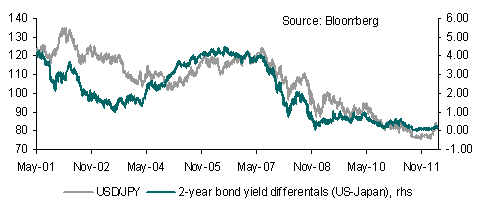
I suspect USD/JPY may have further to fall in the short term as its move corresponds with the narrowing in the US yield advantage over Japan. A drop below USD/JPY 80 looks increasingly on the cards.

Euro and Yen capitalise on weaker Dollar

Equities continued their bounce back overnight helped by a reiteration from Fed officials that US monetary policy will remain highly accommodative through late 2014. Risk assets overcame a weaker than expected report on US jobless claims, with a smaller than expected trade deficit in February ($46 billion) helping sentiment. The launch of a North Korean missile which apparently failed did little to dent sentiment. Nonetheless, Spanish concerns continue to weigh on its markets, bucking the trend of improvement elsewhere.

Today’s data slate has little in terms of first tier data on tap, with inflation releases in Europe and the US in focus. The bigger influence will be a slate of Chinese data including Q1 GDP. The market has already priced in a good number (around 9% YOY) and therefore there is a risk of disappointment, which could hit risk assets. Also watch out for earnings from US financials including JP Morgan and Wells Fargo. So far US earnings have been positive, although admittedly its early days yet.

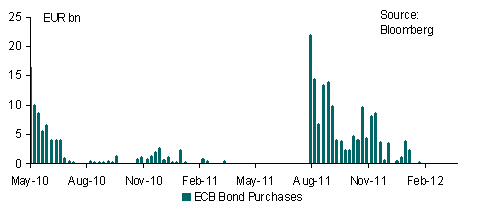
Downward pressure on EUR/USD has lessened for the time being and any further decline will be limited in the short term. While it is evident that the boost to markets provided by the European Central Bank’s Long Term Refinancing Operation (LTRO) has faded, EUR bears have been dealt a blow from renewed prospects of securities market purchases.

Italy’s debt auction yesterday provided little help to the EUR but at least it was not cause of further selling pressure. Concerns about Spain continue but any further downside pressure on EUR/USD will be restricted to technical support around the 1.3004 level (March 15 low), with EUR/USD set to remain in a 1.30-1.32 range.

JPY has pulled back sharply against the USD over the past month as I repeatedly warned. But before I blow my own trumpet any further I would note that further downside risks to USD/JPY remain in place although the room is now more limited than in previous weeks. According to my quantitative model a drop to around 79.00 is likely to mark a low in USD/JPY.

Warnings by the Bank of Japan of more “powerful” monetary easing have helped to prevent further JPY strengthening over recent sessions. However, a renewed narrowing in the US 2-year bond yield advantage over Japan will likely limit any upside for USD/JPY as reflected in the extremely strong correlation between USD/JPY and yield differentials over the past 3-months.

Calm Returns

Returning from being out over the last couple of weeks it seems as though global markets look in a much worse state than when I left. Nonetheless, a semblance of calm returned to markets overnight helped in part by comments from European Central Bank council member Coeure that the ECB may restart its Securities Market Purchases (SMP) programme to support Spanish bonds while Spanish Prime Minister Rajoy denied any need for a Greek style bailout.

Consequently equity markets have firmed helped also by a solid start to the US earnings season from Alcoa. The lack of any fresh positive fundamental news suggests that any risk rally will be fragile. Renewed Spanish and Italian debt worries will not fade quickly while growth concerns have been reignited by last week’s weaker than expected US jobs report.

This leaves currencies in a state of limbo. After having dropped over the last couple of weeks the EUR has stabilised at a weaker level versus USD. In contrast as warned previously the risk of a pull back in the JPY was very high and subsequently it has strengthened sharply from its lows close to 84.00 against the USD. However, comments from the Bank of Japan’s Shirakawa that the BoJ will continue to pursue “powerful” monetary easing may help to limit the bounce in the JPY to technical support around 80.69.

AUD has been on a downward trajectory as the yield differential with the US has narrowed but the currency benefited from a strong March employment report in which the number of jobs added (+44k) was far more than forecast. As a result expectations of further rate cuts from the Reserve Bank of Australia have been pared back. Much will depend on the Q1 CPI release on April 24 to provide further clarity on the prospects of a May move. China’s GDP data tomorrow will provide further direction and will help to determine whether the bounce in AUD can be sustained.

An upcoming Italian bond auction today as well as US Q1 earnings will garner most attention in the absence of first tier data releases. The main event of the week will be tomorrow’s GDP release in China, however. It will require positive results for all of the above to maintain the rally in risk currencies and consequently downward pressure on the USD. However, it seems that markets are in corrective mode and fresh Eurozone and global worries will likely limit any risk rally, leaving the USD well supported.