Greek tensions hit EUR, Aussie jobs boost AUD

Eurozone tensions continue to act as a weight on global market sentiment and the EUR. Talk of a delay of part or all of the second Greek bailout until after elections in April has intensified speculation of a disorderly Greek default. Chinese support for Europe expressed yesterday has done little to alleviate the strain. Attention will now turn to the meeting of the Eurogroup in Brussels on Monday.

Relatively positive US economic data including a jump in the NAHB homebuilders survey to its highest level since May 2007 and hints by Federal Reserve officials of support for more quantitative easing in the minutes of the Jan 24-25 FOMC meeting have failed to outweigh negative developments in Europe.

A ‘risk off’ tone will filter through markets today. Data wise, US Philly Fed and housing starts will continue the positive tone of US releases, while in Europe bond auctions in France and Spain will be watched closely.

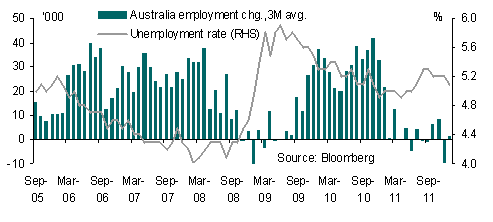
Australian jobs data for January came in stronger than forecast, rising by 46.3k compared to consensus of 10k. The unemployment rate surprisingly dropped to 5.1%. The increase in jobs more than made up for last month’s disappointment and highlights some signs of stability in job market conditions. Moreover, the data supports last week’s decision by the Reserve Bank of Australia (RBA) to keep rates on hold.

AUD jumped on the data but I expect the follow through to be limited especially given the fact that the AUD remains one of the most sensitive currencies to risk aversion. Upside will be restrained to resistance around 1.0788 versus USD today.
Euro and yen downside risks

The lack of progress on a second bailout for Greece will keep markets nervous, leaving risk assets vulnerable to further slippage. The USD will be a beneficiary in this environment. Weak Eurozone GDP data for Q4 2011 released today will contrast with relatively firm data including industrial production and the Empire manufacturing survey in the US, leaving the story of US economic outperformance intact.

EUR has lost steam and looks vulnerable to a further correction lower. The fact that EU finance ministers have cancelled a meeting due to be held today means that markets will have to prolong their wait for an agreement on a second bailout package for Greece.

News that Greece’s political leaders will send a commitment to European officials today that they will implement further austerity measures will give some reassurance that things are moving in the right direction but a looming deadline for debt redemption in March will mean heightened nervousness.

Admittedly the market is still short EUR but positioning has moved close to its 3-month average suggesting a less potential for aggressive short covering. Following the downgrade of ratings of several Eurozone countries yesterday and a likely drop in Q4 2011 Eurozone GDP today, caution will be the prevalent theme today, leaving EUR/USD on the back foot and opening the door for a test of technical support around 1.3026.

The Bank of Japan’s decision to increase its asset purchase program and set an inflation goal had an immediate negative impact on the JPY. A sharp drop in GDP growth in Q4 last year, persistent deflation pressures and more aggressive action from other central banks pushed the BoJ into action.

Will there be any follow through on the JPY? USD/JPY had already been under some upward pressure in the wake of the widening in US bond yields versus Japan. The move by the BoJ will result in even more of a widening in yield differentials especially given that the BoJ actions means there will be an increase in official purchases of Japanese government bonds, helping to suppress JGB yields.

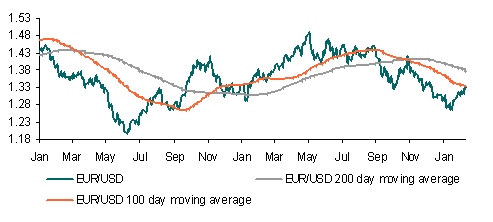
In the near term USD/JPY has broken above its 200 day moving average level, paving the way for a test of the 31 October 2011 high around 79.55. Further out, our bond forecasts show that both US and Eurozone 2-year bond yields will increase relative to Japanese yields over the coming months, supporting our forecasts of USD and EUR appreciation versus JPY.

USD in a lose-lose situation, AUD caution

News that Moody’s Investor service cut the debt ratings on six European countries while revising its outlook on the UK’s and France’s AAA rating to “negative” dampened sentiment for the EUR. Markets will likely trade cautiously ahead of tomorrow’s meeting of European Union Finance Ministers especially as it appears that at least Germany and Netherlands remain sceptical of Greece’s austerity plans, which could frustrate the approval of a second EUR 130 billion bailout package.

The USD is firmer overnight but still struggling to make headway in an environment of improving risk appetite. The fact that USD speculative positioning has dropped sharply to its lowest level since September last year highlights a major shift in USD sentiment. The USD is currently in a lose-lose situation helped neither by economic data or risk appetite. For example a healthy gain in January retail sales expected today, will help to boost risk appetite which in turn will help maintain pressure on the USD.

Encouragingly for the USD, 2 year bond yields have been rising since the start of February in line with firmer economic data. However, rather than giving the USD a boost (except vs. JPY) it has been outweighed by the fact that bond yields elsewhere have risen even more aggressively. The net result is that the prospects for the USD to strengthen further look somewhat restrained over the short term.

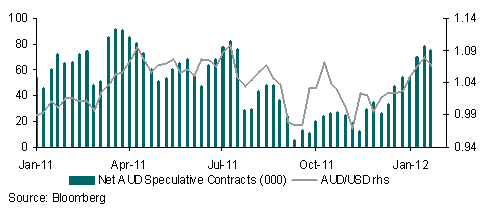
AUD has benefited from a firmer tone to risk appetite at the start of the week but for a currency in which speculative positioning is fast approaching all time highs I would be cautious of adding to long positions at current levels. Remaining one of the most sensitive currencies to gyrations in risk appetite the AUD will continue to be mainly driven by global events especially the Greek saga.

Nonetheless, there a few data releases at home that will capture market attention, in particular the January jobs report on Thursday. After a surprisingly large 29.3k fall in December a bounce is expected in January, with around a 15k increase likely. The report will provide clues to just how long the RBA will pause in its rate cutting cycle. I suspect that even a positive outcome will have a briefly positive impact on AUD, with the currency set to struggle to break above resistance around its 2012 high at 1.0845 versus USD.

Agreement at last!

Greek politicians finally agreed on further austerity cuts totalling EUR 3.3 billion in order to secure a second bailout package. European official discussions now centre on the details of the bail out package, targeting a cut in Greece’s debt to GDP ratio to 120%.

However, the fact European Finance Ministers have withheld more funds for Greece until the austerity measures begin to be implemented suggests further uncertainty on the horizon. A Greek parliamentary vote set to begin this weekend may see some progress but markets will trade cautiously ahead of the vote.

EUR/USD rallied to a high of around 1.3322 but failed to break above its 100 day moving average at 1.3332 following the agreement. As expected the ECB offered no help to the EUR, with market attention continuing to centre on the second 3-year LTRO on 29 February.

The fact that there are still various issues to be resolved means that upside for EUR will be limited in the short term. In any case the currency was already pricing in a lot of good news. EUR/USD will face major resistance around 1.3388.

Notably risk measures are edging higher once again, implying some pressure on risk assets in the near term. Markets today will digest the status Quo from the European Central Bank and an additional but expected injection of GBP 50 billion in quantitative easing from the Bank of England. December US trade data and February Michigan confidence are the only data of note suggesting limited price action ahead of the Greek parliamentary vote.

Euro pricing in a lot of good news

Markets remain in limbo ahead of a potential Greek debt deal although US equities managed to eek out small gains overnight. Stocks in the US have entered a bull market helped by the dovish stance of major central banks.

The Federal Reserve’s commitment to maintain accommodative policy until the end of 2014 and the European Central Bank’s (ECB)3 year LTRO have been drivers of the rally in risk assets. The BoE will contribute to the easy stance of central banks, with an increase in UK quantitative easing set to be announced today. The ECB in contrast is set to remain in status quo.

Will it be a buy on rumour, sell on fact reaction for the EUR to a Greek debt deal? Over recent days anticipation has grown that a deal on debt writedowns and in turn a second bailout package will emerge soon. This has helped to propel EUR/USD higher, with the currency hitting a high of 1.3289 overnight.

So far a deal has been lacking but leaders are expected to approve a draft agreement on fresh austerity measures between the main Greek political parties today. This should pave the way a deal on debt restructuring and a new loan package for the country due to be discussed today between Eurozone finance officials.

However, the EUR has already priced in a lot of good news on this front and even agreements on the issues above may not see the currency push much higher, with strong resistance around EUR/USD 1.3388. Separately today’s ECB meeting is unlikely to provide much direction for the EUR, with the Bank set to maintain current policy settings.

USD/JPY has managed a recovery of sorts but still remains in the middle of multi month 75.5-78.5 range. Nonetheless, the momentum over the short term will continue to be for USD/JPY upside, with resistance around 77.49 targeted. News that the Japanese authorities conducted ‘stealth intervention’ to weaken the JPY in late October/early November will have emboldened JPY bears.

However, at the same time they should also be worried as it is clear that even after all the intervention the JPY remains overly strong. Reflecting this is the fact that speculative and margin trading JPY positioning is at a very high level.

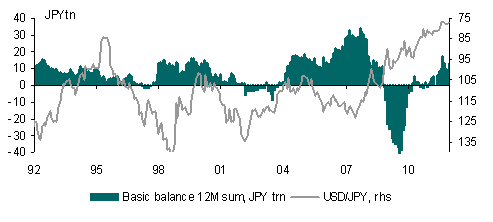
Moreover, while much has been made of the deterioration in Japan’s current account balance over recent months and the potentially negative impact on the JPY it should be noted that Japan’s basic balance (sum of direct investment + current account + portfolio flows) position remains healthy (for now) and is acting as an obstacle to JPY weakness.