Bernanke eyed for QE clues

Range trading is likely to dominate. However, the news flow remains negative, with disappointing retail sales data in the US combined with more the decision by the German constitutional court to delay its decision on the ESM bailout fund until September 12, highlighting the lack of potential for any rally in risk assets in the near term.

The International Monetary Fund (IMF) provided markets with a further dose of caution, with its warning that risks to global growth “loom large” as it cut its forecasts for global growth. Pressure on policy makers to provide more stimulus will grow, but the room for and efficacy of such stimulus is questionable.

The weaker than expected June US retail sales report released yesterday has resulted in fuelling expectations that Fed Chairman Bernanke will announce a shift towards more quantitative easing later today. Consequently the USD has come under pressure losing ground so far this week.

While the USD is set to be restrained ahead of Bernanke’s speech to the Senate we do not believe he will announce a change in stance. Therefore, any USD weakness is likely to prove temporary in the short term. The inability of risk appetite to improve further and the ongoing uncertainties in the Eurozone reinforce the view that the USD’s downside will be limited.

Today’s US releases are likely to reveal gains in June industrial production, and a likely strengthening in long term capital flows in May, factors that will help to provide the USD with further support.

Although the EUR has bounced this week data today will only serve to reinforce its overall downward trajectory. The July German ZEW survey is set to decline further. The range of forecasts for this volatile survey is wide between -10 to -30, with our forecast towards the lower end.

The plethora of negative news in terms of policy progress continues to dampen sentiment and hamper the EUR’s ability to recover. Whether its persistent downgrades of economic growth across Eurozone countries, stalling of reforms and austerity plans, or delays in implementing agreed upon measures, the news is unambiguously bad.

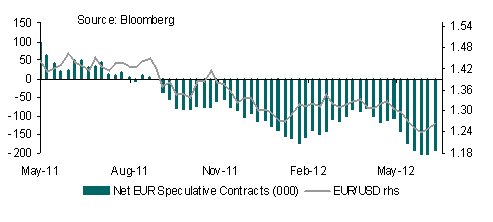
Dashed hopes of progress towards finding and implementing solutions have led to a renewed deterioration in speculative appetite for EUR. Although the potential for short covering remains high, the trigger for any short covering is decidedly absent. We maintain the view that EUR/USD will test 1.2000 over coming weeks.
Bernanke and Eurogroup awaited

Two main events will garner most attention this week. These are Fed Chairman Bernanke’s Monetary Policy Report to Congress on Wednesday and the Eurogroup meeting on Friday. Ahead of these events trading is likely to be restrained. While a solid close to US and European equity markets at the end of last week suggest at least a firm start to the week for risk assets the many and varied uncertainties afflicting markets suggest that positive momentum will be very limited. US data should generally outperform compared to Europe this week with June retail sales, July Empire manufacturing, May industrial production and June housing starts are set to post gains. In contrast, the German July ZEW survey is set to decline further.

Wide ranging uncertainties in Europe including the inability to seal the deal on the main elements of the recent EU Summit, downgrade of Italy’s sovereign ratings by Moody’s, uncertainty of Greece’s austerity programme, delay in the German Constitutional Court’s verdict on the ESM bailout fund, the hard line stance of German Chancellor Merkel towards banking supervision, disagreement within France’s majority government on how to ratify the Fiscal Pact as well as objections from the Netherlands and Finland on the use of the rescue funds, highlight just some of the difficulties remaining in turning around confidence in Europe. All of this suggests that the EUR will remain under downward pressure while Eurozone peripheral bond spreads will see limited compression.

Aside from a relatively weak EUR which we expect to push lower initially to support around 1.2151 versus USD and then towards the psychologically important 1.200 other risk / high beta currencies will remain relatively resilient. Asian currencies will likely begin the week in positive mood helped by expectation of more stimulus from China but unless risk appetite improves significantly any upward bias will be limited. Although there may be some disappointment from a lack of progress in Europe on resolving its crisis and also from Bernanke’s testimony in which he is unlikely to indicate a greater bias towards more quantitative easing, risk appetite is unlikely to sour too much, especially given thin summer trading conditions and hopes of more policy stimulus out of China.

Central banks fail to impress

Three central banks acted within a short time of each other to provide yet more monetary stimulus. However, the European Central Bank’s (ECB) 25 bps cut in its refi rate and deposit rate, China’s central bank, PBoC’s cut in interest rates and an additional GBP 50 billion of asset purchases by the Bank of England have failed to stimulate markets. This is a worrying development for policy makers especially as the drug of monetary stimulus has been a major factor spurring equity markets and risk assets since the global financial crisis began in 2008.

The lack of positive momentum emanating from the policy easing by central banks yesterday reflects the reality that the efficacy of further easing has now become very limited. Will a quarter percent rate cut from the ECB or yet another round of asset purchases from the BoE really make a difference at a time when core bond yields are already at extremely low levels and the demand for credit globally is very weak? Moreover, are policy makers really addressing the underlying problems in the Eurozone or elsewhere? I think the answers are obvious.

The same argument applies to the Fed if it was to embark on a third round of quantitative easing. Admittedly more Fed QE could weaken the USD and boost equities but would it really have a lasting impact? In any case I don’t think the Fed is on the verge of more QE following the recent extension of ‘Operation Twist’ which itself will do little more than have a psychological impact on markets. Today’s release of the June jobs report could give some further impetus to QE expectations if it comes in weak but I doubt this will occur.

One casualty of the cut in ECB rates was the EUR which dropped sharply, having not only given up its post EU Summit gains over recent days but extending its losses even further. This is perhaps an odd reaction considering that a rate cut was widely expected. ECB President Draghi’s warnings about the path ahead will have played negatively on the currency as well expectations of more stronger easing in the months ahead perhaps involving ECB QE.

I still stick to the view that European policy makers have at least put a short term floor under the EUR in the wake of the decisions at the EU Summit suggesting that further downside will be limited, with the 2012 low around 1.2288 likely to act as a short term floor for EUR/USD. Nonetheless, with many details of the plans announced in the Summit yet to be ironed out and implementation risks running very high a degree of market caution should be expected.

Fed disappoints, NZD jumps on firm GDP

The decision by the Fed to extend its maturity extension program through year end by USD 267 billion left markets with a taste of disappointment. Although the Fed noted that it was “prepared to take further action” it was clear that FOMC members were resistant to such action at this point in time. Nonetheless, any downside to risk assets was limited by the potential for more quantitative easing (QE) somewhere down the line.

Indeed, while equity markets took a softer tone it was notable that the VIX ‘fear gauge’ continued to drop reflecting an improvement in risk sentiment. The VIX has dropped by 35% from its high at the beginning of the month. Commodity prices remained under downward pressure, however. The lack of further Fed balance expansion capped gold prices too. The outcome is likely to play positively for the USD given that the Fed is not going to debase the currency any further for now.

Following the Fed decision clearly pressure is on other central banks to act. The European Central Bank’s Coeure hinted at the prospects a press interview while the Bank of England minutes were surprisingly dovish, indicating a strong likelihood of further UK QE at the next MPC meeting.

EUR/USD dropped to around 1.2638 following the FOMC outcome but rebounded probably helped by the fact that the Fed left open the door for further balance sheet expansion. EUR/USD 1.2750 remains a major barrier to the currency pair but if breached there is plenty of upside potential.

Flash Eurozone purchasing managers indices (PMI) releases today will likely restrain the EUR, with a further slight declines in manufacturing confidence expected, consistent with further contraction in activity. The data will put further pressure on the ECB to cut interest rates. EUR direction today will also come from Spanish and French bond auctions today.

It’s worth highlighting the surprisingly robust New Zealand Q1 GDP data released this morning. The data revealed a strong 1.1% quarterly increase compared to consensus expectations of a 0.4% increase. The data boosted NZD which rallied to a high of 0.8018 versus the USD and remains well supported. NZD/USD 200 day moving average around 0.7952 will provide decent support for the currency especially given the sharp move hawkish move in NZ interest rate markets.

Euro rallies on Greek election outcome but gains to be short lived

The Greek election outcome will be met with a sigh of relief across markets. However, there is still likely to be plenty of horse trading before a new government is formed and even then Greece’s fiscal/debt/growth problems will not just miraculously go away. Market pressure will resume after a brief delay.

At least for the early part of this week markets will likely find some support however, and with events including the FOMC meeting, G20 meeting and EU Summit coming up, hopes that some solutions may be forthcoming may at least prevent sentiment for risk assets from deteriorating too significantly.

The EUR garnered support following news that pro-bailout parties have gained sufficient votes to form a government in Greece. Negotiations will begin to form a coalition government between the first placed party New Democracy and third placed Pasok but the risk remains that prolonged discussions could quickly result in the EUR erasing its gains. Indeed, Pasok leaders are talking about the need to form a ‘government of national unity’, suggesting the process of forming a government will not be straightforward.

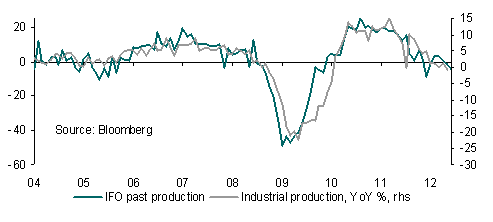
A slightly less negative shift in EUR sentiment has been apparent from the CFTC IMM data which revealed that net short positions dropped (ie there has been some short covering) even before the election outcome. The election result will encourage more short covering although data releases this week including the June German ZEW investor confidence and IFO business confidence surveys, both of which are set to decline, will caution against becoming overly bullish EUR. Short term EUR/USD resistance is seen around 1.2750 but a move back down to around 1.2515 is more likely as the week progresses.
a href=”https://econometer.org/wp-content/uploads/2012/06/gerifo.gif”>
One of the reasons the EUR has managed to garner support over recent days has been growing speculation of Fed action to boost the economy in the wake of a rash of softer data releases. Such expectations have put the USD under pressure, with last week’s data revealing disappointing retail sales, industrial production and consumer confidence. On Wednesday the markets will find an answer to speculation of more Fed action, with the Fed FOMC policy decision.

Expectations of more quantitative easing will be disappointed but the Fed will likely increase Operation Twist buying time to evaluate incoming data releases. A combination of a relatively positive Greek election outcome together with speculation of more QE will keep the USD under pressure ahead of Wednesday’s outcome but weakness ought to prove short lived, with USD gains expected following the Fed decision not to expand its balance sheet further.