US Dollar Facing Battle On US Debt Ceiling

President Obama, the Fed’s Beige Book and a firm reading for US retail sales provided some temporary relief for the beleaguered USD but this soon gave way to renewed pressure. Obama proposed cutting around $4 trillion from the fiscal deficit over the next 12-years, similar in size to Republican plans, but structured differently. Separately the Beige Book relatively upbeat, noting “widespread” economic gains across sectors. Finally, whilst top line retail sales were slightly softer than forecast ex-autos sales were upbeat, with upward revisions to the past month.

President Obama’s deficit reduction plans sets the stage for a fractious political battle regarding the $14.3 trillion debt ceiling. Having averted a government shut down following a late agreement between Republicans and Democrats the USD will have a much bigger challenge to face in the weeks ahead. Obama has stated his support for raising the debt ceiling but if agreement is not reached by around mid May (or July if temporary measures are introduced), the US government may effectively default.

When will the USD lose its funding currency mantle? The approach of the end of quantitative easing (QE2) by end June 2011 (assuming the Fed sticks to the plan) will be a particularly important period for the USD. Assuming that there will be no QE3 much will depend on how proactive the Fed is in reducing the size of its balance sheet. This remains unclear and judging by the variety of comments from Fed officials over recent weeks, there is plenty of debate within the Fed FOMC about the pace of balance sheet reduction.

St Louis Fed President Bullard (non-voter) maintained his hawkish stance by highlighting his preference for reducing the Fed’s balance sheet rather than hiking interest rates as a first step towards policy normalisation. There will be further clues both in terms of Fed thinking as well as inflation pressures.

Fed speakers including Duke, Kocherlakota and Liang, Plosser, Tarullo, Lacker, Baxter and Evans will give further clues. CPI inflation data will also be in focus, with headline inflation likely to be boosted by higher energy prices but core inflation likely to remain well behaved. Despite Bullard’s comments the majority of Fed officials appear to be taking a more cautious stance, suggesting that the USD will remain under pressure for a while yet.

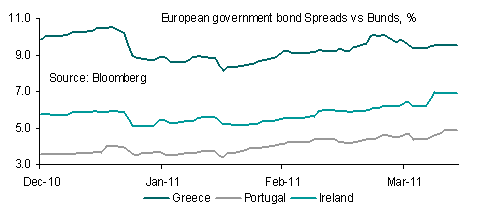
The EUR continues to capitalise on generally weak USD sentiment despite nervousness about the details of Portugal’s bailout program. More worryingly for the EUR is ongoing speculation about Greek debt restructuring, with S&P ratings agency noting that the risk of Greek debt restructuring was almost one in three and the Zeit newspaper reporting that investors could lose around 50-70% in a restructuring. Although plans to restructure have been denied by the Greek government this has not stopped Greek bond yields from skyrocketing.
Euro’s Teflon Coating Wearing Thin

EUR has suffered a setback in the wake some disappointment from the European Union summit at the end of last week and the major defeat of German Chancellor Merkel and her ruling Christian Democratic Union party in yesterday’s election in Baden-Wuerttemberg. The EUR had been fairly resistant to negative news over recent weeks but its Teflon like coating may be starting to wear thin.

The setbacks noted above + others (see previous post) follow credit rating downgrades for Portugal by both S&P and Fitch ratings and growing speculation that the country is an imminent candidate for an EU bailout following the failure of the Portuguese government to pass its austerity measures last week and subsequent resignation of Portugal’s Prime Minister Socrates.

For its part Portugal has stated that it does not need a bailout but looming bond redemptions of around EUR 9 billion on April 15 and June 15 against the background of record high funding costs mean that the pressure for a rescue is intense. Complicating matters is the fact that fresh elections cannot be held earlier than 55 days after being announced, meaning that policy will effectively be in limbo until then. A June vote now appears likely.

After what was perceived to be a positive result of the informal EU leaders summit a couple of weeks ago, the outcome of the final summit last week failed to deliver much anticipated further details whilst more negatively the EU bailout fund’s paid-in capital was scaled back to EUR 16 billion (versus EUR 40 billion agreed on March 21) due to concerns expressed by Germany.

Ireland is also in focus ahead of European bank stress tests results on March 31. Ireland is pushing for increased sharing of bank losses with senior bondholders as part of a “final solution” for financial sector. Meanwhile the new government remains unwilling to increase the country’s relatively low corporation tax in exchange for a renegotiation of terms for the country’s bailout. This point of friction also threatens to undermine the EUR.

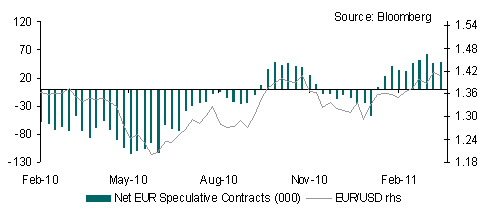
The bottom line is that the bad news is building up and the ability of the EUR to shake it off is lessening. Considering the fact that the market long EUR, with positioning well above the three-month average the EUR is vulnerable to position adjustment. After slipping over recent days EUR/USD looks supported above 1.3980 but its upside is looking increasingly restricted against the background of various pieces of bad news.

Euro resilient but for how long?

The resilience of the EUR to bad news has been impressive but is unlikely to persist. The recent negatives include 1) the rejection of the Portuguese government’s austerity plan and the increased likelihood of a bailout, 2) a likely delay in the decision on increasing the size and scope of the EFSF EU bailout fund, 3) a drop in Eurozone purchasing managers indices in March, 4) downgrades to Portugal’ sovereign credit ratings by Fitch last night and S&P and 5) Moodys downgrades of 30 Spanish banks. Despite all of this, and after hitting a low of around EUR/USD 1.4054, EUR has bounced back close to the 1.4200 level.

Further direction will come from the outcome of the EU leaders’ summit today and the March German IFO business confidence survey. For the former there is unlikely to be a decisive result, with the optimism following the informal March 11 leaders’ summit likely to give way to delay due to wrangling over details. For the latter, a slight moderation in the IFO is expected following February’s upside surprise. However, there is a bigger risk of a downside surprise following the softer than forecast March German manufacturing PMI released. Against this background, EUR/USD is likely to struggle to break resistance around 1.249.

In general FX markets look somewhat more stable and even the pressure on the USD appears to have abated slightly despite a much weaker than expected outcome for US February durable goods orders yesterday, which revealed a drop in both headline and ex-transportation orders. My composite FX volatility measure has dropped sharply over recent days, led by short term implied JPY volatility which has dropped close to pre-crisis levels. Lower volatility has also likely reduced the prospects of further FX intervention although USD/JPY 80 will continue to be well defended.

Lower volatility as also reflected in the sharp drop in the VIX index has corresponded with a general easing in risk aversion as both Middle East and Japan tensions have eased slightly. US data today are unlikely to offer much direction, with a slight upward revision to US Q4 GDP and an unchanged outcome for the final reading of Michigan consumer confidence expected.

Japan’s Earthquake Aftermath

The aftermath of the devastating earthquake and Tsunami in Japan will largely drive markets this week outweighing the ongoing tensions in the Middle East. Having been in Tokyo as the earthquake struck I can testify to the severity and shock impact of the earthquake. Aside from the terrible human cost the economic cost will be severe at least for the next few months before reconstruction efforts boost growth. An early estimate suggests around a 1% negative impact on GDP this year.

The government is expected to announce a spending package over coming weeks to help fund relief efforts but this will likely put additional strain on Japan’s precarious debt situation at a time when worries about the country’s fiscal health were already high. Nonetheless, there is around JPY 550 billion available from the Fiscal Year 2010 and FY 2011 budgets even before a supplementary budget is needed.

The initial negative JPY impact of the natural disaster gave way to strength in anticipation of expected repatriation flows by Japanese life insurance companies and other institutions as they liquidate assets abroad in order to pay for insurance payments in Japan. The bias to the JPY will likely continue to be upwards but trading will be choppy.

Many of the margin traders holding extreme long USD/JPY positions will likely reduce these positions in the weeks following the earthquake in order to fulfil JPY demand. This may be countered by some foreign selling of Japanese assets especially given that foreigners have accelerated Japanese asset purchases over recent weeks. Therefore, it’s not a straight forward bet to look for JPY strength.

If however, the JPY strengthens rapidly and threatens to drop well below the psychologically important level of 80 the spectre of FX intervention will loom large. Indeed, following the Kobe earthquake in 1995 the JPY strengthened sharply by around 18% but the USD was already in decline prior to the earthquake and USD/JPY was also being pressured lower by Barings Bank related liquidation.

Therefore, comparisons to 1995 should be taken with a pinch of salt. Nonetheless, Japanese authorities will be on guard for further upward JPY pressure. The immediate market focus will be on the Bank of Japan (BoJ) meeting today, with the BoJ announcing the addition of JPY 7 trillion in emergency liquidity support to help stabilise markets.

Interest Rate Decisions Galore

The Reserve Bank of New Zealand (RBNZ) decision to cut policy rates by a bigger than expected 50bps does not necessarily mark the onset of a new wave of NZD selling. Indeed, whilst the NZD was hit by the rate cut it recovered quickly.

The NZD was aided by comments from the RBNZ Governor Bollard that short term inflation may spike due to the earthquake but this tempered by another RBNZ official who stated that the central bank may hold rates at 2.5% at least until January 2012. The post meeting statement indicated that the RBNZ will not embark on a series of rate cuts, a fact that will provide some relief to the Kiwi. Moreover, the currency looks increasingly oversold especially relative to the AUD as indicated by relative positioning.

Weaker than expected employment data in Australia will also help to stem AUD strength versus NZD. After many months of positive surprises the labour market is showing signs of cracking. Admittedly full time employment rose but this was outweighed by an even bigger drop in part time employment, resulting in a 10.1k fall in overall employment.

Although the AUD is unlikely to face too much downside markets the data will likely dampen expectations of possible rate hikes in the months ahead. My preferred way of playing possible AUD underperformance is via the NZD. AUD/NZD is likely to face plenty of resistance around the 1.3800 level and eventually as indicated by our quantitative models the currency pair is likely to move lower over coming weeks.

In sharp contrast to the RBNZ, the Bank of Korea hiked interest rates by 25bps in a further move to normalize policy. The decision was not much of a surprise and the statement indicated that more rate hikes should be expected. The KRW remains rangebound but the currency remains on path for further appreciation over coming months. The surprise trade deficit in China has weighed on Asian currencies in general but weakness is likely to be limited.

The Bank of England is the next central bank on tap today but is unlikely to hike rates despite the hawkish shift within the Monetary Policy Committee. A rate hike is moving closer but the Bank will likely wait until at least May before moving. Further details about today’s decision will as usual wait for the minutes in two weeks time. GBP looks vulnerable and whilst a rate move today is not expected the currency may lose ground over coming days against the background of a firmer USD.