Will the ECB intervene to support the Euro? (Part 1)

The EUR has lost around 23% since it all time high in April 2008 when it traded close to 1.6000. The EUR failed to rally even in the wake of the EUR 750 billion European Union / International Monetary Fund support package, a fact that has highlighted the weight of negative sentiment towards the currency. The latest blow to the currency came from the announcement of unilateral measures from Germany to ban naked short selling on sovereign debt and some financial stocks, actions that only highlighted the lack of policy co-ordination within the eurozone.

The rationale for further EUR/USD weakness is clear and justified partly by growth divergence within the eurozone countries, with Germany on the one extreme and weaker Southern European countries on the other. Moreover, relatively weaker overall growth in the eurozone compared to the US economy, a delay in interest rate hikes by the European Central Bank (ECB) and ongoing concerns about implementation and execution of deficit cutting plans, will also weigh on the EUR.

The EU/IMF support package and in particular ECB interventions in the Eurozone bond market have managed to alleviate some of the strain on European bond markets, but without similar intervention in the FX markets the EUR has become the release valve for Europe’s fiscal and debt problems. As a result the EUR’s fall has accelerated over recent weeks, only showing any sign of stability as fears of currency intervention increased.

The quickening pace of EUR depreciation has led to growing speculation of FX intervention by the ECB and other central banks to support the currency. I believe intervention is highly unlikely and see little reason for panic about the drop in the EUR. Once markets realise that there is indeed little risk of intervention the EUR will resume its downtrend.

One of the main reasons behind this view is that the EUR is not particularly “cheap” at current levels. In fact, “fair value” estimates based on the OECD measure of purchasing power parity (PPP) suggest that EUR/USD is around 5.6% overvalued at current levels, based on an implied PPP rate of around 1.17. Therefore, the drop in the EUR over recent months has only brought it back close to PPP fair value estimates.

Moreover despite the fact that there has been a large nominal depreciation of the EUR its trade weighted exchange rate has declined by much less, around 8.5% since the beginning of the year and around 11.3% since its high in October 2009. Although the trade weighted EUR is around its lowest level since October 2008, taking a longer term view shows that it is slightly above its average over the past 20-years.
German Action Backfires

Just as it appeared that a semblance of calm was returning to markets over the last day or so, markets went into a tailspin in reaction to the announcement that the German regulators will temporarily ban naked short-selling of shares in 10 financial institutions, EUR government bonds and credit-default swaps based on these bonds. “Exceptional volatility”, “massive” short-selling and excessive price movements were cited as reasons for the ban. The action was reminiscent of a similar move by the US SEC in September 2008.

The action appears to have backfired, fuelling uncertainty over its impact, potential replication by other European countries, how and to whom it would apply as well as how it will be enforced. Once again a single eurozone country has enforced a unilateral measure in an uncoordinated fashion. It is unclear whether other eurozone countries will follow Germany’s actions but it is clear that the measure has led to a further bailout from European asset markets.

Aside from a reversal in equity markets, risk currencies will remain under pressure, with EUR/USD dropping to a low of 1.2163 following a tentative rally earlier. Options barriers on the way down could prevent a more rapid sell-off, with 1.2033 seen as the next support level. Pressure is likely to continue today and will likely spread through Asian markets and currencies. Clearly confidence is extremely low and unfortunately such measures are doing very little to change the growing negative sentiment towards Europe.

Even at current levels the risk of intervention on EUR/USD remains low. The pace of the move in EUR/USD and its volatility may be more important than even the level of the currency. In any case, at current levels EUR/USD is trading around “fair value” and a weaker EUR will be a boon to the European economy. Implied EUR/USD volatility is also not at a particularly high level, suggesting little concern by European officials about the level of the EUR.

Capital Flowing Out of Europe

When investors’ concerns shift from how low will the EUR go to whether the currency will even exist in its current form, it is blatantly evident that there is a very long way to go to solve the eurozone’s many and varied problems. As many analysts scramble to revise forecasts to catch up with the declining EUR, the question of the long term future of the single currency has become the bigger issue. Although the EUR 750 billion support package was hailed by EU leaders as the means to prevent further damage to the credibility of the EUR, it has failed to prevent a further decline, but instead revealed even deeper splits amongst eurozone countries.

Although the European Central Bank (ECB) confirmed that it bought EUR 16.5 billion in eurozone government bonds in just over a week, with the buying providing major prop to the market, private buyers remain reluctant to renter the market. As a result of the ECB’s sterilised interventions bond markets have stabilised but the EUR is now taking the brunt of the pressure, a reversal of the situation at the beginning of the Greek crisis, when the EUR proved to be far more resilient. Reports that some large institutional investors have exited from Greek and Portuguese debt markets whilst others are positioning for a eurozone without Greece, Portugal and Spain, suggest that the ECB may have taken on more than it has bargained for in its attempts to prop up peripheral eurozone bond markets.

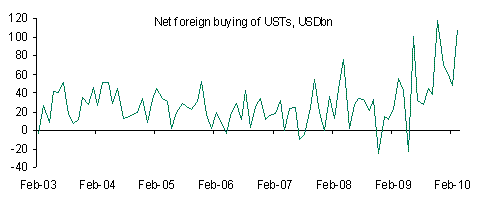
As was evident in the US March Treasury TICS report it appears that a lot of the outflows from Europe are finding their way into US markets. The data revealed that net long-term TIC flows (net US securities purchases by foreign investors) surged to $140.5 billion in March. The bulk of this flow consisted of safe haven buying of US Treasuries ($108.5 billion), although it was notable that securities flows into other asset classes were also strong especially agencies and corporate bonds, which recorded their biggest capital inflow since May 2008. Asian central banks also reversed their net selling of US Treasuries, with China investing the most into Treasuries since September 2009. Anecdotal evidence corroborates this, with central banks in Asia diversifying far less than they were just a few months ago.

This reversal of flows is unlikely to stop anytime soon. It is clear that enhanced austerity measures in the eurozone will result in weaker growth and earnings potential. This will play negatively on the EUR especially given expectations of a superior growth and earnings profile in the US. Evidence of implementation, action and a measure of success on the fiscal front will be necessary to begin the likely long process of turning confidence in the EUR around. This will likely take a long time to be forthcoming. EUR/USD has managed to recover after hitting a low of around 1.2235 but remains vulnerable to further weakness. The big psychological barrier of 1.20 looms followed by the EUR launch rate of around 1.1830.

Criminals Favouring The Euro

It says a lot for a currency when banks stopped accepting it as a means of exchange. The EUR’s woes continue to pile up and the currency received more bad news unrelated to Europe’s fiscal woes when it was announced that banks and foreign exchange bureax in the UK have stopped exchanging EUR 500 banknotes. The rationale was not because the currency is dropping sharply in value though this is also a credible reason, but due to the fact that 90% of the notes were found to be linked to tax evasion, terrorism and other crimes.

EUR/USD came close to the technical support level around 1.2510. Options barriers will likely provide some strong support around this level, temporarily delaying an inevitable drop to the next support at 1.2457. It was not just the EUR that suffered, with GBP faring even worse, in part due to a wider than expected trade deficit, with GBP/USD heading for a test of 1.4500. Sovereign woes continue to depress the EUR in what is turning into a no-win situation. Fresh austerity measures in Greece, Spain and Portugal failed to assuage market fears, and instead the measures have only heightened concerns about social unrest and a weakening growth outlook.

EUR/USD to test 1.2510, GBP/USD heading for 1.4500

Following on from the EUR 750 billion EU / IMF package European governments are starting to hold up to their end of the bargain. Spain announced a bunch of austerity measures. The measures aim at cutting the country’s budget deficit by an additional EUR 15 billion from 11.2% of GDP in 2009 to close to 6% in 2011. This was accompanied by some better economic news as Spain edged out of a close to 2-year recession in Q1 2010.

Evidence that some action is being taken on the fiscal front in Europe accompanied a slightly stronger than expected reading for Eurozone GDP in Q1 2010, helping risk appetite to improve overnight. Portugal was also able to find some success in its sale of EUR 1 billion of 10-year bonds, with a bid to cover ratio of 1.8 and a premium of only 18bps above the yield at April’s sale. Portugal has also pledged to cuts its budget deficit further than initially planned, aiming for a deficit of 7.3% of GDP this year.

Of course, pledges need to be followed by action and implementation and execution will be essential to bring markets back on side given the likely damage inflicted on confidence in the whole EUR project. Continued skepticism explains why EUR/USD has failed to take much notice to the developments in Spain and Portugal, with the currency continuing to languish, heading towards technical support around 1.2510 in the short-term.

The new UK coalition government is also moving quickly to appease markets, with plans to cut the budget deficit in the country by GBP 6 billion this year. The plans failed to have a lasting impact on GBP, which was dealt a blow by the dovish interpretation of the Bank of England’s quarterly inflation report released yesterday. GBP/USD continues to struggle to gain a foothold above 1.5000 and technical indicators suggest the currency pair is still heading lower, with a move to 1.4500 likely over the short-term.