Anxious wait for Greek PSI

An anxious wait for the outcome of the Greek private sector involvement in a debt swap taken together with a bout of risk aversion and confirmation of weak growth in the Eurozone (Q4 GDP dropped by 0.3%) have set the scene for nervous trading in EUR/USD. Confirmation of the Greek debt swap deadline on Thursday has done little to stead nerves.

The EUR has lost plenty of ground over recent days but will likely consolidate ahead of the outcome of the PSI. Direction will then depend on whether there has been sufficient voluntary participation by bond holders to avoid forcing private sector involvement. In the event of strong participation the EUR will rally but I suggest selling into any such rally.

Another factor that is playing a role in dampening EUR demand is the fact that the European Central Bank (ECB) balance sheet continues to expand at a rapid rate, to a record EUR 3.02 trillion last week following the second ECB long term refinancing operation (LTRO). Overall, expect little respite for the EUR. Effectively the ECB is undertaking quantitative easing via the back door, which is weighing on the EUR in the process.

USD/JPY has pulled back from its highs in the wake of an increase in risk aversion. As I have been noting over recent days the move in USD/JPY had overshot its short term ‘fair value’ estimate according to my quantitative models. The drop in USD/JPY fits into line with this view. The fact that US bond yields have pulled back from recent highs has also played into the drop in USD/JPY.

While I remain bearish on the JPY over the medium term, there is scope for a further move to technical support the 80.00 level in the short term. Further out, much will depend on the ability of Japanese officials to follow through on more aggressive policy to reflate the economy.

The Bank of Japan’s inflation goal will need a determined effort in terms of more aggressive monetary policy to enable it to succeed. This will ensure that Japanese government bond yields remain suppressed at a time when I expect US bond yields to move higher. Consequently USD/JPY will likely move higher too, with my year end target remaining at 85.00.
Euro extends gains, yen pressured

The EUR found another spurt of life following the release of the stronger than expected February German IFO business confidence survey yesterday. The data helped make up for the disappointment related to the manufacturing and service sector surveys. However, while it may have alleviated concerns about weakening growth in Germany it only serves to highlight the disparities in growth across the Eurozone.

I continue to believe the EUR may struggle to sustain gains. In the near term, after breaking above 1.3320 resistance, EUR/USD will face further resistance around 1.3460. Nonetheless, my 2012 year end forecast of EUR/USD 1.26 shows that despite growing growth pressures in the Eurozone economy the EUR will still find underlying support from a healthy external balance and continued EUR buying from Asian official investors.

Over the near term upcoming votes in various countries on the second Greek bailout deal will provoke some nervousness while Greek reform implementation risks will also act to dampen EUR sentiment.

JPY has faced significant degree of pressure since the beginning of February. As noted previously one of the biggest sources of upward pressure on USD/JPY has been the widening in US – Japan 2-year bond yield differentials. US bonds currently yield around 19 basis points above Japan, the highest gap since August 2011. The widening yield gap already appears to be prompting foreign outflows from Japanese bonds, with outflows registered in six of the seven past weeks. These outflows have helped contribute to the weakness in the JPY.

The fact that the BoJ will step up its purchases of Japanese government bonds (JGBs) will also add to the downward pressure on the JPY as it will mean a further widening in US – Japanese yield differentials. Over the short term USD/JPY may face some resistance above the 80 level and I suspect that it will lose some momentum but maintain my view that it will reach 85.0 by the end of the year.

EUR/GBP upside overdone, CHF overly strong

Disappointing Eurozone service sector and manufacturing purchasing managers’ confidence indices as well as a contraction in Chinese manufacturing confidence sets the scene for a drop in risk assets. In addition in the US, existing home sales rose less than expected taking into account revisions to previous data.

Meanwhile scepticism over Greece’s ability to implement agreed upon reforms and reported resistance from Germany to increasing the firewall around peripheral Eurozone countries has delivered a further dose of negativity to markets. The market was probably looking for an excuse to sell after a strong rally and found plenty in yesterday’s news.

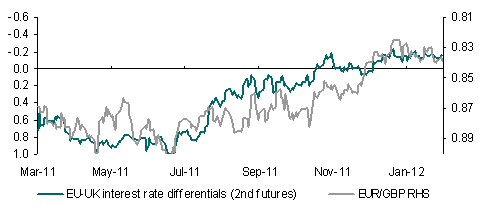
GBP has followed on the coat tails of the EUR over recent weeks, with the currency showing little independent direction. Reflecting this is the fact that EUR/GBP had until recently been trapped in a 0.83-0.84 range. As with the EUR I see downside risks to GBP over the short term against the USD.

Against the EUR, GBP will largely track the movement in yield differentials as it has done over recent months. Relatively dovish MPC minutes, with two members voting for bigger amounts of quantitative easing helped to put GBP under further pressure but the move higher in EUR/GBP look overdone.

My medium term view continues to show GBP appreciation versus EUR and current levels highlight a good opportunity to go short EUR/GBP. Markets are rewarding central banks that are proactive in their policy prescriptions. I exect this to result in some GBP resilience even if the BoE announces more QE.

EUR/CHF has continued to hug the 1.2000 line in the sand enforced by the Swiss National Bank. Ongoing Eurozone doubts even after the agreement of a second bailout for Greece mean that the CHF remains a favoured destination for European money. This is reflected by the fact that EUR/CHF has been highly correlated with Risk Aversion over the past 3-months.

It will take also take a relative rise in German yields versus Swiss yields for EUR/CHF to move higher. This is certainly viable given the deterioration in Swiss economic data over recent months. Indeed, as reflected in the KoF Swiss leading indicator and manufacturing PMI data, the economy is heading downwards. Assuming that there will be an eventual improvement in risk appetite, CHF will weaken given the strong correlation between EUR/CHF and risk aversion over the past 3-months.

EUR capped, NOK strength overdone

The positive reaction to the Greek bailout deal failed to gain traction leaving risk assets under a degree of pressure. The fact that the deal was highly expected played a role in the unenthusiastic reaction but markets may also be cautious given the major tasks that still like ahead including a tough reform timetable for Greece, parliamentary approvals in various countries and implementation of the debt swap.

EUR looks stretched. The lack of follow through in terms of EUR upside suggests that the currency will struggle. The news of the deal came as a relief to markets but after so many days of negotiations failure to agree would have been inconceivable. However, the aftermath has seen renewed doubts creep into the market especially given the short time horizon (just nine days) for Greece to implement reform measures.

Market positioning suggests that there is still scope for some EUR upside but I doubt that the deal will be sufficient to prompt a big wave of short covering. Eurozone fundamentals remain weak and if anything the exercise in forming an agreement about Greece has revealed various splits within the Eurozone. Superior US growth expectations plus relatively higher US bond yields suggest EUR will struggle to extend gains in the medium term. Short term EUR/USD gains are likely to be capped at 1.3322.

EUR/NOK has dropped sharply over recent weeks, with NOK strength accelerating in February. The currency has been the second best performer versus EUR so far this year much to the chagrin of Norwegian officials who feel that the strength in the currency will weigh on the economy. Such concerns should be taken at face value. The NOK is highly overvalued according to various measures of ‘fair value’ but I do not expect the strength in NOK to persist over the short term.

Last week, warnings from Norway‘s central bank that they are ready to act to curb NOK strength may provoke some hesitation to enter long NOK positions especially as weakening economic growth will only strengthen the resolve of officials to prevent excessive currency strength. The NOK is sensitive to risk aversion and any correction in the recent rally in risk appetite could render the NOK highly vulnerable to renewed weakness.

Greek deal reached but euro rally to fade

The EUR rallied on the news of a breakthrough in talks to reach a deal to provide Greece with a second bailout of up to EUR 130 billion until 2014 and PSI (private sector involvement) in a debt swap with a nominal haircut of 53.5%. The question is whether the EUR has room to rally further. I suspect that a deal has been increasingly priced in and the room for further appreciation is set to be limited in the short term.

A stronger EUR shows some confidence in the ability of officials to move forward but will prove counter productive given the negative impact on the Eurozone economy at a time when growth is already sliding into recession. Moreover, the relative rise in US bond yields compared to bund yields will create headwinds to any further EUR appreciation. Overall, we are cautious of buying into the EUR rally at current levels.

Effectively the deal buys time for Greece to implement its stated reforms allowing the debt / GDP ratio to drop to 120.5% by 2020. The private sector debt swap procedure will be launched tomorrow. However, the deal was reached shortly after a report that suggested that Greece may need a further bailout on top of the EUR 130 billion announced.

The report which highlighted the risks of an especially deep recession in Greece and consequent risks to reducing the county’s debt / GDP ratio explains the reluctance of countries including Germany, Netherlands and Finland to agree on the proposals.

The bottom line is that the positive impact on markets may fade soon. There was already a great deal of expectation built into the rally in risk currencies over recent weeks and it is doubtful whether the final announcement of a Greek deal will be sufficient for the rally to continue.