Shaping up to be a “risk on” week

It’s most definitely turning into a “risk on” week. On the earnings front both JP Morgan Chase and Intel beat forecasts whilst data releases did not disappoint either. In particular, US retail sales came in much stronger than expected. The Fed’s Beige Book also gave markets some good news to chew on. The reports from the twelve Federal Reserve Districts noted that economic activity “increased somewhat” since the March 3rd report.

The positive tone will continue today with the release of the March industrial production data, expected to show a strong gain over the month (consensus 0.7%), whilst both the Empire State and Philly Fed manufacturing surveys are set to post small gains in April, consistent with strengthening manufacturing activity in the months ahead.

Fed speakers have also been helpful for market sentiment. Fed Chairman Bernanke sounded a little more upbeat on the economy but highlighted the “significant restraints” remaining in the US economy. Bernanke maintained the “extended period” of low rates statement despite some speculation that the Fed was verging on removing this. The net impact of the testimony, improved data and earnings and firmer risk appetite is to keep the USD on pressure. In contrast, commodity currencies including AUD, NZD and CAD, will benefit, both from firmer risk appetite and an upturn in commodity prices.

Despite the positive reception to Greece’s debt auction there is not a lot of faith in the ability of Greece to weather the storm. Reports that Greece will need far more funding than has been initially promised by the EU/IMF – potentially as high as EUR 90 billion over coming years – together with worries about selling the loan package to the public in Germany and other eurozone countries, as well EU comments that Portugal will need further fiscal consolidation, have not done much good for confidence. Technically EUR/USD will see plenty of resistance around 1.3692.

After Singapore’s move to tighten monetary policy via the SGD revaluation, and following close on the heels of India, Malaysia and Vietnam, attention has turned to who’s next in line. South Korea must be a prime candidate, especially following data yesterday revealing a drop in the unemployment rate. Of course, China is very much in the spotlight and is set to embark on monetary tightening measures as well as CNY revaluation soon.

India is set to move again as early as next week, with inflation data today likely to seal the case for another hike (consensus 10.37% in March). The risk remains however, that many Asian central banks are moving too slowly to curb building inflation pressures and may find that they ultimately need to tighten more than they otherwise would have done.

China’s heavy slate of data released will if anything fuel greater expectations of an imminent CNY revaluation as well as monetary tightening. China’s economy grew a very strong 11.9% in Q1, above already strong consensus expectations, whilst CPI rose 2.4% YoY in March.

The growth data alongside further evidence of accelerating real estate prices highlight the risks of overheating in the economy and the need to act quickly to curb inflation threats. Given this expectation, firm risk appetite, and more follow through from Singapore’s FX move, the outlook for other Asian currencies remains positive.
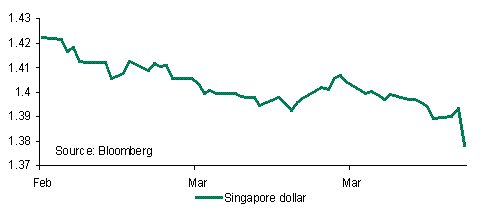
Singapore revalues, Asian currencies jump

The positive tone to risk appetite is keeping the USD on the back foot and for once FX attention has turned away from events in Greece. Before elaborating further and staying with Greece, it’s worth highlighting that the outcome of Greece’s note auction was reasonably solid, with more debt than anticipated being sold. However, the cost of borrowing for Greece rose compared to the previous auction in January, which means that the Greece will still suffer higher funding costs to roll over debt.

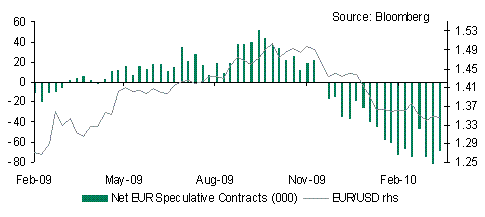
The positive reception to the debt offering was not particularly surprising given that it followed so closely after the EU/IMF loan package announcement but it is difficult to see sentiment for Greece and the EUR for that matter, getting much of a lift. The main positive for the EUR is the fact that market positioning remains very short but EUR/USD is likely to struggle to make much headway above technical resistance around 1.3653.

More interestingly Asian central banks are continuing on the track towards fighting rising inflation pressure and Asian currencies, in particular the SGD, were boosted by the Monetary Authority of Singapore (MAS) decision to revalue its currency. Singapore has moved back to a policy of a “modest and gradual appreciation” of the SGD from a policy of zero appreciation, which obviously implies openness to further FX appreciation in the weeks and months ahead.

The rationale for the decision was clear and as revealed in the strong first quarter Singapore GDP data which revealed a 13.1% annual rise. Stronger growth is fuelling growing inflationary concern and to combat this Singapore’s MAS will allow greater SGD appreciation. The reaction in other Asian currencies was also positive, with markets (quite rightly in my view) that other Asian central banks will be more tolerant of currency strength in their respective currencies.

Moreover, Singapore’s move was pre-emptive, perhaps with one eye on an imminent revaluation in China. The recent easing in tensions between the US and China has if anything increased the likelihood that China revalues its currency, the CNY, sooner rather than later, and most likely before the end of Q2 2010. Whatever the rationale, strengthening inflation pressure across the region, will mean a less FX interventionist stance in Asia, and likely stronger currencies over coming months.

Greek Aid Boosts Euro

Greece is never far from the headlines and the big news over the weekend was once again centred on this small (in terms of economy size) eurozone Country, with the agreement by Eurozone members to provide up to EUR 30 billion in loans to Greece. This will be supplemented by additional contributions from the IMF to the tune of around EUR 15 billion. The rate of around 5% for the three-year fixed loan is well below that yielding on Greek debt but above the International Monetary Fund (IMF) standard lending rate. In other words, the terms of the loan are far more favourable than they would currently face in the market.

After weeks of haggling the decision to detail the amount and terms of a loan for Greece will help reassure markets and likely result in a narrowing in Greek spreads over the near term. Further details will be finalised early in the week including conditions imposed on Greece as well as the exact amount of the IMF contribution but the real test of confidence will be the reception to Greece’s EUR 1.2 billion sale of 3 and 6-month paper at the beginning of the week.

Markets were already embarking on a short covering exercise in EUR/USD early last week according to the latest CFTC IMM report which showed a reduction in net EUR short speculative positions. As a result of the weekend’s agreement the EUR looks set to consolidate its gains into the beginning of this week. Further out, there are still plenty of risks ahead and sellers are likely to emerge around EUR/USD resistance at 1.3696.


Data releases this week will be conducive to maintaining further support for risk appetite whilst shoring up recovery expectations. In particular US March retail sales are set to jump on the back of strong autos spending (consensus 1.2% monthly gain). March industrial production is also likely to record a healthy reading (consensus 0.7% month-on-month), whilst gains in both manufacturing (Empire manufacturing and Philadelphia Fed) and consumer confidence (Michigan confidence) for April are likely.

There will also be plenty of attention on Chinese data this week with a plethora of releases over coming days including FX reserves, GDP, loans data, inflation, retail sales and industrial production. In short, the data will continue to reveal a robust economic performance, which will be good for risk appetite and Asian currencies, but will also add to the pressure to revalue the Chinese currency, CNY, soon.

The USD impact will depend on whether the market reacts to firmer risk appetite or signs of stronger US growth. I suspect the former will apply for now, likely keeping the USD on the back foot early in the week. The main beneficiaries include risk currencies such as AUD, NZD and CAD as well as most Asian currencies. AUD/USD is set to target technical resistance around 0.9407 whilst NZD/USD will set its sights on resistance around 0.7252 over the next few days.