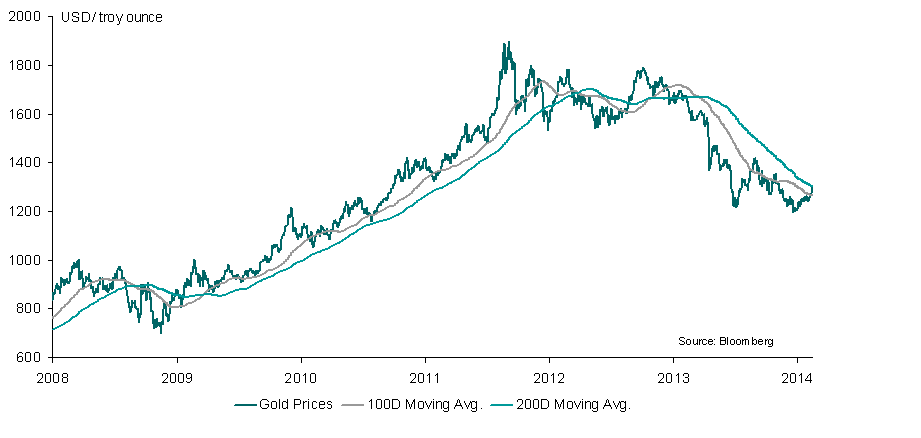
Gold breaches its 200 day moving average

AUDjobsGold prices have risen sharply since the beginning of the year, up over 8% year to date. Higher risk aversion, lower US yields and a weaker USD have boosted gold. Consequently gold prices are trading around their 200 day moving average level around 1303.70. This could prove significant, with a close above the 200 day moving average important to sustain any short term uptrend,

Encouraging signs for gold bulls
ETF investor demand appears to have stabilised over recent weeks while CTFC IMM demand appears to be picking up. This data suggests that Investors are tentatively moving back into gold. The poor performance of equity markets since the start of the year has indeed made gold look more attractive as an investment while lower yields mean that the opportunity cost of holding gold has lessened.

Chinese demand for gold increases sharply
Additionally gold demand from China has picked up strongly. China Gold Association data showed that Chinese demand for gold jumped 41% to 1,176 tonnes last year. Chinese demand likely overtook India’s last year. Oddly Chinese import and production data were even stronger, making it possible that China bolstered its reserves with gold last year.

Indian restrictions hit demand
India restricts demand for gold via import restrictions. However, there is a lot of pressure domestically to remove these restrictions and a review is scheduled to take place at the end of the fiscal year at end March 2014. If these restrictions are removed or at the least weakened, Indian gold imports could increase sharply but it seems unlikely that imports will rise as strongly as previous years.

Moreover, the Indian government will want to avoid an adverse impact on India’s current account deficit, suggesting that a complete removal of gold import restrictions is unlikely. However, in the meantime the restrictions are having a major impact on Indian gold demand which dropped sharply last year.

Gold rally to fade
Risk appetite has already improved sharply over February and while I continue to expect bouts of volatility in the weeks and months ahead I do not expect to see sustained periods of elevated risk aversion. Therefore any boost to gold from rising risk aversion is set to prove temporary in the months ahead.

Secondly global inflation pressures remain well contained. Inflation for the major economies is likely to remain benign. Only in Japan is inflation expected to pick up but this is an aim of policy and is not expected to result in a bout of gold buying to hedge against such inflation risks. Therefore, gold demand as an inflation hedge will not take place.

Two major drivers of the gold price are US bond yields and the US dollar. Both are highly correlated with gold price gyrations, with gold falling as US yields and the USD rise and vice-versa. Both yields and the USD are set to rise over the coming months. Consequently any short term gold price gains are unlikely to hold, with the metal set to resume its decline.

My Interview on Reuters / ET Now

Watch my interview on Reuters / ETNOW. Click on the link below

videoId=276730253&videoChannel=104″>http://in.reuters.com/video/2014/02/06/need-reform-oriented-government-in-india?videoId=276730253&videoChannel=104

“Mitul Kotecha, head of global markets research Asia & FX strategy at Credit Agricole CIB, is more optimistic on emerging markets than before but sees risk aversion among investors in EM equities. He tells ET NOW, investors are awaiting the election outcome and says it’s essential a reform-oriented government comes to power.”

Summers’ departs Fed race, risk assets supported

Another weaker than forecast US economic release, namely August retail sales has obscured the picture ahead of the mid week Fed FOMC meeting. Moreover, the data alongside news that one of the leading candidates to take over as Fed Chairman, Lawrence Summers, has withdrawn his candidacy has helped to undermine the USD. Summers is perceived as relatively hawkish and less in favour of quantitative easing than the other leading contender Janet Yellen.

Summer’s departure from the Fed race will help to buoy risk assets and cap US bond yields. His candidacy faced increased resistance from both sides of the political spectrum, with an “acrimonious” confirmation ahead of him. Yellen is now the clear front runner in the race although she may still face competition from former vice-chairman Donald Kohn.

Ahead of the FOMC meeting there is likely to be little directional bias for markets, with the Fed expected to announce USD 10 billion in tapering in an even split between Treasuries and mortgage backed securities. Additionally the Fed is set to strengthen its forward bias in order to soothe markets and this ought to alleviate some of the impact some of the potential pressure on risk assets from the announcement of tapering.

In Europe politics will be in focus, with Senate hearings on the Berlusconi case in Italy continuing, heightening cross party tensions and maintaining the threat of a government collapse. Meanwhile in Germany Chancellor Merkel gained some momentum ahead of national elections as her ally, the CSU took an absolute majority in Bavaria.

However, the fact that her Federal government partner the Free Domocrats failed to reach the 5% threshold to enter the Bavarian parliament, means that Merkel still faces the prospect of having to enter into a grand coalition if they record a similar performance in national elections. EUR may face some restrain given the uncertainty around political events in Europe.

In Asia currencies are likely to find further support from the news that Summer’s has pulled out of the Fed race. Already over recent weeks there was strong evidence of a resumption of equity capital inflows to the region, helping to steady many Asian currencies. If the Fed attempts to counter any pressure from tapering news with reinforced forward guidance it ought to leave Asian currencies supported in the near term.

The INR has been the outperformer so far this month and will benefit further over the short term although the Reserve Bank of India policy meeting under new governor Rajan this week will give further clues on the direction of the currency.

USD edges higher

There appears to be some prevarication over possible military strikes on Syria resulting in less angst in markets over an imminent strike. Consequently risk appetite edged higher overnight while US Treasury yields also rose. Potential military strikes have also led to firming oil prices. Pressure on vulnerable emerging market assets has continued unabated however, with tapering worries and domestic vulnerabilities resulting in ongoing capital outflows.

In Asia the INR and IDR remain under considerable pressure. However, INR forwards recovered somewhat overnight and the spot rate strengthened in the wake of the introduction of a forex swap window for Indian oil firms. The measure will help to alleviate some of the demand/supply pressures for USDs but is however, unlikely to arrest the decline in the INR for long. In Indonesia the central bank may increase policy rates by 50bps today which ought to help the IDR in the short term.

The USD gained a little ground as US yields rose. The USD may benefit as markets fret about possible military action against Syria resulting in an attendant rise in risk aversion. Nonetheless, a series of negative data surprises over recent days contrasting with positive surprises in Europe leaves the USD rather vulnerable against major currencies. In contrast the USD is set to continue to remain firm against many emerging market currencies given the ongoing outflow of capital in the wake of higher US yields and tapering fears.

AUD’s tentative recovery in early August has proven to be an abject failure. Like many other high beta currencies AUD has suffered as risk aversion has intensified recently. Additionally speculation of further policy easing has also dampened the AUD. Consequently speculative sentiment remains weak. In reality, further rate cuts may depend on whether the AUD can rally following an over 15% fall since April. Any failure for the AUD to gain ground may stay the hand of the RBA. Although it has found some support today, further downside pressure is likely with a breach of the 5 August low at 0.8848 expected.

GBP underwent some volatility in the wake of BoE governor Carney’s speech. Initial weakness was bought into as shorts were covered however, leaving the currency back where it started. Carney’s speech was interpreted as dovish, with the governor noting that the BoE was read to loosen policy if higher market rates impacted the economy. Nonetheless, there was little immediate implication for policy. Overall GBP is likely to be constrained around resistance at 1.5590, with gains limited ahead of the BoE policy meeting next week.

Respite for Asian currencies

Pressure on policymakers in developed economies to orchestrate more predictable exits from unconventional monetary policies has intensified as reflected in comments at the Jackson Hole symposium the wake of the intense volatility in emerging market assets over recent weeks. While it is unlikely that a crisis is looming there is no doubt that mixed messages and lack of clarity over exit policies is having a demonstrable impact on EM assets.

Such clarity is unlikely to come this week. However, a pull back in core bond yields from recent highs will likely contribute to a calmer tone to markets at the turn of the week and some further near retracement in a positive direction for risk assets. Whether this lasts will depend on the clarity of the message from central bankers and in this respect speeches by four Fed officials over coming days, ECB’s Weidmann today and BoE governer Carney on Wednesday, will be scrtutinized.

The data slate is not particularly heavy but looks skewed towards relatively more positive Eurozone releases. In the US a likely drop in July durable goods orders today and pull back in consumer confidence tomorrow will provide little support to US asset markets including the USD while the trend of positive data surprises in Europe including likely gains in August economic sentiment indices and German IFO will add further evidence that growth will turn positive in Q3.

In Japan labor market data will reveal relative strength, with a low unemployment rate, helping to support the consumer. Inflation is set to rise further too, suggesting that policy measures are garnering some success. However, the upward trend in inflation is by no means guaranteed and ultimately renewed aggressiveness on the JPY will be needed as inflation tops out.

How will this leave currency markets? The USD is likely to continue to fare poorly against the EUR and GBP especially given the less than impressive data releases expected this week while the JPY is likely to remain on the back foot, pressured in part by firmer risk tone.

On the Asian currency front, further short term retracement is likely, especially for those currencies that have been beat up the most, namely INR and IDR. However, gains will likely prove limited, with tapering concerns and capital outflows showing little sign of reversing. Additionally, a likely disappointing Q2 GDP release in India at the end of the week will be unhelpful for the INR.