Euro extends gains, yen pressured

The EUR found another spurt of life following the release of the stronger than expected February German IFO business confidence survey yesterday. The data helped make up for the disappointment related to the manufacturing and service sector surveys. However, while it may have alleviated concerns about weakening growth in Germany it only serves to highlight the disparities in growth across the Eurozone.

I continue to believe the EUR may struggle to sustain gains. In the near term, after breaking above 1.3320 resistance, EUR/USD will face further resistance around 1.3460. Nonetheless, my 2012 year end forecast of EUR/USD 1.26 shows that despite growing growth pressures in the Eurozone economy the EUR will still find underlying support from a healthy external balance and continued EUR buying from Asian official investors.

Over the near term upcoming votes in various countries on the second Greek bailout deal will provoke some nervousness while Greek reform implementation risks will also act to dampen EUR sentiment.

JPY has faced significant degree of pressure since the beginning of February. As noted previously one of the biggest sources of upward pressure on USD/JPY has been the widening in US – Japan 2-year bond yield differentials. US bonds currently yield around 19 basis points above Japan, the highest gap since August 2011. The widening yield gap already appears to be prompting foreign outflows from Japanese bonds, with outflows registered in six of the seven past weeks. These outflows have helped contribute to the weakness in the JPY.

The fact that the BoJ will step up its purchases of Japanese government bonds (JGBs) will also add to the downward pressure on the JPY as it will mean a further widening in US – Japanese yield differentials. Over the short term USD/JPY may face some resistance above the 80 level and I suspect that it will lose some momentum but maintain my view that it will reach 85.0 by the end of the year.
FX outlook this week

Direction in FX markets will largely hinge on developments at the beginning of the week in Europe but a US holiday (Presidents’ Day) will mean a subdued start. US data has continued to beat expectations as revealed by the recent gains in core retail sales, manufacturing surveys, jobless claims and industrial production. US recovery is taking shape and the USD is finally showing some signs of perking up on the news.

Rising US bond yields have provided the USD with some support although the impact has been muted by higher bond yields elsewhere. Nonetheless, despite ongoing speculation of more Fed quantitative easing the USD looks set to be on a slightly firmer footing over coming days. In a relatively light week of data releases housing data will be the major focus of attention.

Assuming approval for a second Greek bailout goes ahead (after much procrastination) the week will at least begin on a positive note for the EUR. Whether the EUR will extend gains will partly be determined by the release of flash February purchasing managers’ indices (PMI) and the German IFO business confidence survey. Our forecasts of weak service sector readings but firm manufacturing indices will be a mixed blessing for the EUR but overall data will remain consistent with mild recession.

Failure of EUR/USD to sustain a move below the psychologically important 1.30 level suggests a bit more resilience over coming days. Nonetheless, speculation of a Greek euro exit will not fade quickly and markets will likely gyrate between ‘risk on’ and ‘risk off’ depending on the latest comments from Greek or European officials. All in all, the EUR will continue to struggle to move higher.

For a change one of the bigger movers in currency markets over recent days has been the JPY. Its decline following more aggressive monetary policy action by the Bank of Japan has extended further. The move by the BoJ helped to suppress Japanese government bond yields (JGBs) allowing USD/JPY to move higher in line with relatively higher US yields. This week’s release of January trade data will support the case for more JPY weakness given the deteriorating trend.

The data will also strengthen the resolve of the Japanese authorities to intervene in FX markets should the JPY strengthen anew. Immediate focus will be whether USD/JPY can break through the psychologically important 80 level where JPY weakness will be met by plenty of exporters offloading USDs. I suspect the upside momentum in USD/JPY will fade over coming days unless US bond yields continue their ascent.

Euro and yen downside risks

The lack of progress on a second bailout for Greece will keep markets nervous, leaving risk assets vulnerable to further slippage. The USD will be a beneficiary in this environment. Weak Eurozone GDP data for Q4 2011 released today will contrast with relatively firm data including industrial production and the Empire manufacturing survey in the US, leaving the story of US economic outperformance intact.

EUR has lost steam and looks vulnerable to a further correction lower. The fact that EU finance ministers have cancelled a meeting due to be held today means that markets will have to prolong their wait for an agreement on a second bailout package for Greece.

News that Greece’s political leaders will send a commitment to European officials today that they will implement further austerity measures will give some reassurance that things are moving in the right direction but a looming deadline for debt redemption in March will mean heightened nervousness.

Admittedly the market is still short EUR but positioning has moved close to its 3-month average suggesting a less potential for aggressive short covering. Following the downgrade of ratings of several Eurozone countries yesterday and a likely drop in Q4 2011 Eurozone GDP today, caution will be the prevalent theme today, leaving EUR/USD on the back foot and opening the door for a test of technical support around 1.3026.

The Bank of Japan’s decision to increase its asset purchase program and set an inflation goal had an immediate negative impact on the JPY. A sharp drop in GDP growth in Q4 last year, persistent deflation pressures and more aggressive action from other central banks pushed the BoJ into action.

Will there be any follow through on the JPY? USD/JPY had already been under some upward pressure in the wake of the widening in US bond yields versus Japan. The move by the BoJ will result in even more of a widening in yield differentials especially given that the BoJ actions means there will be an increase in official purchases of Japanese government bonds, helping to suppress JGB yields.

In the near term USD/JPY has broken above its 200 day moving average level, paving the way for a test of the 31 October 2011 high around 79.55. Further out, our bond forecasts show that both US and Eurozone 2-year bond yields will increase relative to Japanese yields over the coming months, supporting our forecasts of USD and EUR appreciation versus JPY.

Euro pricing in a lot of good news

Markets remain in limbo ahead of a potential Greek debt deal although US equities managed to eek out small gains overnight. Stocks in the US have entered a bull market helped by the dovish stance of major central banks.

The Federal Reserve’s commitment to maintain accommodative policy until the end of 2014 and the European Central Bank’s (ECB)3 year LTRO have been drivers of the rally in risk assets. The BoE will contribute to the easy stance of central banks, with an increase in UK quantitative easing set to be announced today. The ECB in contrast is set to remain in status quo.

Will it be a buy on rumour, sell on fact reaction for the EUR to a Greek debt deal? Over recent days anticipation has grown that a deal on debt writedowns and in turn a second bailout package will emerge soon. This has helped to propel EUR/USD higher, with the currency hitting a high of 1.3289 overnight.

So far a deal has been lacking but leaders are expected to approve a draft agreement on fresh austerity measures between the main Greek political parties today. This should pave the way a deal on debt restructuring and a new loan package for the country due to be discussed today between Eurozone finance officials.

However, the EUR has already priced in a lot of good news on this front and even agreements on the issues above may not see the currency push much higher, with strong resistance around EUR/USD 1.3388. Separately today’s ECB meeting is unlikely to provide much direction for the EUR, with the Bank set to maintain current policy settings.

USD/JPY has managed a recovery of sorts but still remains in the middle of multi month 75.5-78.5 range. Nonetheless, the momentum over the short term will continue to be for USD/JPY upside, with resistance around 77.49 targeted. News that the Japanese authorities conducted ‘stealth intervention’ to weaken the JPY in late October/early November will have emboldened JPY bears.

However, at the same time they should also be worried as it is clear that even after all the intervention the JPY remains overly strong. Reflecting this is the fact that speculative and margin trading JPY positioning is at a very high level.

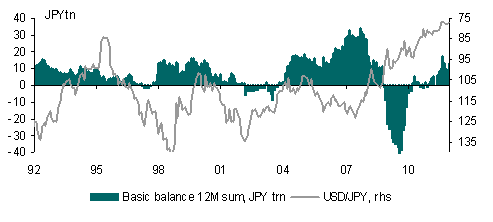
Moreover, while much has been made of the deterioration in Japan’s current account balance over recent months and the potentially negative impact on the JPY it should be noted that Japan’s basic balance (sum of direct investment + current account + portfolio flows) position remains healthy (for now) and is acting as an obstacle to JPY weakness.

EUR slips, Yen gains

There has been good and bad news in Europe, with leaders’ rubber stamping the permanent bailout mechanism (ESM) and 25 out of 27 EU countries agreeing on the fiscal discipline treaty. Finally, EU leaders agreed that it was not all about austerity, with growth orientated policies as yet undefined, also required.

The bad news is that there has still been no final agreement on Greek debt restructuring and in turn a second Greek aid package said to total around EUR 130 billion while Portugal is increasingly moving into focus as the next casualty. Unsurprisingly the EUR has lost steam so far this week but markets remain short and any downside looks limited at technical support around 1.3077.

A cautious tone will prevail today, with risk assets likely to remain under mild pressure. Developments in Greece and the Eurozone will continue to garner most attention although US data in the form of the January Chicago PMI manufacturing survey and consumer confidence data will also be in focus.

Both surveys will reveal further improvement in confidence as the US economy continues to show signs of gradual recovery. This was supported overnight by a relatively positive Federal Loan Officers survey which revealed an increase in demand for business loans at banks in Q4 2011. Although the USD has been somewhat restrained by a dovish Fed stance the risk off tone to markets will likely bode well for the currency over the short term.

JPY is benefiting from the risk off market tone despite comments by Japanese Finance Minister Azumi who warned about action being taken to combat JPY strength. The JPY has benefited from the Fed’s dovish tone last week which has weighed on US bond yields relative to Japan. While FX intervention risks have increased, officials will remain wary given the underlying upward pressure on the JPY. The near term risk is for USD/JPY to retest the 2011 low around 75.38.