Will the ECB intervene to support the Euro? (Part 1)

The EUR has lost around 23% since it all time high in April 2008 when it traded close to 1.6000. The EUR failed to rally even in the wake of the EUR 750 billion European Union / International Monetary Fund support package, a fact that has highlighted the weight of negative sentiment towards the currency. The latest blow to the currency came from the announcement of unilateral measures from Germany to ban naked short selling on sovereign debt and some financial stocks, actions that only highlighted the lack of policy co-ordination within the eurozone.

The rationale for further EUR/USD weakness is clear and justified partly by growth divergence within the eurozone countries, with Germany on the one extreme and weaker Southern European countries on the other. Moreover, relatively weaker overall growth in the eurozone compared to the US economy, a delay in interest rate hikes by the European Central Bank (ECB) and ongoing concerns about implementation and execution of deficit cutting plans, will also weigh on the EUR.

The EU/IMF support package and in particular ECB interventions in the Eurozone bond market have managed to alleviate some of the strain on European bond markets, but without similar intervention in the FX markets the EUR has become the release valve for Europe’s fiscal and debt problems. As a result the EUR’s fall has accelerated over recent weeks, only showing any sign of stability as fears of currency intervention increased.

The quickening pace of EUR depreciation has led to growing speculation of FX intervention by the ECB and other central banks to support the currency. I believe intervention is highly unlikely and see little reason for panic about the drop in the EUR. Once markets realise that there is indeed little risk of intervention the EUR will resume its downtrend.

One of the main reasons behind this view is that the EUR is not particularly “cheap” at current levels. In fact, “fair value” estimates based on the OECD measure of purchasing power parity (PPP) suggest that EUR/USD is around 5.6% overvalued at current levels, based on an implied PPP rate of around 1.17. Therefore, the drop in the EUR over recent months has only brought it back close to PPP fair value estimates.

Moreover despite the fact that there has been a large nominal depreciation of the EUR its trade weighted exchange rate has declined by much less, around 8.5% since the beginning of the year and around 11.3% since its high in October 2009. Although the trade weighted EUR is around its lowest level since October 2008, taking a longer term view shows that it is slightly above its average over the past 20-years.
Shock and Awe

The Greek crisis spread further last week, not only to Portugal and Spain, but in addition to battering global equity markets, contagion spread to bank credit spreads, OIS-libor and emerging market debt. In response, European Union finance ministers have rushed to “shock and awe” the markets by formulating a “crisis mechanism” package with the International Monetary Fund (IMF). The package includes loan guarantees and credits worth as much as EUR 750 billion. The support package can be added to the EUR 110 billion loan package announced last week.

In addition, the US Federal Reserve (Fed) announced the authorisation of temporary currency swaps through January 2011 between the Fed, European Central Bank (ECB), Bank of Canada (BoC), Bank of England (BoE) and Swiss National Bank (SNB) in order to combat in the “the re-emergence of strains” in European markets. Separately, the ECB will conduct sterilised interventions in public and private debt markets, a measure that was hoped would be announced at the ECB meeting last week, but better late than never. The ECB did not however, announce direct measures to support the EUR.

The significance of these measures should not be underestimated and they will go a long way to reducing money market tensions and helping the EUR over the short-term. Indeed, recent history shows us that the swap mechanisms work well. The size of the package also reduced default and restructuring risks for European sovereigns. However, the risk is that it amounts to a “get out of jail free card” for European governments. A pertinent question is whether the “crisis mechanism” will keep the pressure on governments to undertake deficit cutting measures.

The Greek crisis has gone to the heart of the euro project and on its own the package will be insufficient to turn confidence around over the medium term. In order to have a lasting impact on confidence there needs to be proof of budget consolidation and increasing structural reforms. Positive signs that the former is being carried out will help but as seen by rising public opposition in Greece, it will not be without difficulties whilst structural reforms will take much longer to implement. Confidence in the eurozone project has been shattered over recent months and picking up the pieces will not be an easy process.

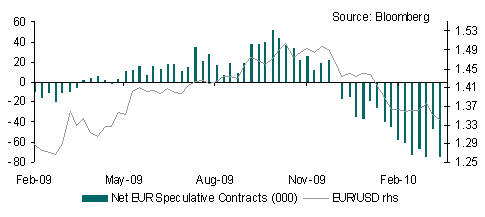
Some calm to markets early in the week will likely see the USD lose ground. There was a huge build up of net USD long positioning over the last week as reflected in the CFTC IMM data, suggesting plenty of scope for profit taking and/or offloading of USD long positions. In contrast, EUR positioning fell substantially to yet another record low. Some short EUR covering is likely in the wake of the new EU package, but EUR/USD 1.2996 will offer tough technical resistance followed by 1.3114.

The EU/IMF aid package will help to provide a strong backstop for EUR/USD but unless the underlying issues that led to the crisis are resolved, EUR/USD is destined to drop further. Perhaps there will be some disappointment for the EUR due to the fact that the package of support measures involves no FX intervention. This could even limit EUR upside given that there was speculation that “defending the EUR” meant physically defending the currency. In the event the move in implied FX volatility over the last week did not warrant this.

Q1 Economic Review: Elections, Recovery and Underemployment

I was recently interview by Sital Ruparelia for his website dedicated to “Career & Talent Management Solutions“, on my views on Q1 Economic Review: Elections, Recovery and Underemployment.

Sital is a regular guest on BBC Radio offering career advice and job search tips to listeners. Being a regular contributor and specialist for several leading on line resources including eFinancial Careers and Career Hub (voted number 1 blog by ‘HR World’), Sital’s career advice has also been featured in BusinessWeek online.

As you’ll see from the transcript of the interview below, I’m still cautiously optimistic about the prospects for 2010 and predicts a slow drawn out recovery with plenty of hiccups along the way.

Sital: Mitul, when we spoke in December to look at your predictions for 2010, you were cautiously optimistic about economic recovery in 2010. What’s your take on things after the first quarter?

Click here to read the rest…

FX / Economic Preview

The European Union (EU) aid package for Greece and extension of collateral requirements by the European Central Bank (ECB) helped return a semblance of confidence to markets. Although the probability of a Greek default now looks extremely small, further austerity measures, fiscal issues in other EU countries and the negative impact on growth that all of this implies, suggest that Europe will be plagued by various problems for some time yet.

As a result of more favourable market conditions Greece is set to launch a syndicated bond issues today or tomorrow of up EUR 5 billion according to press reports. Attention will also turn to Greek debt rollovers, beginning with EUR 8.2 billion on April 20.

Improving sentiment following the Greece deal has extended to the EUR, with the currency bouncing off its lows around 1.3267. EUR/USD will now look to break through resistance around 1.3446, which would set up a test of 1.3516. There is plenty of scope for short-covering to help the EUR as reflected in the latest IMM Commitment of Traders’ report (a gauge of speculative market positioning) which revealed net EUR positions reaching yet another record low in the week to 23rd March. Whilst sovereign/official buying interest may keep EUR/USD supported this week the currency pair is best played as a sell on rallies.

A similar assessment applies for GBP. Speculative sentiment for the currency also hit a record low in the latest week but unlike the Greek deal helping the EUR, last week’s UK budget has done little to boost GBP’s prospects. Moreover, a report in the Financial Times highlighting hedge funds bets against GBP, suggests that there are still plenty of headwinds against the currency.

Volumes are set to thin out this week ahead of upcoming holidays, whilst the US March jobs report at the end of the week will likely prevent moves out of current ranges ahead of its release. The consensus forecast is for a 190k increase in non-farm payrolls though much of this is likely to reflect hiring for the 2010 US consensus and a rebound from adverse weather effects in February.

In Europe March economic confidence surveys will be watched closely to determine how much damage Greece and general fiscal woes are having on sentiment. Some improvement, in line with the Eurozone Purchasing Managers Index (PMI) and the German IFO business confidence survey, is expected, which will help to give further, albeit limited relief to the EUR.

The Japanese data slate kicked off the week in good form, with the release of February retail sales data, revealing its biggest annual increase in 12-years. It is difficult to see the recovery in sales taking much greater hold given persistent deflation pressures however, and part of the gain probably reflects the government’s shopping incentive program.

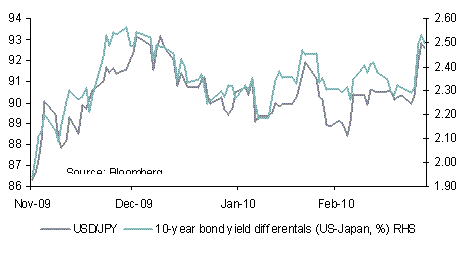
Aside from industrial production and jobs data in Japan the key release will be the results of the Q1 Tankan survey on Wednesday. The survey of manufacturers’ confidence is set to show further improvement. USD/JPY is likely to remain supported around 91.67 but will need a further widening in US/Japan 10-year bond yield spreads to push higher.

US Dollar Back On Top As Yields Rise

Two issues are driving markets and both are playing negatively for sentiment; the rise in G7 bond yields and the outcome of the EU summit. At a time when G7 bond yields have been pushing higher the poor response to the US $32 billion 7-year note sale contributed to a further increase in yield. The sale resulted in a yield of 3.374%, which was higher than expected, and a bid/cover ratio of 2.61. A combination of large US Treasury supply, medium term funding issues and signs of improving growth suggest no let up for US Treasuries.

The most reactive currency to yield differentials is currently USD/JPY. The 1-month correlation between USD/JPY and US/Japan bond yield differentials is a high 0.85. The spike in US 10-year Treasury yields especially relative to JGB yields (by around 21 basis points this week) is the main contributor to the jump in USD/JPY over recent days. Given the bearish outlook for US bonds in the near term, it suggests more upside for USD/JPY but also increasingly for other currencies against the USD as the importance of yield increases. Immediate USD/JPY technical resistance is seen around 93.21, with support at 91.87.

The other event of note yesterday was developments surrounding Greece in the European Union summit though in truth it was probably the strong comments by ECB President Trichet that had the bigger impact on EUR sentiment. The final EU communiqué noted the readiness for bilateral loans to Greece and substantial International Monetary Fund (IMF) financing in a Greek aid mechanism. Importantly and a likely sop to Germany, any aid will not contain a subsidy for Greece. Aid by the EU and IMF will only be provided in the event of “very serious difficulties”.

The EU agreement means that no money will be forthcoming immediately, but at least there will be a back stop should Greece have financing difficulties over coming weeks, which will act as an important safety net ahead of substantial Greek debt rollovers. This news was supplemented by the fact that ECB will not raise its minimum collateral requirements at the end of the year, which means that Greek debt will not be excluded in the event of a ratings downgrade. This is good news for Greece.

The combination of the fact that Greece will have to borrow money only at market rates, ongoing worries about other EU countries fiscal problems and European Central Bank (ECB) President Trichet putting somewhat of a dampener on sentiment by criticizing IMF involvement in the deal, will keep the EUR under pressure. Although Trichet later reversed his comments, the damage was already done and any relief to EUR/USD will be short-lived. The currency pair is increasingly poised for a further downside move, with the next target at 1.3213 on the path towards an eventual test of 1.3000.