What to watch this week

Despite a slow start to the week there are plenty of events and data this week for markets to chew on for further direction including in the US the February Empire and Philly Fed manufacturing surveys, January housing starts and existing home sales, as well as CPI and PPI inflation and FOMC meeting minutes. Overall the data will look relatively unimpressive, with softer manufacturing confidence, weaker housing data and benign inflation readings likely.

In the Eurozone, the flash purchasing managers’ indices will capture most attention. A slight softening is expected but this will not alter the picture of gradual recovery in the Eurozone economy. Indeed, last week’s better than expected Eurozone GDP release revealing broad based growth of 0.3% in Q4 highlighted the positive recovery path, in turn maintaining positive sentiment for the EUR.

On the policy front the Bank of Japan decides on policy tomorrow but no change is expected despite a disappointing Q4 GDP release this morning, which revealed that growth came in at a paltry 0.3% QoQ compared to 0.7% expected. Nonetheless, the weaker GDP data highlights that the BoJ and government has a big job to do in the months ahead especially given the risks to growth from the upcoming consumption tax hike. USD/JPY may find some support if the data translates into expectations of more aggressive BoJ action.

Posted in eurozone, Japan, US. Tags: , , . Leave a Comment »

USD/JPY bracing for a rebound

In the post below I look at the arguments for JPY weakness in the weeks and months ahead.

A combination of elevated risk aversion and a narrowing US / Japan yield differential have been the major contributors to the strengthening in the JPY over January resulting in safe haven JPY demand and repatriation flows. The sensitivity of the JPY to both factors has been especially strong and it will require a reversal of one if not both of these to spur another wave of JPY selling.

Improving risk appetite required
If there is not a metamorphosis of the current bout of pressure into a full blown crisis as seems likely, risk appetite will improve and the upward pressure on the JPY will abate. Any improvement in risk appetite will however, be gradual and prone to volatility, especially in an environment of Fed tapering. It may therefore require more than simply improving risk appetite to weaken the JPY anew.

Japanese equity performance will be eyed
Of course associated with any improvement in risk appetite has to be a reversal of the recent negative performance of Japanese equities. Although Japanese equities will continue to be hostage to the fortunes of global risk sentiment, assuming that “Abenomics” continues to deliver results and growth in Japan continues to pick up (our forecast this year is 2% YoY GDP growth) further fallout in the Japanese equity market may be limited.

Flows will need to reverse
Over the past several weeks Japan has registered net inflows of capital in large part due to repatriation by Japanese investors. JPY has faced upward pressure from such inflows over recent weeks. Looking ahead assuming that risk appetite improves and US yields increase net capital outflows are expected to resume, which will put further downward pressure on the JPY.

Yield differentials will be particularly important
The extra dose of JPY pressure and important determinant of renewed weakness will be a re-widening of the US / Japan real yield differential. Eventually US bond yields will resume their ascent, driving the yield differential with Japan wider, and putting upward pressure on USD/JPY. The same argument will apply for EUR/JPY, albeit to a lesser degree.

Speculation positioning more balanced
The recent short covering rally has likely resulted in a market more evenly balanced in terms of positioning, providing a solid footing for the next leg lower in JPY. Indeed, compared to the three month average, JPY positioning has bounced back and is susceptible to a rebuilding of JPY shorts over coming weeks, driving the JPY lower.

Model points to renewed JPY weakness
Combining the factors above (except positioning) and adding in forecasts for US bond yields, risk aversion and conservative estimates for a recovery in Japanese equity markets over coming months, my quantitative model for USD/JPY highlights the prospects of a major rebound in the currency pair.

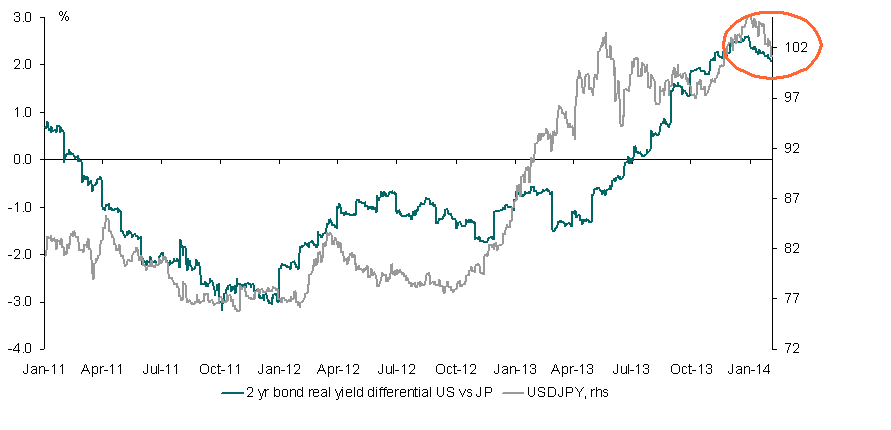
Japanese yen firms as US yields drop

USDJPYyielddiff

Safe haven currencies in particular the JPY and CHF remain well supported, with the former resting on its 100 day moving average around 101.10 versus USD. USD/JPY is set to remain under downward pressure but will face some difficulty in sustaining a move below 101.10 unless US bond yields slip further narrowing the US yield differential with Japan; the yield differential between 10 year US Treasuries and 10 year Japanese JGB yields has already dropped by around 89 basis points since the start of the year.

The drop in Japanese equities has also corresponded to upward pressure on the JPY, with the Nikkei among the worst performing stock markets so far this year. The prospect of further equity weakness suggests that JPY will not resume a weaker trend anytime soon.

Posted in Japan. Tags: , . Leave a Comment »

Risk assets under growing pressure

The growing turmoil in emerging markets is inflicting damage on risk assets across the board and no let up is expected in the near term. Even the rally in US Treasuries has failed to provide any relief to risk assets given the weight of negative sentient. Whether triggered by concerns about a slowing in Chinese growth, Argentina’s letting go of its currency support, and/or political tensions elsewhere such as in Thailand and Ukraine or a combination of all of these, the picture looks increasingly volatile.

Additionally, earnings and valuation concerns are acting to restrain equity markets. Finally, lurking in the background as another weight on asset markets is Fed tapering, with a further USD 10 billion reduction in asset purchases expected to be announced by the Fed this week (Wednesday). The combination of the above spells more bad news in the days ahead, with risk assets set to remain under pressure this week.

Amid the growing gloom in global markets there are still some key data releases and events that will garner some attention this week. In the US as noted the Fed FOMC meeting is the main event, but December new home sales today, January consumer confidence tomorrow and Q4 GDP on Thursday will also be important. However, the former two releases are set to record declines implying a mixed slate of US releases this week.

In Europe, coming off the back of some encouraging flash purchasing managers’ indices the January German IFO business climate index will record its third consecutive gain, while Spanish GDP is set to record its second consecutive quarterly gain. A slight rebound in January inflation is unlikely to stand in the way of a further reinforcement of forward guidance by the European Central Bank.

In Japan Trade data reported today revealed an 18th straight month of deficit while inflation data will reveal that the Bank of Japan still has a lot of work to do to reach its 2% inflation target implying that there will be some discomfort with the recent rebound in the JPY. Finally, expect no change from the RBNZ at its policy meeting on Wednesday, which will leave the NZD under further pressure.

JPY and EUR find support

Rising risk aversion is supporting the JPY but the currency may also be finding some support from the misplaced view that the Bank of Japan may not need to be any more aggressive in its policy stance to reach its 2% inflation target, with Japan’s finance minister noting that deflationary conditions have almost ended. Such talk looks premature.

Japan still has a long way to go to reach and sustain inflation at its target. The risk is that without any structural reforms (jobs market, manufacturing sector, immigration) deflation and slower growth could quite easily take hold again. In any case, the Bank of Japan is likely to embark on more aggressive policy in the months ahead in order to achieve the 2% target. In the near term USD/JPY looks supported around 102.50.

The EUR found some additional support from a strengthening in manufacturing confidence in the region, which highlighted that economic recovery continues to take shape. Fitch’s affirmation of Germany’s credit ratings at AAA has also helped sentiment towards the currency.

In the near term much of the same tone is likely although the relatively stronger US economic performance and tapering expectations will mean the USD will not fall too far. EUR/USD will face technical resistance around its 2014 high at 1.3776.