World Cup FX Positioning/Data Highlights

The market tone felt decidedly better over the course of the last week although it was difficult to tell if this was due to position squaring ahead of the World Cup football or a genuine improvement in sentiment. There was no particular event or data release that acted as a catalyst either, with the European Central Bank (ECB) and Bank of England (BoE) meetings passing with little fanfare.

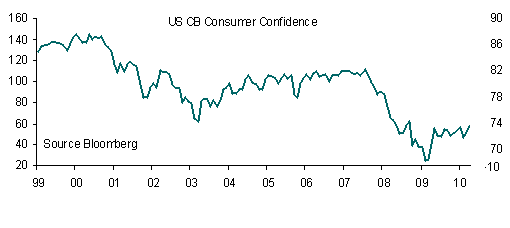
US data ended the week mixed, with retail sales disappointing in May but in contrast June consumer confidence beating expectations. Although questions about the pace of recovery remain, other data such as the Fed’s Beige Book suggest that recovery remains on track, sentiment echoed, albeit cautiously by Fed Chairman Bernanke last week.

Attention this week will centre on inflation data. Expected benign CPI readings will support the view that the Fed will take its time to raise interest rates. Speeches by the Fed’s Bullard, Plosser and Bernanke this week will be eyed for further clues on Fed thinking.

Central banks in Brazil and New Zealand hiked rates last week but this is not likely to be echoed this week. No change is likely from both the Bank of Japan and Swiss National Bank although there will be plenty of attention on the SNB’s comments on the CHF following recent data showing a surge in FX reserves due to currency intervention. The BoJ is unlikely to announce anything new but perhaps some further detail on the loan support plan could be forthcoming.

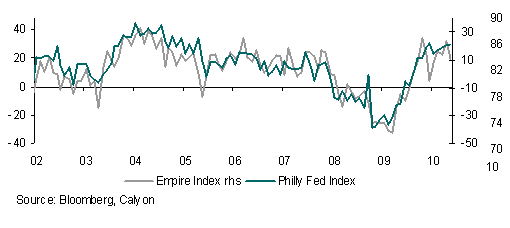
Manufacturing data will also garner some attention, with the US June Empire and Philly Fed surveys and May industrial production on tap. All three reports will confirm the improving trend in manufacturing activity in the US. Housing data will look weaker, with starts set to pull back in starts in May following the expiry of government tax incentive programmes though permits are set to rise.
In Europe, the June German ZEW (econ sentiment) investor sentiment survey will likely slip slightly due to ongoing fiscal/debt worries but this will be countered by stronger domestic data. In any case the index remains at a high level and a slight drop is unlikely to derail markets.

GBP may find some support form upgrade of UK growth forecasts by the CBI to 1.3% for 2010 and relatively hawkish comments from the BoE’s Sentance in the weekend press warning that inflation is higher than expected, indicating that the Bank may need to hike rates sooner than expected.

Further GBP/USD direction will come from CPI and retail sales data this week as well as public borrowing figures and a report by the new Office of Budget Responsibility on the UK’s fiscal position ahead of the June 22 budget. A break above GBP/USD resistance around 1.4760 is unlikely to materialise.

Despite the many data releases this week, the overall tone is likely to be one of consolidation and reduced volatility in the days ahead. This may allow EUR/USD to gain some ground due to short covering, with the CFTC commitment of traders (IMM) report revealing a further increase in net short speculative positions last week, close to the record set a few weeks back, though we suspect that there will be strong resistance around 1.2227.
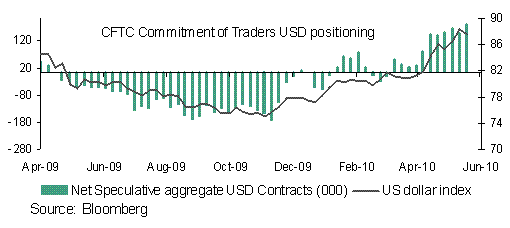
The fact that the IMM data revealed that net aggregate net USD long positions reached an all time high last week, highlights the potential for profit taking this week. USD/JPY will look to take out resistance around 92.55 but this looks unlikely unless the BoJ dishes up anything particularly dovish from its meeting.
The Pain Of A Stronger Swiss Franc

Volatility and increasingly large market swings are characterizing current market conditions. A warning by Fitch on the UK’s “formidable” fiscal challenge, concerns about Bulgaria’s public finance statistics and a massive public sector strike in Spain, combined to fuel another bout of risk aversion.

Hungary’s government attempted to diffuse worries about its finances, with the country’s Prime Minister listing measures including cutting public pay and prohibiting mortgages denominated in foreign currencies, in order to hit the 3.8% of GDP budget deficit target. There was also some good news in the US, with small business confidence (NFIB) rising to its highest level since September 2008 whilst ABC consumer confidence edged higher.

The US Beige Book and Fed Chairman Bernanke’s testimony on the US economy to Congress, mark the highlights today. The Beige Book is set to reveal further signs of economic recovery but with limited inflation pressures. Bernanke is likely to maintain a similar tone to comments he made yesterday, highlighting a “moderate” economic recovery, with unemployment likely to stay “high for a while”. His testimony will be scrutinized for the timing of rate hikes, and any elaboration on his comments about rates rising before the economy is at full employment.

Against the background of the many and varied uncertainties still afflicting markets maintain a sell on rallies view on risk trades is still the best option. EUR/USD will struggle to breach resistance around 1.2010 and remains susceptible to test support around 1.1826. GBP/USD could target fresh lows in a “negative reversal”, with potential to head back down to 1.3996.

Confidence has plummeted to extreme lows and it will be several months before appetite for risk trades returns. The AUD and NZD as well as many Asian currencies will struggle over the interim period before their appreciation trend finally resumes.

In contrast to the weakening of risk currencies, CHF strength is showing little sign of letting up. Switzerland recorded a massive 50% jump in FX reserves in May to CHF 232 billion from CHF 153 billion in April. This is not usually market moving data but the scale of the jump in reserves is huge and it is not just due to valuation changes. The Swiss National Bank (SNB’s) effective abandonment of defending a particular level in EUR/CHF turned into more a smoothing operation but this did not stop the bank from massive FX interventions. Despite the interventions EUR/CHF dropped by 0.8% over the month.

Aside from alleviating upward pressure on the CHF the interventions had an indirect effect of reducing the pain of holders of CHF mortgages. E.g. around 30% of Hungary’s bank loans and 60% of mortgages are denominated in CHF but countries across Europe have plenty of CHF denominated loans, especially Austria. Although Hungary announced steps to meet its deficit targets its woes are far from over.

The CHF has appreciated by around 3% since the beginning of May versus HUF, exacerbating the pain for CHF borrowers in the country. The fact that CHF strength shows no sign of letting up on the back of strong data and safe haven flows, the pain for these borrowers will only add to the problems for banks and borrowers alike in Europe.

Euro Has That Sinking Feeling

The reaction to the US May jobs report shows that markets are particularly susceptible to negative US news at a time when growth fragilities in Europe are becoming increasingly apparent. Coupled with worries about Hungary, risk aversion has jumped.

Unsurprisingly the EUR took the brunt of pressure. Rhetoric over the weekend may help to assuage some fears but I suspect it is too late now that the cat is out of the bag. Hungary’s government maintained that it will meet this year’s budget deficit target of 3.8% of GDP. European Union officials also attempted to calm market concerns, downplaying any comparison of Hungary to Greece.

The overall EUR/USD downtrend remains intact. Renewed doubts about German participation in the EU/IMF rescue package, with the German constitutional court potentially blocking its contribution, will add to pressure as well as a UK press report titled EUR ‘will be dead in five years’ . The January 1999 EUR/USD introduction level around 1.1830 has now moved squarely into sight.

It is unlikely that data and events this week will do much to reverse the market’s bearish tone. Highlights include the ECB, BoE and RBNZ meetings in Europe, UK and New Zealand, respectively. The ECB (Thursday) is highly unlikely to shift its monetary policy stance. Given some opposition to bond purchases from within the ECB council the comments in the accompanying statement will be closely monitored. The BoE will also leave policy unchanged on the same day but the RBNZ is set to begin its hiking cycle with a 25bps move.

On the data front the US slate includes the Fed’s Beige Book, April trade data, May retail sales and June Michigan confidence. The Beige Book is likely to reveal some improvement in activity with little sign of inflation, whilst the trade deficit is set to widen further due to a higher oil import bill. Retail sales will reveal an autos led increase in the headline reading but more subdued core sales, whilst consumer confidence is set to rise for a second straight month.

There will be more attention on rhetoric from EU officials rather than eurozone data, with the Eurogroup of Finance Minister’s and Ecofin meetings garnering more interest. In Japan, politics will take centre stage, with the new cabinet line up in focus following the confirmation of Naoto Kan as Prime Minister. Comments by the new PM himself will be of interest, especially with regard to combating deflation and in particular any elaboration on his penchant for a weaker JPY.

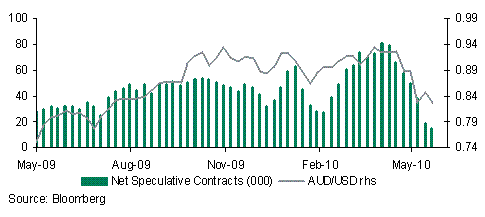
All-in-all, the week is unlikely to see a let up in pressure on risk trades and will start much as the last week ended. Although the market’s attention is on the EUR, it should be noted that the AUD has lost even more ground so far this month although the EUR remains the biggest loser in terms of major currencies so far this year (vs USD). In the case of the AUD the move reflects a massive unwinding of long positioning (as reflected in the latest CFTC IMM data which shows that speculative AUD positioning has dropped to its lowest since March 2009).

In contrast in the case of the EUR where positioning is already very negative, the move simply reflects deteriorating fundamentals. The fact that European officials are showing little concern about the decline in the EUR (why should they given that the currency is now trading around fair value) and in some cases encouraging it, suggests that there is little to stop EUR/USD from dropping much further and parity is looming a lot closer.

Renewed concerns

Despite some positive US data, with both the May ISM manufacturing index and April construction spending coming in stronger than forecast, market sentiment soured. The relative calm that was exhibited at the end of May is giving way to renewed fears as equity markets weaken, volatility increases and risk aversion intensifies. Risk trades are set to remain on the back foot, with the EUR likely to remain the weakest link. After testing support close to 1.2110 EUR/USD bounced but remains vulnerable to a fresh test of this level in the short-term.

A combination of concerns including rumours of ratings downgrades, with France the new target, Middle East tensions, weaker Chinese manufacturing activity and worries about increasing bank writedowns in Europe, have conspired to drag markets lower. The failure to stem the hue oil-leak in the US contributed to the malaise as the US government announced a criminal probe.

For the most part, data releases were unhelpful to risk appetite as the majority of global purchasing managers indices (PMIs) slipped in May, led by China. Only a few increased, including India and notably Ireland, whilst the Spanish and Greek PMIs fell. Although the US ISM index slipped the components looked positive, especially the employment component which moved higher, suggesting some upside potential for Friday’s May payrolls data for which we look for a 500k increase.

A picture of divergence appears to be growing in the eurozone, which will act as another source of pressure on the EUR. Germany’s outperformance is widening as reflected by the fact the German unemployment dropped to 7.7% in May in contrast to a rise in eurozone unemployment, to 10.1%. Moreover, Germany was the only country where its PMI was actually revised higher relative to the flash reading. There are also growing divisions within the European Central Bank (ECB), in particular towards the purchase of government bonds, with German ECB members particularly critical.

What To Watch This Week

The end of last week proved to be a calmer affair than the preceding few days. There was some encouraging news on the Greek front, with Germany finally approving its share of the European Union (EU) aid package whilst Greece appeared to be on track with its budget deficit reduction as the country recorded a cash deficit of EUR 6.3billion in the first four months of the year, a 42% reduction compared to a year earlier. EU officials also agreed on tougher sanctions for countries breaching austerity rules.

There were plenty of negatives to offset the good news however, as European business surveys including the German IFO index and flash eurozone purchasing managers indices (PMIs) revealed some loss of momentum in growth as well as increased divergence. European banking sector concerns intensified as the Bank of Spain was forced to take control of CajaSur, a small savings bank holding 0.6% of total Spanish banking assets, which faced difficulties due to distressed real estate exposure. Its woes highlighted the problems faced by many Spanish savings banks due to property market exposure.

US data releases this week will confirm that economic recovery gathered steam in Q2. May consumer confidence data is likely to record a small gain, due in large part to improving job market conditions, whilst the Chicago PMI is set to retrace slightly in May, albeit from a healthy level. Both new and existing home sales are set to record gains in April, the former following a sizeable gain in March although the drop in house prices likely to be revealed by the Case-Shiller index will continue to fuel doubts about the veracity of the turnaround in the US housing market.

In Europe there is not much in terms of first tier releases and highlights include sentiment data such as German Gfk and French consumer confidence indices, and the May French business confidence indicator. The data are likely to be mixed, and as indicated by last week’s surveys will reflect a relatively healthy Q2 2010, but a worsening outlook for the second half of the year.

In the absence of UK data today there will be plenty of attention on the details of plans by Chancellor Osborne to cut GBP 6 billion from the budget deficit. The measures will be small change ahead of the emergency budget package on June 22nd when much bigger cuts are expected. Nonetheless, the first step today will be a crucial test of the new government’s ability to convince ratings agencies and markets that it is serious about reducing the burgeoning fiscal deficit.

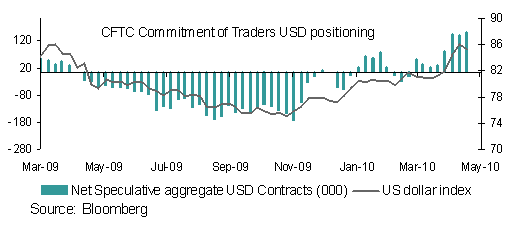
Following the massive positioning adjustments of the last week markets will look somewhat calmer over coming days but risk aversion is likely to remain elevated, suggesting little respite for most currencies against the USD. The recent moves have left net aggregate USD positioning registering an all time high according to the CFTC Commitment of Traders data, in the latest week, but after the slight retracement lower in the USD index, it is set to make further gains over coming days.

It was notable that EUR and GBP looked more composed at the tail end of the week whilst attention turned to the liquidation of long positions in CHF, AUD, NOK and SEK. These risk currencies are set to remain under pressure but there will be little respite for EUR which is set to drift lower, albeit a less aggressive pace than over recent weeks and a re-test of EUR/USD technical support around 1.2296 is likely. GBP/USD has showed some resilience over recent days but remains vulnerable to further downside pressure, with 1.4310 immediate support.