What To Watch This Week

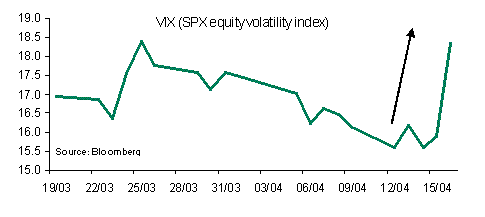
Well so much for a “risk on” week. Market sentiment soured at the end of last week following The US Securities and Exchange Commission (SEC) civil action against Goldman Sachs, in which they accused the bank of fraud. The impact reverberated across markets and risk trades were pulled back as a consequence. Bulls shouldn’t be too downhearted though as the drop in risk trades followed several days of gains and part of the pullback could be attributed to profit taking.

Speculation of similar probes in Europe by financial regulators will cast a shadow over markets early this week. Nonetheless, direction will at least in part come from earnings. So far the run of earnings looks upbeat, with around 83% of the 48 S&P 500 companies reporting, beating analysts’ estimates. Overall profits are forecast to increase by around 30% from a year ago but are on track to easily beat this estimate. Bellwether names including IBM, Apple, Coca-Cola, Boeing, Microsoft, and AT&T report this week.

The meeting between Greek officials, ECB, IMF and EU has been delayed until Wednesday. There is little likelihood of Greece seeing any loan money soon as the need for parliamentary approval in some EU countries and upcoming regional elections in Germany on 9 May will put a spanner in the works. An issue of EUR 1.5bn of 3-month Greek debt tomorrow will act another test of market confidence but the recent widening in Greek debt spreads suggests a less positive reception than the previous sale.

There are also a few central bank meetings to contend with this week including Canada, Sweden, India, Philippines and Thailand. The only Bank likely to hike interest rates out of this bunch is the RBI in India with another hike expected, following closely on the heels of the March move. Canada and Sweden are unlikely to shift policy until at last after the end of Q2 whilst protests in Bangkok, Thailand, and the knock on impact on consumer confidence, have effectively sealed the case for no rate move there.

On the data front, attention will turn to US housing market activity. Markets will be able to gauge further clues to whether recovery in the housing market has stalled. An increase in both existing (Thu) and new home sales (Fri) in March is expected, which may allay some concerns although any improvement is likely to continue to fragile against the background of tight credit and high foreclosure levels.

In Europe, aside from the ongoing Greek sage, sentiment surveys will garner most attention, with the release of the German ZEW (Tue) and IFO (Fri) surveys as well as manufacturing and service sector purchasing managers indices (PMIs) across Europe. On the whole the surveys are likely to reveal some improvement as confidence.

Risk aversion will be slightly elevated at the beginning of this week but strong earnings and improving data will help to prevent too much damage. Consequently Risk currencies will start the week under pressure but any pullback will be limited. Given that speculative positioning in risk currencies such as the AUD, NZD and CAD is well above their three-month average according to the latest Commitment of Traders’ IMM data there will be some scope for profit taking. EUR speculative sentiment has seen some improvement but EUR/USD remains vulnerable to a further pull back to technical support around 1.3302 this week.

Q1 Economic Review: Elections, Recovery and Underemployment

I was recently interview by Sital Ruparelia for his website dedicated to “Career & Talent Management Solutions“, on my views on Q1 Economic Review: Elections, Recovery and Underemployment.

Sital is a regular guest on BBC Radio offering career advice and job search tips to listeners. Being a regular contributor and specialist for several leading on line resources including eFinancial Careers and Career Hub (voted number 1 blog by ‘HR World’), Sital’s career advice has also been featured in BusinessWeek online.

As you’ll see from the transcript of the interview below, I’m still cautiously optimistic about the prospects for 2010 and predicts a slow drawn out recovery with plenty of hiccups along the way.

Sital: Mitul, when we spoke in December to look at your predictions for 2010, you were cautiously optimistic about economic recovery in 2010. What’s your take on things after the first quarter?

Click here to read the rest…

US/China Tensions Ratchet Higher

FX policy tension is a theme that looks to be making a come back. The potential for CNY revaluation continues to be hotly debated, with international pressure on China intensifying. For its part China continues to resist such calls, but growing speculation that the US will label China a “currency manipulator” in the semi-annual US Treasury report on 15 April suggests that the issue will remain very much on the radar screen.

Tensions have ratcheted higher in the wake of a proposed bill by US senators targeting countries with “fundamentally misaligned currencies” and those needing “priority action”. Any country that is targeted would then have a year to correct its currency or face a case at the World Trade Organisation. If China is labelled as a currency manipulator it could also result in anti dumping regulations.

Much of the increase in tension may be attributable to politicking ahead of the November mid-term Congressional elections but it is clear that the issue is not going away quickly. Chinese Premier Wen’s strong comments over the past weekend denying any need for revaluation of the CNY suggests that the stakes will get even higher over coming months.

It is looking increasingly difficult for the US administration to ignore Congress’ calls for stronger action on FX. Moreover, US President Obama’s pledge to double US exports within 5-years will require some USD weakness, but the USD will need to weaken against Asian currencies led by China and not just against the usual culprits such as the EUR.

There is little sign of this happening anytime soon as Asian central banks continue to intervene to prevent their currencies from strengthening. Nonetheless despite China’s insistence that it does not believe the CNY is undervalued China is likely to be edging closer to an eventual revaluation in the CNY sometime in Q2 2010 as it combined a stronger currency with higher interest rates and tighter lending to curb inflation. A stronger CNY will also spur other Asian central banks to allow stronger currencies.

A deterioration in the China/US relationship could have potentially significant FX implications. The latest US Treasury TIC report this week showed that China reduced its holdings of US Treasuries for the third straight month in January. Should China feel that it needs to retaliate against a more aggressive US trade or FX stance it could reduce its holdings of US Treasuries further.

GBP bulls brave or crazy?

The UK Pound’s (GBP) performance over recent months has been dismal. The currency has failed to show any real sign of recovery, having fallen to and below the psychologically important level of 1.50 against the USD. A number of factors including fiscal/debt concerns, political worries, and uncertainties about whether the Bank of England will step up asset purchases, have accumulated to turn even the most ardent GBP bulls into bears.

The outcome of the upcoming UK general election widely expected on May 6, remains a major weight on GBP sentiment. Until the outcome is clear or unless one or other party develops a clear lead in the polls, it is difficult o see GBP sustain any durable recovery. In the near term GBP/USD is vulnerable to a test of its 2010 low around 1.4780 and then towards 1.44. The risk to this is that the market is very short GBP which could result in a sharp bounce in GBP in the wake of any good news. However, a rally in GBP will only result in fresh sellers.

Ahead of the elections will be the budget and this will be closely scrutinized for steps to reduce the size of the burgeoning fiscal deficit. Whichever party comes into power will need to convince markets that a credible and timely plan exists to reduce the size of the deficit and prevent a sovereign ratings downgrade. If not, GBP could see itself under much more pressure. In this respect it’s worth noting the Fitch ratings warning that the UK sovereign credit profile has deteriorated.

It’s not all bad for GBP, however. By some measures it’s now the most undervalued major currency, opening up the possibility of a sharper bounce back over the medium term. Moreover, UK debt markets are already trading as if a ratings downgrade has taken place, whilst arguably GBP has also priced in a lot of negative news already, as reflected in the very negative speculative positioning in the currency.

The economic news is also not as bad as the headlines might suggest and although recent housing data has been a bit mixed, both consumer spending and the housing market have held up reasonably well. Bearing all this in mind GBP is set to recover over the medium term, but it would be very brave to buy the currency any time soon, at least until UK elections are out of the way.

Europe to recover at a snail’s pace

There have been two pieces of data released over recent days which give us a good idea of the state of Europe’s biggest economy, Germany. The IFO survey – a crucial gauge of business confidence and an important forward looking indicator for the German economy, if not the whole eurozone economy – increased in May for the second straight month but came in lower than forecast. The second was the final reading of first quarter GDP, which confirmed the very steep 3.8% quarterly decline in growth, fuelled in large part by weaker exports.

Of course any improvement is encouraging but the fact that the rise in the IFO was less than expected highlights that the market has moved from excessive pessimism to being overly optimistic about recovery prospects. Moreover, at current levels the IFO remains at historically lows and still consistent with economic contraction. Admittedly it is at least consistent with a smaller pace of contraction in the economy in the months ahead but still way off indicating actual economic expansion.

The problem for Germany as highlighted by the GDP data is that the economy remains highly export dependent and given that global trade continues to shrink it points to very difficult times ahead. Moreover, the likelihood of a much bigger increase in unemployment and ongoing problems in the financial sector, points to the outlook for the consumer remaining very tough indeed for a long time to come.

Financial sector problems will only delay recovery.  A report in the UK’s Telegraph even carries a warning from the German bank regulator that toxic debts at German banks could blow up “like a grenade”. I won’t spend any more time on toxic debts at European banks but suggest reading a previous post titled “Stress testing European and UK banks” ,that highlights the lack of transparency and potential for much more writedowns in the months to come.

The problem is not just a German one. The eurozone economy is likely to recover much more slowly than the US despite the fact that the US was at the epicenter of the crisis. The major difference is that policy in the US is far more aggressive and rapid compared to Europe. European policymakers have struggled to put together any form of co-ordinated policy response and there is still an unwillingness from Germany to enact a fiscal stimulus package despite the fact the economy has weakened more rapidly than many other countries.

Moreover, conflict within the European Central Bank (ECB) council means that an aggressive move towards quantitative easing appears highly unlikely. The latest measure by the ECB to purchase EUR 60 billion in covered bonds hardly registered with markets. Faced with many opposing views from within the ECB representing many different countries this situation is unlikely to change anytime soon. As a result, Europe is destined for a snail’s pace of recovery, which could also stall the appreciation of the euro in the month ahead.