EUR/CHF still clinging to 1.2000

The job of the Swiss National Bank has become increasingly tougher over recent weeks. Speculation of a Greek exit or ‘Grexit’ and continued flight of capital from Greece as well as other peripheral countries mean that there is more prospect of upside for the CHF than downside versus EUR. The EUR/CHF 1.2000 floor has not deterred investors from parking such capital in CHF, much to the chagrin of the SNB, which has even warned about implementing capital restrictions.

Elevated risk aversion means that inflows of capital to Switzerland from the Eurozone periphery will persist. As a result, EUR/CHF looks set to trade around the 1.2000 floor for some time to come, with the risk that the SNB increasingly has to buy EUR to protect the floor. My forecasts reflect the view that any CHF weakness versus EUR will be extremely gradual in the months ahead as I expect any improvement in risk appetite to be similarly slow.

On the economic front the arguments for CHF weakness have actually lessened. Consumer confidence increased to its highest in a year in April. More importantly from the point of view of the SNB, Switzerland has registered positive CPI readings on a monthly basis for the past three months. Unfortunately, CPI is still negative on an annual basis, meaning that deflationary concerns continue to persist. On balance, the SNB’s fears over deflation will eventually lessen, suggesting in turn that worries about CHF strength will also be pared back.

Although the CHF has remained strong against the EUR it has weakened against the USD, but this is attributable to EUR weakness (due to the EUR/CHF floor) rather than inherent CHF weakness.
It will not be a one-way bet lower against the USD for both the EUR and CHF. The speculative market is highly short both currencies and they could rally in the event of any good news from Greece or the Eurozone. The CHF may also find itself weakening against the EUR if the news is sufficiently good to help stem outflows of capital from Greece and other parts of the Eurozone, but I believe this is unlikely. For the next few weeks at least, ahead of Greek elections, EUR/CHF is set to continue to cling to the 1.2000 floor, with the market set to test the SNB’s resolve.
Sell Euro into rallies

There was limited respite for markets in yesterday’s thin market trading, with any bounce in risk appetite sold into quickly. This is exactly the pattern of trading that is likely to take place over coming weeks as Greece remains in the spotlight while Spanish banking woes garner more attention.

Taken together with rising global growth worries (note the Baltic Dry Index is turning over again) suggests that it will be very difficult for markets to drag themselves out the quagmire. The lack of major data releases today, with only German inflation and US consumer confidence of note, suggests that there will be little for markets to take their minds off the Eurozone debt crisis.

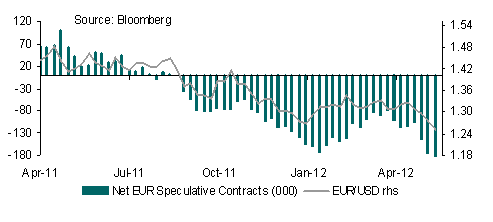
EUR/USD hit a high around 1.2625 helped no doubt by the fact that positioning was at record short levels. However, the bounce was quickly sold into leaving the EUR vulnerable to a drop below 1.2500 today. A renewed sell off in Spanish debt as banking sector concerns intensify dented any positive impact from weekend polls in Greece showing more support for pro bailout parties.

There is little on the data front today aside from German CPI leaving markets to continue to ponder on peripheral country woes. “Grexit’ fears have by no means been quelled as the reduction in bank deposits continues to show. EUR/USD will struggle to make any headway against this background, with further probing below 1.2500 likely in coming days.

The job of the Swiss National Bank has become increasingly tougher. Speculation of a ‘Grexit’ and continued flight of capital from Greece as well as other peripheral countries means that there is more prospect of upside for the CHF than downside versus EUR. The EUR/CHF 1.2000 floor has not deterred investors from parking such capital in CHF much to the chagrin of the SNB which has even warned about implementing capital restrictions.

Elevated risk aversion means that inflows of capital to Switzerland from the Eurozone periphery will persist. As a result EUR/CHF looks set to trade around the 1.2000 floor for some time to come, with the risk that the SNB has to increasingly buy EUR to protect the floor.

US dollar restrained, Swiss franc too strong

Better than expected March US new home sales, stable consumer confidence and firmer than consensus earnings, all contributed to boost markets overnight. In Europe, decent demand for Dutch, Spanish and Italian debt auctions helped to reassure markets in the region. Apple earnings added to the good news, contributing to more than 82% of S&P 500 companies topping estimates so far for Q1 2012 earnings.

Despite encouraging news on the data and earnings front US equities only registered small gains, failing to echo the larger gains in European equity markets, suggesting that investors remain cautious. Ahead of the Fed FOMC outcome today trading is likely be relatively restrained, with the risk rally struggling to make much headway.

The Fed FOMC rate decision will be critical to determine USD direction over coming sessions. Assuming that the Fed does not alter its policy setting but instead only tinkers with its economic forecasts, the USD will escape any further selling pressure. Any reference or hint to further quantitative easing would play negative for the USD but I do not expect this to occur.

If anything I expect the USD to edge higher over coming sessions as risk aversion continues to rise. An expected drop in March durable goods orders today will not give the USD much help, however. I don’t expect the FOMC outcome to mark an end to speculation of more QE, and in this respect the USD will continue to be restrained until there is more clarity on the economy and in turn Fed thinking.

EUR/CHF continues to flat line close to the 1.20 line in the sand implemented by the Swiss National Bank (SNB). Renewed tensions in the Eurozone have if anything renewed the appeal of the CHF, making the job of the SNB even more difficult. The fact that risk aversion has been rising suggests CHF demand will remain firm in the short term. CHF demand is occurring in the face of speculation of a shift in FX stance.

Although the SNB has not hinted at any change in the level of the EUR/CHF floor, market speculation that the SNB will move it higher, possibly to around 1.30 from 1.20, has intensified. The problem for the SNB is that the CHF is substantially overvalued and this in turn is fuelling persistent deflationary risks as reflected in six straight months of declining CPI. Against this background it would not be surprising if the EUR/CHF floor is lifted.

AUD risks, CHF speculation, CAD upside

News that the IMF revised up its global growth forecasts, decent demand for a Spanish bill auction and a stronger than expected reading in the April German ZEW investor confidence survey helped to calm market nerves overnight. Some solid US Q1 earnings also supported equities too.

Weaker readings for US industrial production and housing starts were largely ignored. Hopes of an expansion of IMF funds were boosted by the news that Japan will be provide an extra $60 billion. High beta currencies rallied overnight but notably the EUR failed to register gains despite a narrowing in peripheral Eurozone bond yields.

AUD has undergone some major gyrations. The boost from by a strong jobs report last week was quickly undone by a relatively dovish set of RBA minutes, which appeared to confirm the view that a rate cut would take place in May. Of course, as the RBA pointed out the April 24 Q1 inflation report would be essential to provide the final clues to the rate decision.

As a rate cut is already priced in, an upside inflation surprise may actually result in a bounce in the AUD but any positive impetus will have to contend with a more fragile risk environment, yesterday’s risk rally not withstanding. AUD is one of the most highly sensitive currencies to risk aversion and bounced overnight as risk appetite improved but we suspect the risk rally will fade in the short term putting the AUD under renewed downward pressure.

EUR/CHF continues to track the 1.20 ‘line in the sand’ closely, but rumours of a shift in the floor continue to do the rounds. Swiss officials have not confirmed such speculation but have highlighted the impact of a strong CHF in fuelling deflation pressures. The case for a move higher in the CHF ceiling is therefore quite high, but the cost could also be high if speculators test the resolve of the Swiss authorities.

Although the Swiss economy continues to suffer it appears that the pain of a strong CHF is lessening slightly although not enough to ease concerns about the strength of the currency. The March KoF Swiss leading indicator revealed a second straight increase, albeit from a low level. Further gains may be limited however, given the ongoing downward pressure emanating from weaker growth in the Eurozone.

The Bank of Canada left policy rates unchanged at 1% but the accompanying statement appeared to pave the way for higher interest rates. Consequently expectations of rate hikes have been brought forward, with the CAD rallying due to its strong correlation with interest rate differentials. Firmer commodity prices also helped to boost CAD.

Our quantitative models show scope for further CAD gains over the short term, suggesting more gains ahead. Further direction will come from the BoC Monetary Policy Report today, with USD/CAD setting its sights on a test of technical support around 0.9766 in the near term.

Weak USD will not persist, CHF to drop eventually

Risk appetite has deteriorated slightly since the Bernanke fuelled bounce earlier this week but there does not appear to be much of a directional bias for markets either way. Interestingly Treasury yields continue to pull back even while equity markets have softened overnight.

Data has been mixed, with US consumer confidence dipping in March albeit not as much as expected while US house prices also did not drop by as much as anticipated. Data releases on tap today include monetary aggregates in the Eurozone and durable goods orders in the US. The tone will likely continue to be slightly ‘risk off’.

The USD has come under growing pressure since its mid March high, with the EUR in particular taking advantage of its vulnerability. A combination of improving risk appetite and a correction lower in US Treasury yields in the wake of relatively Fed comments have been sufficient to deal the USD a blow.

However, the outlook for the USD is mixed today as on the one hand it will be helped by a reduction in risk appetite but hit on the other by a drop in US Treasury yields overnight. Data today should be a little more constructive for the USD, with a likely bounce back in durable good orders in February.

Overall, I do not expect the weak USD bias to persist especially as it is based on unrealistic expectations that the Fed will still implement more quantitative easing. Indeed, while further Fed easing is possible it may not need to involve an expansion of the Fed’s balance sheet.

EUR/CHF remains pinned to the 1.20 ‘line in the sand’ imposed by the Swiss National Bank while the CHF has strengthened over recent weeks against the USD. Economic data has deteriorated over recent months, with the forward looking Swiss KoF leading indicator pointing to a further weakening.

We will get further news on this front on Friday with the latest KoF release, with a slight a bounce expected. In turn, bad news on the economic front is adding to pressure for CHF weakness. Market positioning in CHF is negative but there is plenty of scope to increase short positioning in the months ahead given that short CHF positions remain well off their all time highs.

Eventually as risk appetite improves and the US yield advantage widens against Switzerland, both EUR/CHF and USD/CHF will move higher.