JPY retracement, CHF pressure

Risk assets rallied overnight, the USD weakened and US Treasury yields rose. There was little new in terms of economic news, with only NAHB March homebuilders confidence of note, which came in slightly weaker than expected. The bigger driver for markets was the news that Apple Inc. will pay around USD 45 billion in dividends and share buybacks over the next 3-years.

Today sees a crop of second tier releases including housing starts and building permits in the US and inflation data in the UK while there will also be attention on a speech by Fed Chairman Bernanke. Risk assets will remain supported but I continue to see consolidation for markets in the near term.

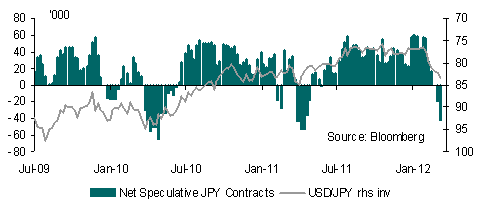
USD/JPY has retraced lower as warned last week. My quantitative models suggest scope for even more of a correction lower, with a drop below 83.00 on the cards in the short term. While the upward move in the currency pair was built on a widening in the US yield advantage over Japan, the move looks overdone. Nonetheless, any pullback will offer better levels to initiate long USD/JPY medium term positions.

Clearly the market believes that the JPY will weaken further given the build up in JPY short positions over recent weeks, with shorts at their highest since April 2011. February trade data to be released on Thursday will provide further fuel for JPY bears given the persistence of a trade deficit and weakness in exports.
Following the bounce in EUR/CHF last week the currency pair has dropped back into its recent tight range around the 1.2050-1.2070 area. Strong warnings by the Swiss National Bank at its policy meeting did not lead to any follow through on the CHF. I expect a gradual drift higher in EUR/CHF over coming weeks in line with the incremental change in sentiment for the Eurozone as Greece slips from the radar.

Official pressure for CHF weakness will remain intense given the deterioration in economic data as likely to be revealed in today’s release of Q4 industrial production. Nonetheless, the SNB will be wary of confronting the market in terms of FX intervention to weaken the CHF despite its verbal warnings. Meanwhile USD/CHF remains highly sensitive to gyrations in the USD index given its strong correlation, suggesting some consolidation in the short term as the USD pulls back.
Euro and Swiss franc under pressure

Positive momentum in risk assets slowed, with higher core bond yields in the US and Europe weighing on sentiment. The USD in particular has been buoyed by higher US bond yields, with the move in line with my long held medium term view of a firmer yield led gain in the USD. Commodity prices in contrast have come under growing pressure, with gold and copper prices sliding in particular. Risk measures continue to improve including my risk barometer, suggesting that the overall tone to risk assets will remain positive.

The main focus today will be on a plethora of US data releases including industrial production, Philly Fed and Empire manufacturing confidence while in Europe attention will be on Spanish and French bond auctions. US data will likely remain upbeat, while the auctions should be well received.

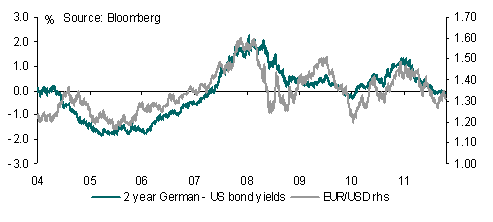
EUR has pulled back sharply over recent not just against the USD but also on the crosses, with EUR/GBP finally playing some catch up yesterday. It’s interesting that the drop in the EUR has occurred despite generally improving conditions for peripheral Eurozone as reflected in narrowing yield spreads between peripheral countries and Germany.

The bottom line is that the EUR is suffering from a widening in the US / Europe (Germany) bond yield differential as it is becoming increasingly clear that the US economy will strongly outperform the Eurozone economy this year. As noted at the beginning of the week EUR/USD was set to drop to below support around 1.3055. Having hit this level, strong support around the 1.2974 level moves into sight.

Ahead of today’s quarterly Swiss National Bank meeting at which no change in policy is widely expected, EUR/CHF has taken a sharp lurch higher, finally moving away from around the 1.2050 level it has been trading at over recent weeks. While I am bearish on the CHF over the medium term further upside in EUR/CHF will be limited over the short term given that the move in the currency is at odds with interest rate differentials which have actually narrowed between the Eurozone and Switzerland. Technical resistance around 1.2298 will cap gains over coming sessions.

As for USD/CHF the picture remains a bullish one, with general USD strength driven by higher yields, pushing the currency pair higher. I look for a test of resistance around 0.9393 over coming sessions.

The case for Swiss franc weakness

EUR/CHF has continued to hug the 1.2000 ‘line in the sand’ enforced by the Swiss National Bank. CHF currently shows little sign of weakening although we continue to see risks of a higher EUR/CHF. Against the USD the CHF has been similarly stable but we look for USD/CHF to move higher eventually. The main imponderable is the timing of CHF weakness. Ongoing Eurozone doubts even after the agreement of a second bailout for Greece mean that the CHF remains a favoured destination for European money.

The outlook for EUR/CHF will depend on how the situation in the Eurozone develops. The recent agreement for a second Greek bailout received a muted reaction from markets, and there is a long way to go before confidence towards a resolution of the debt crisis can be fully restored. Assuming that there will be an eventual improvement in risk appetite, CHF will weaken given the strong correlation between EUR/CHF and risk over the past three months.

EUR/CHF has enjoyed a strong relationship with movements in interest rate differentials over the past few months, with both bond yields and interest rate futures. This implies that it will take a relative rise in German yields versus Swiss yields for EUR/CHF to move higher. This is certainly viable given the deterioration in Swiss economic data over recent months. Indeed, as reflected in the KoF Swiss leading indicator and manufacturing PMI data, the economy is heading downwards.

The threat of deflation has also increased in the wake of unwelcome CHF strength, which has left the currency extremely overvalued according to our measures of ‘fair value’. Growth will be weak this year but the economy may just avoid a negative GDP print. Against this background Swiss bond yields will remain low, along with policy rates. While the outlook for the Eurozone economy is not much better, bond yield differentials between the Eurozone and Switzerland are likely to widen, which will eventually help lead to a higher EUR/CHF exchange rate.

My blog posts will be less frequent over coming days as I am on a business trip to New York. Happy trading.

Risk currencies buoyed

Positive developments helped to buoy markets. Although US durable goods orders were weaker than forecast a jump in US consumer confidence to its highest since February 2011 gave equity markets and risk assets in general a lift. Even in Europe the news was encouraging as Italy managed to auction 10-year debt at a cheaper rate than previously while Portugal passed a third review of its bailout programme and noted that unlike Greece it would need a second bailout.

There was some negative news however, with the European Central Bank (ECB) temporarily suspending the eligibility of Greek bonds as collateral for its funding operations and Ireland calling a referendum on the European fiscal compact. Nonetheless, hopes of a healthy take up at today’s ECB second 3-year Long term refinancing operation (LTRO) will keep markets in positive mood in the short term.

The USD index continues to look restrained when risk assets are rallying. Given the positive equity market mood overnight it is no surprise that the USD came under further pressure while the EUR looks firm ahead of today’s 3-year LTRO by the ECB. Fed Chairman Bernanke’s testimony will give the USD some direction but we do not expect him to deliver any big surprises. EUR/USD will continue to rally if we are correct about a strong EUR 600-700 billion take up at the LTRO but the currency pair will meet resistance around 1.3550.

JPY has lost ground against various cross including USD, EUR and AUD. Much of its weakness is related to widening yield differentials but our models reveal that USD/JPY in particular has overshot its implied value. Unless US yields widen further versus Japan, JPY could even rebound over coming days. EUR/JPY has breached its 200 day moving however, which is a bullish signal for the currency pair. A generally firm EUR tone likely to be maintained in the short term will also be exhibited versus JPY.

Warnings by Swiss National Bank head Jordan reiterating his stance of defending the EUR/CHF floor of 1.20 has done little to push the currency pair higher. EUR/CHF has enjoyed a strong relationship with movements in interest rate differentials. This implies that it will take a relative rise in German yields versus Swiss yields for EUR/CHF to move higher. This is certainly viable given the deterioration in Swiss economic data over recent months. Eventually EUR/CHF will move higher but over the short term it is unlikely to move far from the 1.20 level.

EUR/GBP upside overdone, CHF overly strong

Disappointing Eurozone service sector and manufacturing purchasing managers’ confidence indices as well as a contraction in Chinese manufacturing confidence sets the scene for a drop in risk assets. In addition in the US, existing home sales rose less than expected taking into account revisions to previous data.

Meanwhile scepticism over Greece’s ability to implement agreed upon reforms and reported resistance from Germany to increasing the firewall around peripheral Eurozone countries has delivered a further dose of negativity to markets. The market was probably looking for an excuse to sell after a strong rally and found plenty in yesterday’s news.

GBP has followed on the coat tails of the EUR over recent weeks, with the currency showing little independent direction. Reflecting this is the fact that EUR/GBP had until recently been trapped in a 0.83-0.84 range. As with the EUR I see downside risks to GBP over the short term against the USD.

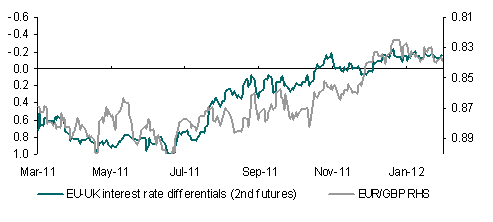
Against the EUR, GBP will largely track the movement in yield differentials as it has done over recent months. Relatively dovish MPC minutes, with two members voting for bigger amounts of quantitative easing helped to put GBP under further pressure but the move higher in EUR/GBP look overdone.

My medium term view continues to show GBP appreciation versus EUR and current levels highlight a good opportunity to go short EUR/GBP. Markets are rewarding central banks that are proactive in their policy prescriptions. I exect this to result in some GBP resilience even if the BoE announces more QE.

EUR/CHF has continued to hug the 1.2000 line in the sand enforced by the Swiss National Bank. Ongoing Eurozone doubts even after the agreement of a second bailout for Greece mean that the CHF remains a favoured destination for European money. This is reflected by the fact that EUR/CHF has been highly correlated with Risk Aversion over the past 3-months.

It will take also take a relative rise in German yields versus Swiss yields for EUR/CHF to move higher. This is certainly viable given the deterioration in Swiss economic data over recent months. Indeed, as reflected in the KoF Swiss leading indicator and manufacturing PMI data, the economy is heading downwards. Assuming that there will be an eventual improvement in risk appetite, CHF will weaken given the strong correlation between EUR/CHF and risk aversion over the past 3-months.