Agreement at last!

Greek politicians finally agreed on further austerity cuts totalling EUR 3.3 billion in order to secure a second bailout package. European official discussions now centre on the details of the bail out package, targeting a cut in Greece’s debt to GDP ratio to 120%.

However, the fact European Finance Ministers have withheld more funds for Greece until the austerity measures begin to be implemented suggests further uncertainty on the horizon. A Greek parliamentary vote set to begin this weekend may see some progress but markets will trade cautiously ahead of the vote.

EUR/USD rallied to a high of around 1.3322 but failed to break above its 100 day moving average at 1.3332 following the agreement. As expected the ECB offered no help to the EUR, with market attention continuing to centre on the second 3-year LTRO on 29 February.
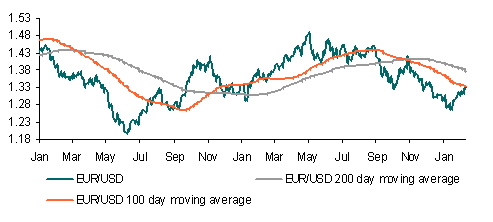
The fact that there are still various issues to be resolved means that upside for EUR will be limited in the short term. In any case the currency was already pricing in a lot of good news. EUR/USD will face major resistance around 1.3388.

Notably risk measures are edging higher once again, implying some pressure on risk assets in the near term. Markets today will digest the status Quo from the European Central Bank and an additional but expected injection of GBP 50 billion in quantitative easing from the Bank of England. December US trade data and February Michigan confidence are the only data of note suggesting limited price action ahead of the Greek parliamentary vote.

Still waiting for Greece

The USD has taken a steady path of recent days, with little move in either direction, reflecting the general malaise in currency markets waiting for an outcome to the Greek debt talks. However, hopes that an agreement will be announced shortly saw the USD lurch lower overnight. The conflicting forces of firming US economic data on the one hand and uncertainties in Greece on the other have left market participants in a bind.

The USD has at least purchased some solace from reduced expectations of quantitative easing but as we noted earlier in the week the Fed may still carry out QE despite of better data. The USD could also suffer from the fact that US bond yields remain relatively low compared to some other major countries.

Indeed, the Fed’s commitment to maintain accommodative monetary policy until the end of 2014 suggests that the USD’s use as a funding currency could continue for a while longer. We look for the USD index to consolidate around the 78.50-79.00 level over the short term.

GBP’s recovery from its lows around 1.5233 on 13 January has been impressive. GBP’s gains are not as strong as that of commodity and Scandinavian currencies but it has outperformed the EUR. We expect this to continue.

Like other currencies GBP has benefited from a widening yield gap between the UK and the US. This has little to do with UK policy expectations given that the Bank of England is expected to initiate more quantitative easing this week. The move in relative US–UK yield differentials has more to do with the rally in US interest rate futures since the start of the year, supported by the recent dovish FOMC statement, which has put the USD under a degree of pressure.

GBP gains will be limited ahead of the BoE meeting tomorrow, with technical resistance seen around 1.5931 vs USD. Against the EUR much will depend on Greek debt talks but eventually we look for a retest of the EUR/GBP January lows around 0.82213.

Speculators still short Euro

Since I wrote “Beware of EUR short covering” EUR/USD has gained around 4%. EUR/USD is trying to gain a foothold above 1.3200 but failed overnight. Further gains will be more gradual. Helping the EUR is the fact that short positions hit an all time high according to IMM data for last week. However, data releases are unlikely to provide much impetus to the EUR, with most attention on the monthly series of PMI manufacturing confidence indices as consumer confidence readings.

At best the data will show some stabilisation but market will focus instead on the EU Summit beginning today and ongoing Greek debt talks as well as Italian debt auctions today. Greek debt talks are expected to be finalised this week including writedowns of around 70% but tensions over a German proposal to create a “budget commissioner” could yet hit the EUR.

The major release of the week in the UK is the January PMI manufacturing survey although there will also be attention on housing data including mortgage approvals and house price surveys from the Nationwide and Halifax. Overall the data will do little to dispel fears about the UK economy following the contraction in Q4 GDP revealed last week.

GBP will likely remain resilient to any bad economic news however, but its gains look limited especially given the revelation in the BoE MPC minutes that some members thought that more quantitative easing will be required. Having strengthened against the USD but weakened against the EUR over recent days, GBP continues to trade in a middle of the road manner. GBP/USD sellers will likely emerge around the 1.5870 resistance level while EUR/GBP is set to consolidate around 0.8350.

Euro edging towards year highs, GBP lagging

Contrary to most expectations at the beginning of this week EUR has managed to claw back its losses and more, with the currency edging towards its year-to-date highs around 1.3069. The resilience of the currency to bad news in Europe has been impressive and its gains have reflected a speculative market that has been extremely short. The end of the week sees no key data of note so markets will have to contend with digesting the outcome of the relatively positive Spanish and French debt auctions while keeping one eye on Greek debt talks with private investors.

Unless there is yet another breakdown of talks in Greece the EUR will end the week on a positive note. I suspect it won’t last further out especially given the pitfalls ahead but at a time when investors have become increasingly bearish on the EUR it may just extend its bounce over the short term. One country to watch is Portugal whose bonds have underperformed recently as markets speculate that it could be the next contender for any debt writedown.

Retail sales data in the UK will capture local market attention today. Sales are set to have bounced back in December but the improvement is likely to be short-lived, suggesting any support to GBP will be fleeting. GBP has underperformed even against the firmer EUR recently but this is providing better levels for investors to take long positions versus EUR. In part this reflects the move in relative European/US interest rate differentials, which has been correlated with the move in EUR/GBP.

I expect GBP to outperform EUR over coming months to around 0.80, with the former continuing to benefit from the simple fact that it is not in the Eurozone and has therefore acquired a quasi safe haven status. Nonetheless, as reflected in the drop in Nationwide consumer confidence in December, this year will be particularly difficult for the UK economy. GBP will be restrained by the prospects of more quantitative easing by the Bank of England as inflation eases further

The Devil is in the details

The “partial solution” delivered by European Union (EU) leaders last week has failed to match the high hopes ahead of the EU Summit. Nonetheless, the deliverance of a “fiscal compact”, acceleration of the European Stability Mechanism (ESM) to July 2012 , no forced private sector participation in debt restructuring (outside Greece), and possible boost to the International Monetary Fund (IMF) of up to EUR 200 billion, are steps in the right direction. The fact that UK Prime Minister Cameron threw a spanner in the works to veto a joint proposal to revise the EU Treaty should not detract from the progress made.

Nonetheless, the measures may not be sufficient to allay market concerns, with disappointment at the lack of European Central Bank (ECB) action in terms of stepping up to the plate as lender of the last resort still weighing on sentiment. Data will add to the disappointment this week as “flash” Eurozone purchasing managers indices (PMI) drop further in December.

This week events in the US will garner more attention, including the Federal Reserve FOMC meeting, November inflation and retail sales data plus manufacturing confidence gauges as well as November industrial production on tap. The Fed will not shift its policy stance at this meeting but may sound a little more upbeat on the economy following recent firmer data. Inflation will likely remain subdued while the other data will continue to show gradual recovery.

Overall, the market is likely to thin further as the week progresses and holidays approach, with ranges likely to dominate against the background of little directional impetus. Our call to sell risk assets on rallies remains in place, however. The EUR will likely struggle to make much headway in the current environment, especially given that many details of the EU agreement still need to be ironed out and once again the risk to market confidence lies in implementation or lack of it. A range of EUR/USD 1.3260-1.3550 is likely to hold over the short term.