Dollar firm, but beware of a short covering euro bounce

The USD has risen sharply since the end of April, benefiting from the ongoing turmoil in the Eurozone and rise in US Treasury yields (2-year). Markets have managed to brush US fiscal and political concerns under the carpet as focus centres on Europe. The USD also managed to shrug off a soft April retail sales report and a slightly more cautious set of FOMC minutes.

A recovery in April durable goods orders, new homes sales and a relatively stable reading for Michigan confidence should ensure that the USD’s upward trajectory remains unimpeded this week. Given the potential for continued uncertainty ahead of Greek elections in mid June, risk aversion and the USD are set to remain elevated.

In Europe, it’s all about Greece and the machinations ahead of fresh elections in mid June. The EUR shows little sign of stabilising ahead of these elections. Data releases will take a back seat although the calendar will be heavy. FX markets will have one eye on the May German IFO survey and the flash readings in purchasing managers indices. The PMI data will give no relief to the EUR, with the data consistent with growth contraction for the most part while the IFO is set to register a decline too.

Meanwhile, pressure on German Chancellor Merkel to accept measures that were previously vetoed at an informal EU summit on Wednesday has also heightened. Such measures include direct recapitalisation of banks and/or unlimited purchases of peripheral country debt by the ECB and through the Eurozone rescue fund.

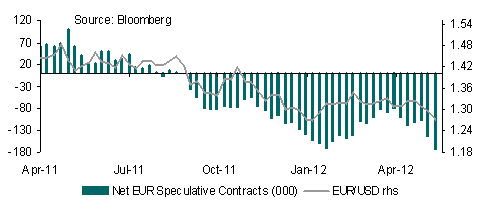
Admittedly the large extent of short market positioning (the latest CFTC IMM report revealed an all time low for EUR positioning) means that the risk of a bounce is high in the event of any good news or perhaps in the wake of any renewed securities markets purchases by the ECB or fresh hints of a third LTRO. Whether there will actually be any good news is another question entirely.
USD/JPY has been relatively stable despite a rise in US bond yields compared to Japanese JGB yields, with rising risk aversion helping to keep the JPY firm. The Bank of Japan meeting this week has the potential to change the currency pair’s trajectory but is unlikely to do so. No action is expected at the policy meeting on Wednesday, leaving the JPY with a firm bias.

Trade data will provide some justification for a more bearish stance on the JPY, with another deficit set to be registered in April as export conditions remain weak. However, as usual the JPY will continue to ignore domestic economic data and focus more on relative yields and risk.

Euro grinding lower as officials talk about Greek exit

The week begins in sour mood although notably Asian market pressure was limited even in the face of ongoing Eurozone tensions. China’s cut in its RRR over the weekend helped to limit the damage to markets but there are still plenty of negatives to chew on. Notably European officials are openly discussing and even preparing for the possibility of a Greek exit from the euro, an outcome that has grown in probability as fresh elections loom in Greece.

FX markets have finally awoken from their stupor, with a spike in volatility and moves out of long worn ranges registered. The USD has extended its upward trajectory that began in this cycle on 27th April. The rally looks strong and sustainable but is built largely on the fact that the USD looks less ugly than some other currencies rather than on positive US economic developments.

Admittedly US recovery is taking shape but the data is not sufficiently strong to erase expectations of further Fed quantitative easing, a factor that will limit the ability of the USD to capitalise on weakness elsewhere. Data over coming days will not help to provide much clarity on the issues, with April retail sales likely to be soft and the Fed FOMC minutes unlikely to deliver much new information. Even so, risk aversion is intensifying, providing the USD with firm support, suggesting that the USD will continue to edge higher over coming days.

The EUR in particular has sustained a drop below the psychologically important 1.30 level, spelling more downside risks. Greek politics and the potential for fresh elections remain at the forefront of attention. A small amount of relief on upcoming Greek bond redemptions following the EU’s deliverance of EUR 4.2 billion funds will not be sufficient to offset political worries.

EUR will also find direction from the Eurogroup meeting of finance ministers meeting today who aside from Greek issues will also discuss the Spanish banking sector. Meanwhile, a meeting between French President and Hollande and Germany’s Chancellor Merkel will have the potential to move markets but the chances of a breakthrough on any fresh deal is limited.

Data releases will confirm Eurozone recession while the May German ZEW investor confidence survey is set to record a decline. All of this will not bode well for the EUR, with the currency set to grind lower over coming sessions. EUR/USD 1.2852 will be a crucial support level, a break of which will see EUR slide much further.

Political pressures afflicts the euro

I’m in Dubai today presenting at a client seminar so am a little late on my blog post today. There is definitely lots going on however and all the talk is about politics. The mood is decidedly downbeat following the elections in France and Greece over the weekend. Risk assets have tanked while the USD looks firm except versus JPY. The elections over the weekend clearly dealt a blow to advocates of austerity resulting in a major increase in policy uncertainty.

Following the weaker the forecast US jobs report at the end of last week data over coming days will be less influential on the USD. In general I expect the USD to edge higher, helped by a decidedly more nervous market tone and higher risk aversion. The main interest for FX markets on the data front will be the April NFIB Small Business Optimism survey, March trade data and May Michigan confidence at the end of the week.

Although not a particular driver for the USD, the dip in the NFIB survey in March provoked concerns about the pace of US recovery and potential downturn in growth. This has been echoed in other data, which in turn has kept the door open to more Fed action restraining the USD in the meantime.

The ECB failed to rattle the EUR’s cage following its policy meeting last week although the lack of a dovish tone did help the EUR to rally briefly. We believe the market reacted prematurely and if anything the ECB may be setting the scene for a rate cut in June. Weak data has helped to undermine the EUR and I expect little or no improvement over coming days. Given that Germany has also succumbed to some weakness, the March German industrial production report will be monitored with interest on Tuesday.

The main driver for the EUR over coming days will be politics rather than the ECB or economic data however, with markets digesting the outcomes of the second round of the French Presidential election and Greek elections as well as the poor result for Chancellor Merkel in German state elections. Against this background and facing a bearish technical picture EUR/USD will struggle to recover, with 1.3060 providing a new resistance level.

US dollar tracking Treasury yields

Despite the firmer tone to risk appetite the USD index moved higher tracking the move in US Treasury yields. Indeed, the USD’s reaction was actually opposite to what would be expected given the rally in risk assets but its move clearly reflects the growing influence of yields.

The surprisingly robust April ISM manufacturing survey following the disappointing Chicago PMI for the same month highlights that recovery is not straightforward, suggesting that USD gains will also not be straightforward.

March factory orders are on tap today but the bigger focus will be on the April ADP jobs report, which will give important clues to Friday’s payrolls data. Expectations centre on a 170k outcome for the ADP report, a smaller increase than the 209k registered in March. In the meantime I expect the USD to hold its gains.

As noted at the start of the week EUR/USD was poised to edge higher despite the bad economic news emerging from the region. EUR/USD has continued to strengthen over recent weeks despite the release of data showing Eurozone economic underperformance relative to the US. A case in point is the April Eurozone purchasing manager’s data to be released today, which will reveal further weakness, especially in peripheral countries.

Some easing in peripheral bond yields has helped to support sentiment for the EUR leading to further short covering in the currency but further gains are expected to be limited. EUR/USD now sits around the middle of its 1.30-1.35 range but further upside will be restricted ahead of the key US jobs data on Friday. EUR/USD resistance is seen around the 1.3385 level.

Calm ahead of US payrolls and ECB meeting

It’s non-farm payrolls week in the US, with currencies treading water until Friday when the report is released. Ahead of the data there are several other releases on tap which will give clues to the outcome of the April jobs report, including the ISM manufacturing survey and ADP jobs report. The USD has taken a softer tone as risk appetite improved and US bond yields dropped further.

Given the Fed kept open the door to more easing it will act as a restraint on the USD unless markets become convinced that there will no further Fed balance sheet expansion over coming months. In the meantime unless risk aversion spikes again the USD is set to find it difficult to sustain any gains.

It’s always the same story with the EUR, a tale of ongoing resistance to bad news. Weaker Eurozone confidence surveys as well as a downgrade to Spain’s credit ratings did little to weaken the EUR. The key event is the European Central Bank (ECB) meeting on Thursday but despite growing growth worries, a policy rate cut is unlikely as the ECB remains in wait-and-see mode.

Data releases will not be too damaging for the EUR, with monetary and credit aggregate set to rise and German retail sales set to rebound in March. The EUR looks poised to edge higher against this background in the short term, but will be constrained by uncertainty ahead of the US jobs report. Technical resistance to the upside will be found around the 1.3265 area.

The JPY barely flinched when the Bank of Japan announced an expansion of its asset purchase fund by JPY 10 trillion in its aim to reach a 1% inflation goal. Unfortunately for the BoJ the ongoing narrowing in the US Treasury yield premium over Japan JGB yields overwhelmed the negative impact of its action on the JPY.

Overall, my quantitative models continue to show USD/JPY lower over the short term, with a move below 80.00 on the cards. If as I expect, risk aversion also creeps higher, it will imply more short term upside JPY pressure. Trading will be relatively quiet, with no major data on the calendar due to Golden Week holidays in Japan.