Euro and Yen capitalise on weaker Dollar

Equities continued their bounce back overnight helped by a reiteration from Fed officials that US monetary policy will remain highly accommodative through late 2014. Risk assets overcame a weaker than expected report on US jobless claims, with a smaller than expected trade deficit in February ($46 billion) helping sentiment. The launch of a North Korean missile which apparently failed did little to dent sentiment. Nonetheless, Spanish concerns continue to weigh on its markets, bucking the trend of improvement elsewhere.

Today’s data slate has little in terms of first tier data on tap, with inflation releases in Europe and the US in focus. The bigger influence will be a slate of Chinese data including Q1 GDP. The market has already priced in a good number (around 9% YOY) and therefore there is a risk of disappointment, which could hit risk assets. Also watch out for earnings from US financials including JP Morgan and Wells Fargo. So far US earnings have been positive, although admittedly its early days yet.

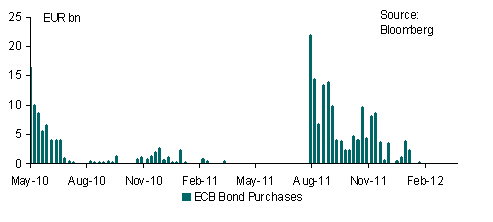
Downward pressure on EUR/USD has lessened for the time being and any further decline will be limited in the short term. While it is evident that the boost to markets provided by the European Central Bank’s Long Term Refinancing Operation (LTRO) has faded, EUR bears have been dealt a blow from renewed prospects of securities market purchases.
Italy’s debt auction yesterday provided little help to the EUR but at least it was not cause of further selling pressure. Concerns about Spain continue but any further downside pressure on EUR/USD will be restricted to technical support around the 1.3004 level (March 15 low), with EUR/USD set to remain in a 1.30-1.32 range.

JPY has pulled back sharply against the USD over the past month as I repeatedly warned. But before I blow my own trumpet any further I would note that further downside risks to USD/JPY remain in place although the room is now more limited than in previous weeks. According to my quantitative model a drop to around 79.00 is likely to mark a low in USD/JPY.

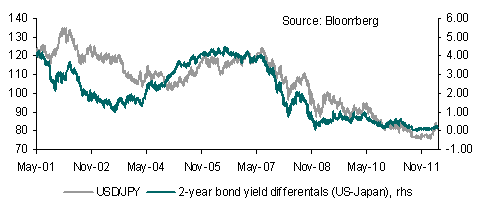
Warnings by the Bank of Japan of more “powerful” monetary easing have helped to prevent further JPY strengthening over recent sessions. However, a renewed narrowing in the US 2-year bond yield advantage over Japan will likely limit any upside for USD/JPY as reflected in the extremely strong correlation between USD/JPY and yield differentials over the past 3-months.
FX volatility declining, AUD still vulnerable

FX options appear to be increasingly comfortable with the current lack of movement in currencies. For example, 3-month EUR/USD implied volatility has dropped to multi-year lows while my measure of G3 implied volatility has been at very low levels over recent months.

This has corresponded with the drop in risk aversion as market fears over US growth and Eurozone debt issues recede. Over the short term there appears to be little to jolt markets out of their stupor and if anything EUR/USD is likely to continue to drift higher according to our short term quantitative models.

Indeed, firmer risk appetite, despite the odd hiccup, plays positively for the EUR while the pull back in US bond yields has restrained the USD. The Ecofin meeting beginning tomorrow will likely give further support to the EUR, if as expected, ministers bolster the Eurozone ‘firewall’.

It has been a one step forwards, two steps back motion for AUD/USD over recent weeks as it continues to edge lower. Although US bond yields have pulled back Australian yields have pulled back relatively more, reducing Australia’s yield advantage and weighing on the AUD in the process.

Over recent weeks speculative AUD positioning has also fallen, reflecting deteriorating sentiment for the currency, but the fact that the market is still long suggests scope for further short term downside.

Aside from yield differentials most of the usual correlations with AUD have broken down suggesting that the AUD is getting a dose of independent weakness. However, China news remains a key focal point for AUD and the decline in the Shanghai composite stock index has become an interesting lead indicator for AUD performance. Over the near term AUD will likely continue to weaken in jagged steps.

Dear readers please note that there will be very limited updates of econometer.org over the next couple of weeks due to my Easter vacation.

Weak USD will not persist, CHF to drop eventually

Risk appetite has deteriorated slightly since the Bernanke fuelled bounce earlier this week but there does not appear to be much of a directional bias for markets either way. Interestingly Treasury yields continue to pull back even while equity markets have softened overnight.

Data has been mixed, with US consumer confidence dipping in March albeit not as much as expected while US house prices also did not drop by as much as anticipated. Data releases on tap today include monetary aggregates in the Eurozone and durable goods orders in the US. The tone will likely continue to be slightly ‘risk off’.

The USD has come under growing pressure since its mid March high, with the EUR in particular taking advantage of its vulnerability. A combination of improving risk appetite and a correction lower in US Treasury yields in the wake of relatively Fed comments have been sufficient to deal the USD a blow.

However, the outlook for the USD is mixed today as on the one hand it will be helped by a reduction in risk appetite but hit on the other by a drop in US Treasury yields overnight. Data today should be a little more constructive for the USD, with a likely bounce back in durable good orders in February.

Overall, I do not expect the weak USD bias to persist especially as it is based on unrealistic expectations that the Fed will still implement more quantitative easing. Indeed, while further Fed easing is possible it may not need to involve an expansion of the Fed’s balance sheet.

EUR/CHF remains pinned to the 1.20 ‘line in the sand’ imposed by the Swiss National Bank while the CHF has strengthened over recent weeks against the USD. Economic data has deteriorated over recent months, with the forward looking Swiss KoF leading indicator pointing to a further weakening.

We will get further news on this front on Friday with the latest KoF release, with a slight a bounce expected. In turn, bad news on the economic front is adding to pressure for CHF weakness. Market positioning in CHF is negative but there is plenty of scope to increase short positioning in the months ahead given that short CHF positions remain well off their all time highs.

Eventually as risk appetite improves and the US yield advantage widens against Switzerland, both EUR/CHF and USD/CHF will move higher.

USD pressured by drop in yield

Risk sentiment starts the week in positive mode. Weekend reports that Germany will not stand in the way of allowing the (European Financial Stability Facility) EFSF and its successor the European Stability Mechanism (ESM) bailout funds to be combined to boost the ‘firewall’ against contagion in the Eurozone has helped to boost sentiment.

Market direction may be obscured by month end and quarter end window dressing this week and despite the likely positive start to the week there are still plenty of factors to dent risk appetite over coming days, not least of which is the gyrations in oil prices.

The USD has slipped over recent days in line with a pull back in US Treasury bond yields. Notably there has also been a pull back in speculative USD sentiment as recorded in the CFTC IMM data. The ‘risk on’ tone to market that appears to be developing today will likely result in renewed downside risks to the currency.

US economic data continues to outshine economic releases elsewhere although US housing data last week was notably mixed. It will be the turn of March consumer confidence and February durable goods orders to capture the market’s attention over coming days.

A slight decline in the former and a healthy increase in the latter are expected. However, it seems unlikely that either release will be particularly supportive for yields and in turn the USD, so it will require a further increase in risk aversion to push the USD higher over coming days.

EUR/USD appears to be settling into the middle of a 1.30-1.35 range. Direction has increasingly been led by economic factors rather than debt issues recently but the news on the former has not been particularly good.

The March German IFO today and EU Finance Ministers meeting will be the key events of the week while there will also be interest on Spain’s budget as well as Spanish and Italian debt auctions. The IFO will likely prove to be more positive for the EUR than the manufacturing surveys last week, with an uptrend in the data continuing.

Moreover, hopes that Finance Ministers will bolster the ‘firewall’ to prevent other peripheral countries from repeating Greece’s debacle, will also likely keep the EUR supported. Overall, this implies EUR/USD will likely continue to creep higher over the week, with a test of technical resistance around 1.3356 eyed.

Consolidation

The overall tone to markets remains a positive one. Core bonds (Treasuries, bunds) have taken on a bearish tone in the wake of strengthening economic data and have established the usual bullish equities / bearish bonds relationship. Meanwhile volatility measures both in equity and currency markets have dropped to historically low levels.

The USD has been propelled by higher US bond yields but looks vulnerable as US Treasuries consolidate in the short term. Data this week is fairly light, suggesting that direction will be limited as only housing data in the US and purchasing managers’ indices in Europe will be of interest. Overall, the start to the week will see markets in consolidation mood.

The USD index had made up plenty of ground since hitting its lows around 78.095 at the end of February. Higher US bond yields in the wake of strengthening economic data and receding expectations of more Fed money printing have boosted the USD. Nonetheless, US Treasuries appear to be consolidating their losses (ie yields have failed to push higher recently), limiting the ability of the USD to strengthen further.

Data releases in the US this week will be mainly centred on the housing market and are unlikely to be strong enough to warrant a further strengthening in the currency. Much will also depend on gyrations in risk. My Risk Barometer has moved into ‘risk loving’ territory, which plays negatively for the USD versus many high beta currencies. The USD will struggle to make further gains in the short term.

The agreement to furnish Greece with a second bailout gave the EUR no help whatsoever. Instead, higher US Treasury yields relative to bunds dealt the EUR a strong blow and the currency came dangerously close to dropping below the 1.3000 psychologically important level versus USD. Even a narrowing in peripheral bond spreads against the core has failed to give the EUR a lift. Further EUR losses will be limited over coming days but only because US yields have not pushed higher.

Nonetheless, the technical picture has turned bearish and any relief could prove temporary. A mixed batch of data releases including ‘flash’ purchasing managers’ indices which overall will reveal the composite PMI below the 50 boom/bust level for a second month in a row, will not be particularly helpful for the EUR. EUR/USD is likely to be stuck in a 1.2974 – 1.3291 range over coming sessions.