Euro and Swiss franc under pressure

Positive momentum in risk assets slowed, with higher core bond yields in the US and Europe weighing on sentiment. The USD in particular has been buoyed by higher US bond yields, with the move in line with my long held medium term view of a firmer yield led gain in the USD. Commodity prices in contrast have come under growing pressure, with gold and copper prices sliding in particular. Risk measures continue to improve including my risk barometer, suggesting that the overall tone to risk assets will remain positive.

The main focus today will be on a plethora of US data releases including industrial production, Philly Fed and Empire manufacturing confidence while in Europe attention will be on Spanish and French bond auctions. US data will likely remain upbeat, while the auctions should be well received.

EUR has pulled back sharply over recent not just against the USD but also on the crosses, with EUR/GBP finally playing some catch up yesterday. It’s interesting that the drop in the EUR has occurred despite generally improving conditions for peripheral Eurozone as reflected in narrowing yield spreads between peripheral countries and Germany.

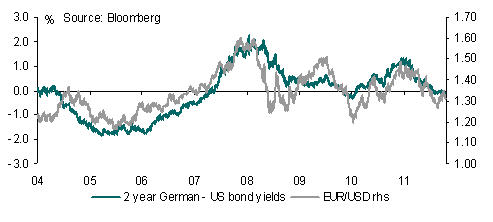
The bottom line is that the EUR is suffering from a widening in the US / Europe (Germany) bond yield differential as it is becoming increasingly clear that the US economy will strongly outperform the Eurozone economy this year. As noted at the beginning of the week EUR/USD was set to drop to below support around 1.3055. Having hit this level, strong support around the 1.2974 level moves into sight.
Ahead of today’s quarterly Swiss National Bank meeting at which no change in policy is widely expected, EUR/CHF has taken a sharp lurch higher, finally moving away from around the 1.2050 level it has been trading at over recent weeks. While I am bearish on the CHF over the medium term further upside in EUR/CHF will be limited over the short term given that the move in the currency is at odds with interest rate differentials which have actually narrowed between the Eurozone and Switzerland. Technical resistance around 1.2298 will cap gains over coming sessions.

As for USD/CHF the picture remains a bullish one, with general USD strength driven by higher yields, pushing the currency pair higher. I look for a test of resistance around 0.9393 over coming sessions.

USD boosted by bond yields, AUD vulnerable

The USD rallied further overnight helped by a Fed FOMC statement that was less downbeat than in January, with no hint of any further quantitative easing. In combination with a solid February retail sales report and upward revisions to December and January, US bond yields pushed higher. US 2-year Treasury yields hit their highest since the beginning of August 2011, which given the strong correlation with the USD, provided further support to the currency.

The highest FX sensitivity to yield differentials is found in JPY, AUD, SEK, and CAD over the past 3-months. However, among these US yields have only widened against Japan over recent days meaning this currency is the most vulnerable. For the other currencies their yields have actually been widening against the USD. Over the near term, the USD is set to remain well supported, especially as data releases over the rest of the week will maintain the tone of strengthening economic activity.

AUD looks increasingly vulnerable to further short term slippage. At least partly explaining the recent drop in AUD/USD is a narrowing in Australia’s yield advantage over the US. A spate of weaker data over recent weeks has helped to undermine the currency including Q4 GDP data which revealed a far slower pace of growth than had been expected. Weak jobs data reinforced the view that the economy is spluttering.

The net result is that Australian interest rate futures have rallied and implied yields have dropped in contrast to the US where futures have sold off in the wake of strengthening economic data. The casualty of all of this is the AUD and it appears that further downside risks are in store for the currency. Indeed my quantitative models show that the AUD continues to trade well above its short term ‘fair value’. For those wanting to take medium term long positions in the AUD I would suggest rebuilding longs around 1.03-1.04 versus USD.

Limbo ahead of Fed FOMC meeting

A mixed session overnight leaves markets with little direction ahead of the Bank of Japan and Federal Reserve FOMC meetings today. There was no stimulus for markets from the meeting of European officials yesterday while Greece’s debt swap has failed to boost confidence.

Overall there is a real hesitancy for investors to take positions, with both volumes and volatility remaining very low. For instance the VIX volatility gauge has dropped to its lowest level since May 2011 while my measure of composite FX volatility continues to languish at relatively low levels compared to last year.

The USD has little to fear from the Fed FOMC meeting tonight. If anything it may even benefit from a less downbeat statement from Fed Chairman Bernanke following the meeting. Growing speculation that the Fed will embark on some form of sterilised quantitative easing, i.e. not printing any more money, bodes well for the USD too.

Ahead of the FOMC decision a firm February retail sales report will help add to the plethora of evidence revealing stronger signs of US recovery. A key indicator to watch in this respect is the (National Federation of Independent Business (NFIB) report of small business confidence which should also strengthen. Importantly for the USD the data should also help to maintain pressure on US bonds, keeping yields elevated and in turn the USD supported.

The BoJ meeting today will not deliver any surprises, an outcome that will likely leave the JPY largely unmoved. Speculative sentiment for the JPY has shifted negatively as reflected in the latest CFTC IMM report which reveals the biggest short position in the currency since April last year.

Crucial in pushing the JPY weaker has been the widening in bond yield differentials with the US, thanks largely to a rise in US bond yields. The 2-year yield gap is now around 20 basis points, the highest gap since August 2011. This will help to keep USD/JPY supported but my quantitative models suggest that the upmove may be overdone in the short term, with a correction lower in prospect to technical support around 81.44.

US dollar on a firm footing

The stronger than expected US February jobs report (227k versus 210k consensus) and the Greek debt swap should by rights have set a positive tone to markets this week. Unfortunately this is not the case and cautious is set to prevail, with sentiment dampened in part by China’s wider than expected $31.5 billion trade deficit posted in February.

Officials in Europe are set to finalise Greece’s second bailout today but sentiment is unlikely to be boosted as various concerns creep into the market. Growing scepticism about the fact that the Greek bailout fails to correct the country’s underlying problems, worries about whether Portugal will follow in Greece’s wake, fiscal slippage in Spain and the Irish referendum, all point to ongoing tensions in the weeks ahead.

The Federal Reserve FOMC meeting takes centre stage over coming days while data releases including retail sales, industrial production and manufacturing surveys will also prove important for USD direction. The USD reacted positively to the lack of quantitative easing (QE) hints by Fed Chairman Bernanke recently and the stronger than expected February jobs report has reinforced this view.

The USD starts the week on a firm footing but could face renewed pressure if the FOMC statement proves to be more ambiguous on the issue of QE. US data releases will reinforce signs of economic recovery and if they play into a ‘risk on’ tone the USD could suffer. We believe this is unlikely however, with risk assets set to correct lower over coming weeks, playing positively for the USD.

Having rallied following the growing optimism over the Greek PSI debt swap the EUR will find limited support in the days ahead. News of 85.8% participation will have come as relief but the use of collection action clauses (CAC) is not so positive. At least finalisation of the second Greek bailout will now move ahead, with officials set to rubber stamp the deal today.

Data releases such as the March German ZEW survey tomorrow will highlight the sharp turnaround in investor confidence following the ECB’s LTRO and progress on Greece. This would usually bode well for the EUR. However, it is already proving to be a case of buy on rumour, sell on fact outcome for the currency. Potential for a drop below support around EUR/USD 1.3055 is growing as the USD builds momentum.

Following February’s surprise decision by the Bank of Japan to expand its asset purchases and set an inflation goal, the outcome of the policy meeting on Tuesday will deliver few punches. Having weakened in the wake of the last BoJ meeting, partly as a result of higher US bond yields relative to Japan, the JPY threatens to pull back against the USD to support around 80.50.

Improved risk appetite has helped to maintain some pressure on the JPY but this impact ought to prove limited unless yield differentials continue to widen. While the BoJ’s actions will likely keep Japanese government yields supressed, JPY direction will continue to be dictated by the gyrations in US bond yields.

USD finding support, AUD slipping

US bond yields look relatively well supported and in turn this is providing a degree of support for the USD. In this respect the firmer than consensus reading in a gauge of service sector activity, the February US ISM non-manufacturing survey (57.3 versus 56.8 in January) which contrasted with relatively weak service sector purchasing managers’ indices (PMI) in Europe, helped to maintain the healthy yield differential between the US and German bunds.

Combined with the generally ‘risk off’ sentiment pervading markets, in part due to the weaker PMI data, the USD looks to be in good form early in the week. The next market mover will be Wednesday’s ADP jobs report (a measure of jobs growth in the services sector), which will provide clues to Friday’s February non-farm payrolls outcome. In the meantime the fact that the speculative market (IMM) is positioned short USD (for the first time since September 2011) suggests that the room for further USD selling looks limited, with the USD index looking well supported above 79.00.

AUD and other high beta currencies lost more ground in the wake of the drop in the Chinese non-manufacturing PMI in February. AUD remains highly reactive to Chinese data releases given the high and growing exposure of Australia’s economy to China. Given the likelihood of a soft landing in China this year, the medium term damage to the AUD will be limited and I stil look for AUD/USD to reach 1.10 by year-end.

Over the near term however, there is scope for more AUD downside but much will depend on the outcome of the Reserve Bank of Australia (RBA) policy meeting. Expectations of rate cuts have diminished following recently better data and a less dovish statement at the last RBA meeting. A relatively benign statement will offer the AUD little support, leaving AUD exposed to a drop to technical support to just under 1.06 versus the USD.

Posted in Australia, FX, US. Tags: , , , , , . Leave a Comment »