Remaining constructive on AUD

In contrast to the consensus view I remain rather constructive on the AUD. As reflected in the RBA minutes today the central bank has shifted its stance somewhat, effectively closing the door on further policy easing while finding it difficult to talk the currency lower as inflation pushes higher.

Separately although Chinese growing is slowing this year assuming that growth does not fall too far and too quickly the AUD is unlikely to suffer much from this source.

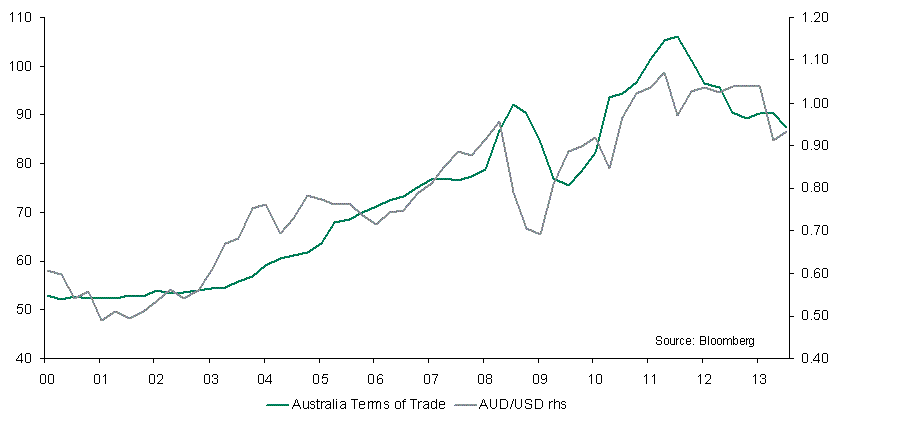
A lot bad news for AUD has been largely priced in. Firstly, the drop in AUD/USD has been consistent with the deterioration in terms of trade.

Secondly Australia’s broad basic balance position is quite healthy as strong direct investment and portfolio inflows counter a current account deficit.

Thirdly, even when looking at China’s growth trajectory the AUD is at a level which discounts this. Near term resistance for AUD/USD is seen around 0.9087.

AUDTOT

Posted in Australia, FX. Tags: . Leave a Comment »

Positive tone to be sustained

A quiet start to the week following the President’s Day holiday in the US saw mixed performances among European equity markets overnight. There was however, a continued improvement in risk appetite as indicated by a further decline in the VIX “fear gauge”.

The impulse provided for today’s sessions is limited although markets are likely to get off to a positive start. The USD managed to show some stability following recent pressures, albeit at a low level, while gold prices remained supported above the key 200 day moving average level.

The main event today is the Bank of Japan policy decision which will be watched closely following yesterday’s release of disappointing Q4 GDP data.

The German February ZEW survey is also on tap, with a relatively stable reading likely to be registered although attention appears to be more on the new Italian Prime Minister Matteo Renzie rather than on economic data.

Additionally UK inflation data for January is set to reveal that inflation has dropped below target highlighting that the BoE is going to be in no rush to hike policy rates over coming months

What to watch this week

Despite a slow start to the week there are plenty of events and data this week for markets to chew on for further direction including in the US the February Empire and Philly Fed manufacturing surveys, January housing starts and existing home sales, as well as CPI and PPI inflation and FOMC meeting minutes. Overall the data will look relatively unimpressive, with softer manufacturing confidence, weaker housing data and benign inflation readings likely.

In the Eurozone, the flash purchasing managers’ indices will capture most attention. A slight softening is expected but this will not alter the picture of gradual recovery in the Eurozone economy. Indeed, last week’s better than expected Eurozone GDP release revealing broad based growth of 0.3% in Q4 highlighted the positive recovery path, in turn maintaining positive sentiment for the EUR.

On the policy front the Bank of Japan decides on policy tomorrow but no change is expected despite a disappointing Q4 GDP release this morning, which revealed that growth came in at a paltry 0.3% QoQ compared to 0.7% expected. Nonetheless, the weaker GDP data highlights that the BoJ and government has a big job to do in the months ahead especially given the risks to growth from the upcoming consumption tax hike. USD/JPY may find some support if the data translates into expectations of more aggressive BoJ action.

Posted in eurozone, Japan, US. Tags: , , . Leave a Comment »

US dollar under pressure

US stocks have clawed back almost all their losses registered in the wake of the mini emerging markets crisis in January. The S&P 500 closed at 1838.63, up 0.48% on Friday. The rally in stocks is impressive considering the run of weaker than forecast US data releases over recent weeks although investors appear to be placing much of the blame on poor weather conditions. The gains in US stocks echoes the generalized improvement in risk appetite, with sentiment towards emerging markets also having stabilized.

The USD continues to be a casualty of the firmer risk tone, with a lack of upward momentum in US yields also not helping the currency (10 year US Treasury yield around 2.7428%). The USD index is now close to its lows for the year around 80.00, with the JPY and commodity currencies the biggest gainers so far this year among major currencies. In terms of emerging market currencies the Indonesian rupiah and Thai baht have been the best performers versus USD.

Despite the firmer tone to risk, gold prices have continued their ascent, closing above their 200 day moving average at the end of last week. As I wrote in Gold breaches its 200 day moving average, I don’t expect the rally in gold prices to be sustained. Some market consolidation is likely today with a lack of key data releases and a US holiday (President’s Day) keeping activity subdued.

Posted in US. Tags: , , , . Leave a Comment »

Gold breaches its 200 day moving average

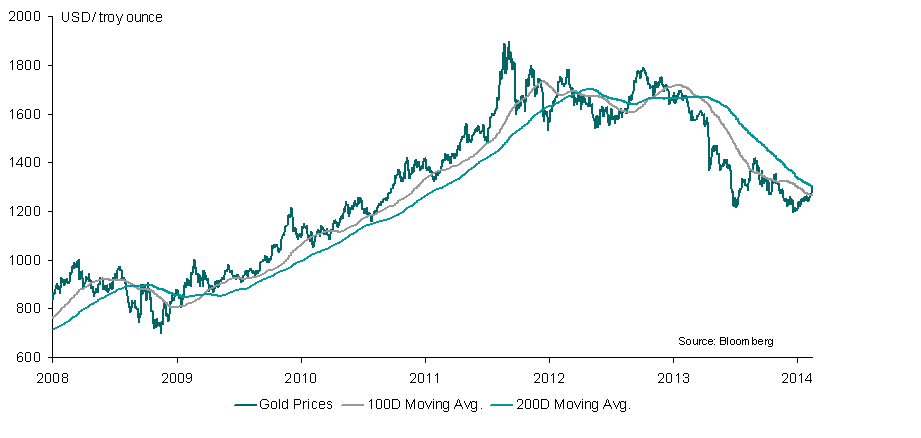
AUDjobsGold prices have risen sharply since the beginning of the year, up over 8% year to date. Higher risk aversion, lower US yields and a weaker USD have boosted gold. Consequently gold prices are trading around their 200 day moving average level around 1303.70. This could prove significant, with a close above the 200 day moving average important to sustain any short term uptrend,

Encouraging signs for gold bulls
ETF investor demand appears to have stabilised over recent weeks while CTFC IMM demand appears to be picking up. This data suggests that Investors are tentatively moving back into gold. The poor performance of equity markets since the start of the year has indeed made gold look more attractive as an investment while lower yields mean that the opportunity cost of holding gold has lessened.

Chinese demand for gold increases sharply
Additionally gold demand from China has picked up strongly. China Gold Association data showed that Chinese demand for gold jumped 41% to 1,176 tonnes last year. Chinese demand likely overtook India’s last year. Oddly Chinese import and production data were even stronger, making it possible that China bolstered its reserves with gold last year.

Indian restrictions hit demand
India restricts demand for gold via import restrictions. However, there is a lot of pressure domestically to remove these restrictions and a review is scheduled to take place at the end of the fiscal year at end March 2014. If these restrictions are removed or at the least weakened, Indian gold imports could increase sharply but it seems unlikely that imports will rise as strongly as previous years.

Moreover, the Indian government will want to avoid an adverse impact on India’s current account deficit, suggesting that a complete removal of gold import restrictions is unlikely. However, in the meantime the restrictions are having a major impact on Indian gold demand which dropped sharply last year.

Gold rally to fade
Risk appetite has already improved sharply over February and while I continue to expect bouts of volatility in the weeks and months ahead I do not expect to see sustained periods of elevated risk aversion. Therefore any boost to gold from rising risk aversion is set to prove temporary in the months ahead.

Secondly global inflation pressures remain well contained. Inflation for the major economies is likely to remain benign. Only in Japan is inflation expected to pick up but this is an aim of policy and is not expected to result in a bout of gold buying to hedge against such inflation risks. Therefore, gold demand as an inflation hedge will not take place.

Two major drivers of the gold price are US bond yields and the US dollar. Both are highly correlated with gold price gyrations, with gold falling as US yields and the USD rise and vice-versa. Both yields and the USD are set to rise over the coming months. Consequently any short term gold price gains are unlikely to hold, with the metal set to resume its decline.