Euro Rally To Fade

It is not an easy time to forecast currencies. Just as many forecasters fought for the accolade of being the most bearish on the EUR and many others were forced to capitulate or risk falling behind the curve, EUR/USD has started to perk up. Similarly, commodity currencies and many emerging market currencies have bounced.

Perhaps the explanation of these moves is merely position adjustments as traders and investors square positions as they keep one eye on the World Cup or maybe its just fatigue after weeks of selling pressure. Either way, the fact that speculative USD market positioning is at a very high level, suggests there is plenty of scope to take profits on long USD positions.

There are various reasons to expect the calm to give way to renewed tensions, however. Public opposition to austerity plans in Europe, added to the prospects for slowing growth as the plans are implemented, in addition to banking sector concerns, suggest that the outlook for the EUR remains downbeat. These factors also point to the prospects of risk aversion rising over the coming weeks, reversing the recent rally in risk currencies.

Further out, the EUR’s travails will not be over quickly and in the wake of the implementation of austerity plans the EUR will struggle from the impact of relatively slower growth in the eurozone compared to the US and other countries. The EUR will continue to remain under pressure even as risk appetite improves and many risk currencies appreciate.

The interruption of risk as an FX determinant is likely to fade towards the end of the year and investors will then go back to differentiating on the basis of relative growth and interest rate dynamics, which will play well for the USD as US growth strengthens.

Relative growth differentials will also bode well for commodity currencies and there will be scope for plenty of upside in the AUD and NZD as growth strengthens. Both countries have benefited from firm demand in Asia and China in particular and this source of support will likely continue to be beneficial.

Funding currencies including JPY and CHF will likely weaken this year against the USD based on the likely improvement in risk appetite later this year. The outlook for the JPY will be particularly interesting in the wake of the change in Prime Minister in Japan, especially given the new PM’s preference for a weaker JPY and reflationary policies. USD/JPY will likely reach 100 by the end of the year.

GBP should not be seen in the same context as the EUR. Although the UK has got its own share of fiscal problems the new government appears to be moving quickly to mollify both investor and ratings agency concerns. The test will come with the reaction of the emergency budget on June 22nd but I suspect that the downside risk to GBP will be limited.

Unlike the EUR which is trading around “fair value”, GBP is highly undervalued. Arguably past GBP weakness puts the UK economy on a stronger recovery footing. Moreover, problems that Europe will face in implementing multi country austerity plans and widening growth divergence, will not be repeated in the UK. Overall, there is likely to be significant outperformance of GBP versus EUR over coming months
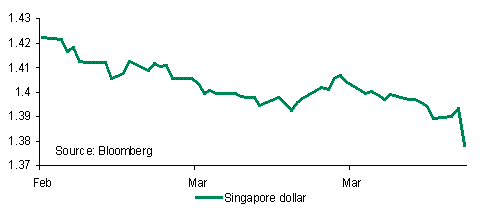
Singapore revalues, Asian currencies jump

The positive tone to risk appetite is keeping the USD on the back foot and for once FX attention has turned away from events in Greece. Before elaborating further and staying with Greece, it’s worth highlighting that the outcome of Greece’s note auction was reasonably solid, with more debt than anticipated being sold. However, the cost of borrowing for Greece rose compared to the previous auction in January, which means that the Greece will still suffer higher funding costs to roll over debt.

The positive reception to the debt offering was not particularly surprising given that it followed so closely after the EU/IMF loan package announcement but it is difficult to see sentiment for Greece and the EUR for that matter, getting much of a lift. The main positive for the EUR is the fact that market positioning remains very short but EUR/USD is likely to struggle to make much headway above technical resistance around 1.3653.

More interestingly Asian central banks are continuing on the track towards fighting rising inflation pressure and Asian currencies, in particular the SGD, were boosted by the Monetary Authority of Singapore (MAS) decision to revalue its currency. Singapore has moved back to a policy of a “modest and gradual appreciation” of the SGD from a policy of zero appreciation, which obviously implies openness to further FX appreciation in the weeks and months ahead.

The rationale for the decision was clear and as revealed in the strong first quarter Singapore GDP data which revealed a 13.1% annual rise. Stronger growth is fuelling growing inflationary concern and to combat this Singapore’s MAS will allow greater SGD appreciation. The reaction in other Asian currencies was also positive, with markets (quite rightly in my view) that other Asian central banks will be more tolerant of currency strength in their respective currencies.

Moreover, Singapore’s move was pre-emptive, perhaps with one eye on an imminent revaluation in China. The recent easing in tensions between the US and China has if anything increased the likelihood that China revalues its currency, the CNY, sooner rather than later, and most likely before the end of Q2 2010. Whatever the rationale, strengthening inflation pressure across the region, will mean a less FX interventionist stance in Asia, and likely stronger currencies over coming months.

Q1 Economic Review: Elections, Recovery and Underemployment

I was recently interview by Sital Ruparelia for his website dedicated to “Career & Talent Management Solutions“, on my views on Q1 Economic Review: Elections, Recovery and Underemployment.

Sital is a regular guest on BBC Radio offering career advice and job search tips to listeners. Being a regular contributor and specialist for several leading on line resources including eFinancial Careers and Career Hub (voted number 1 blog by ‘HR World’), Sital’s career advice has also been featured in BusinessWeek online.

As you’ll see from the transcript of the interview below, I’m still cautiously optimistic about the prospects for 2010 and predicts a slow drawn out recovery with plenty of hiccups along the way.

Sital: Mitul, when we spoke in December to look at your predictions for 2010, you were cautiously optimistic about economic recovery in 2010. What’s your take on things after the first quarter?

Click here to read the rest…

Why Buy Asian FX (Part 2)

The strength of portfolio capital inflows into Asia reflects the outperformance of Asian economies relative to Western economies. Whilst the US, Europe, Japan and UK have struggled to recover from recession and are likely to register only sub-par recovery over the coming months, Asian economies led by China are recovering quickly and strongly. This pattern is set to continue, leading to a widening divergence between Asian and G7 economic growth.

As growth strengthens inflationary pressures are set to build up and Asian central banks will likely raise interest rates more quickly than their G7 counterparts. Already some central banks have moved in this direction, with India, Malaysia, Philippines and Vietnam, having tightened policy. This will be followed by many other central banks in Asia over Q2 2010 including China. Even countries with close trade links to Asia, in particular Australia will rate hikes further over coming months, with Australian interest rates likely to rise to a peak of 5% by year-end.

Given that the US is unlikely to raise interest rates in 2010 higher interest rates across Asia will result in a widening in the interest rate differential with the US leading to more upside potential for Asian currencies as their ‘carry’ attraction increases relative to the USD. The most sensitive Asian currencies to interest rate differentials at present are the Malaysian ringgit (MYR), Thai baht (THB) and Philippines peso (PHP) but I believe that as rates rise in Asia, the sensitivity will increase further for many more Asian currencies.

Most Asian currencies have registered positive performances versus the USD in 2010 led by the MYR and Indonesian rupiah (IDR) and closely followed by the Indian rupee (INR), THB and South Korean won (KRW). The notable exception is China which has been unyielding to pressure to allow the CNY to strengthen. Even China is set to allow some FX appreciation although if the US labels China as a “currency manipulator” it could prove counterproductive and even result in a delay in CNY appreciation.

Looking ahead, the trend of strengthening Asian FX will continue likely led by the likes of the KRW and INR but with the MYR, TWD and IDR not far behind. Stronger growth, higher interest rates, strengthening capital inflows and higher equity markets will contribute to appreciation in Asian currencies over the remainder of the year.

Why Buy Asian FX (Part 1)

Given all the attention on Greece and European fiscal/debt woes over recent weeks it’s been easy to forget about the success story of Asian economies. Of course, there has been a lot of attention on China and the international pressure to revalue its currency. However, the stability and resilience of Asian economies has been impressive throughout the financial crisis and recent Greek saga, helping to boost the attraction of Asian currencies.

Asia has managed to avoid the fiscal/debt problems associated with many developed economies, due to much better fiscal management over recent years. There are a couple of exceptions however, including the Philippines and India, but the fiscal positions in these countries have seen an improvement and are unlikely to lead to anywhere near the same sort of problems associated with Greece and other European countries.

So far this year capital inflows into Asian equity markets have much been stronger than 2009, albeit after a rocky start to the year when flows dried up due to rising risk aversion. Since then inflows have resumed strongly. The comparison to 2008 is even more dramatic as much of Asia registered significant capital outflows that year. South Korea, India and Taiwan, respectively, have led the way in term of inflows into equity markets in 2010, with inflows of $4.3 billion, $3.7 billion and $3.3 billion, respectively.

It is no coincidence that Asian currencies are most sensitive to the performance of Asian equity markets, with strong capital inflows and rising equities leading to stronger currency performance. Asia is set to continue to be a strong destination for equity flows over coming months, which given the high Asian equity correlation with local currencies, will lead to further appreciation in most Asian FX. A likely CNY revaluation in China will also help to fuel further Asian FX upside.