Greek Aid Boosts Euro

Greece is never far from the headlines and the big news over the weekend was once again centred on this small (in terms of economy size) eurozone Country, with the agreement by Eurozone members to provide up to EUR 30 billion in loans to Greece. This will be supplemented by additional contributions from the IMF to the tune of around EUR 15 billion. The rate of around 5% for the three-year fixed loan is well below that yielding on Greek debt but above the International Monetary Fund (IMF) standard lending rate. In other words, the terms of the loan are far more favourable than they would currently face in the market.

After weeks of haggling the decision to detail the amount and terms of a loan for Greece will help reassure markets and likely result in a narrowing in Greek spreads over the near term. Further details will be finalised early in the week including conditions imposed on Greece as well as the exact amount of the IMF contribution but the real test of confidence will be the reception to Greece’s EUR 1.2 billion sale of 3 and 6-month paper at the beginning of the week.

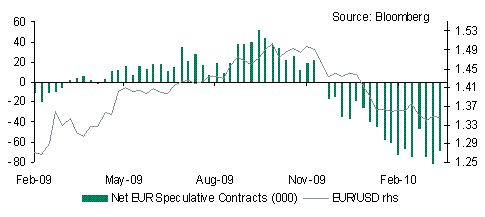
Markets were already embarking on a short covering exercise in EUR/USD early last week according to the latest CFTC IMM report which showed a reduction in net EUR short speculative positions. As a result of the weekend’s agreement the EUR looks set to consolidate its gains into the beginning of this week. Further out, there are still plenty of risks ahead and sellers are likely to emerge around EUR/USD resistance at 1.3696.

Data releases this week will be conducive to maintaining further support for risk appetite whilst shoring up recovery expectations. In particular US March retail sales are set to jump on the back of strong autos spending (consensus 1.2% monthly gain). March industrial production is also likely to record a healthy reading (consensus 0.7% month-on-month), whilst gains in both manufacturing (Empire manufacturing and Philadelphia Fed) and consumer confidence (Michigan confidence) for April are likely.

There will also be plenty of attention on Chinese data this week with a plethora of releases over coming days including FX reserves, GDP, loans data, inflation, retail sales and industrial production. In short, the data will continue to reveal a robust economic performance, which will be good for risk appetite and Asian currencies, but will also add to the pressure to revalue the Chinese currency, CNY, soon.

The USD impact will depend on whether the market reacts to firmer risk appetite or signs of stronger US growth. I suspect the former will apply for now, likely keeping the USD on the back foot early in the week. The main beneficiaries include risk currencies such as AUD, NZD and CAD as well as most Asian currencies. AUD/USD is set to target technical resistance around 0.9407 whilst NZD/USD will set its sights on resistance around 0.7252 over the next few days.

Calming the Tiger

As markets enter the year of the Tiger a somewhat calmer tone appears to be ensuing, with risk appetite edging higher helping equities and the beleaguered EUR to recover some lost ground.  US stocks were helped by a firmer than expected reading for the Empire manufacturing survey (to 24.91 in Feb) and a slight uptick in the US NAHB (National Association of Home Builders) index (to 17 in Feb) but consumer confidence remained weak as indicated by the decline in the weekly reading of ABC Consumer Confidence (-49).  

On the other side of the pond the better than expected February ZEW survey (a survey of investor confidence) in Germany (45.1) helped sentiment although it still recorded a decline from the previous month as Greek fiscal/debt concerns weighed on financial market participants’ confidence.  The bigger impetus came from comments by Greek Finance Minister Papaconstantinou who said there would be no need to for a bailout of the country.

Tensions over Greece eased further following news that tax collectors in the country called off a planned strike, helping to allay some concerns that unions will block planned spending cuts.   On the policy front, the EU Council ratified Greece’s plans but with strings attached, giving the country one month to present a report on the timetable for implementing budget cuts for 2010 and three months to outline policy measures required to cut the deficit below 3% by 2012.

Meanwhile, commodity prices have pushed higher helping currencies such as the AUD and NZD to strengthen.  Moreover, the AUD was boosted by more hawkish interest rate expectations following the release of the minutes of the latest RBA policy meeting which indicated that the Reserve Bank was merely pausing in its rate cycle.  Expectations of a rate hike in March increased as a result.

Overall, the recent rally in the USD is looking increasingly overdone and some reversal is likely over coming weeks.  The fact that market positioning has reached extreme levels in particular in the case of the EUR highlights scope for some recovery in the currency, especially now that the worst case scenario of a Greek default has passed.  The outlook for commodity currencies is even more bullish as risk appetite improves further.     

If anything, data today is likely to give further support to the recovery story, with US industrial production and housing starts expected to post healthy gains.  The Fed FOMC minutes may offer some additional insight into the debate over the implementation of exit strategies but there is unlikely to be much elaboration from the recent comments by Fed Chairman Bernanke in his speech to the US Senate in which he hinted that a rise in the discount rate is not far off.  

Risk currencies including many Asian currencies are likely to benefit from the improvement in risk appetite over the short term.  EUR/USD will likely strengthen as more short positions are covered but will face strong technical resistance around 1.3839.   Asian currencies have been resilient to the recent rise in risk aversion and this is likely to continue over the coming weeks.  As risk appetite recovers currency plays including long AUD/JPY , and even some further upside in EUR/USD look favourable.

Tarnishing The Euro (Part 2)

Will Europe come to the rescue of one its own?  The markets are still not entirely convinced.  Although EU officials spurred on by France and Germany agreed that some form of support was needed the lack of detail came as a disappointment.   Differences in opinion on how help should be provided meant that markets had nothing concrete to digest aside from a general agreement to provide assistance if needed. 

The EU validated Greece’s plans to cut its budget deficit by 4% this year but clearly backed away from committing taxpayers’ money to the country given the potential public backlash that supporting a country widely believed to have fudged its way into the EMU, would involve.   The end result was a further sell-off in the EUR although equity markets showed a bit more resilience which prevented a sharper fall in EUR/USD. 

Risk currencies generally are putting in firmer performances, with the AUD helped in part by the shockingly strong employment report and higher commodity prices.  The AUD and to a lesser extent the NZD are likely to continue to bask in the warm glow of these factors, with AUD/USD setting its sights on technical resistance around 0.8944.  EUR/USD is the weakest link and continues to trend lower, with strong technical support seen around 1.3583.

What To Watch This Week

As usual the G7 meeting will leave markets with little to chew on. G7 officials maintained their commitment to stimulus measures and timely exit strategies but there was little of note for FX markets aside from the usual comments about wanting to avoid excess FX volatility. There was certainly know step up in pressure on China to strengthen though a report prepared for the meeting did push for countries with inflexible currencies to make adjustments. Meanwhile US officials mouthed the usual “strong dollar” mantra.

Where does this leave markets this week? Well I must admit my bullish view on risk currencies is clearly suffering after a positive start to the year. The pullback in high beta currencies (those with the highest sensitivity to risk aversion) has been dramatic. I have highlighted many of the factors weighing on sentiment in previous posts and whilst I still think the US dollar will find itself under renewed pressure over coming months the current environment remains conducive to more USD and JPY buying and selling of currencies such as the AUD, NZD, CAD, GBP, NOK, SEK, ZAR etc.

Ironically the US and Japan have arguably more severe deficit/debt concerns than some of the European countries under pressure but as most of Japan’s debt is held domestically there is little worry of a collapse in JGBs. Unlike Japan foreign investors hold over half of US debt but are not yet losing confidence with US Treasuries though this may not last unless there is some tangible sign that the burgeoning US budget deficit is being reduced. For now, attention remains firmly focussed on Greece, Spain, Portugal and to a lesser extent Italy.

Like the G7 meeting the US January jobs report released at the end of last week will give little direction for markets. Although the 20k drop in payrolls and revisions to past months were slightly disappointing the surprise drop in the unemployment rate was better news. This week’s data highlights include the January US retail sales report and December trade balance. The sales data is likely to help allay some concerns about faltering economic recovery, with retail sales forecast to rise over the month despite a likely pull back in autos spending.

How will this play out for currencies this week? Overall, the risk off tone is set to continue though the moves are looking increasingly stretched. The USD, JPY and CHF will remain on the front foot whilst risk currencies will remain under pressure. The EUR is set to continue to struggle against the background of eurozone deficit concerns and after its dive through 1.40 last week 1.35 now looms large. Meanwhile, the AUD may also struggle following the recent reassessment of interest rate expectations after the recent Reserve Bank of Australia (RBA) meeting in which interest rates were left unchanged.

UK markets will focus on the Quarterly Inflation Report from the Bank of England though the political situation may hold some interesting implications for GBP if polls continue to show that the gap between the governing Labour party and Conservative opposition continues to narrow. Prospects of a hung parliament will hardly hold any positive implications for GBP, a prospect which could limit any potential for GBP to recover ahead of May elections. The drop below 1.60 for Cable (GBP/USD) could extend further, especially as the BoE has kept the door open to further asset purchases if needed.

Central banks in the spotlight

The market mood continues to be weighed down by a combination of worries including monetary tightening in China and Greece’s debt woes. Consequently, risk aversion has taken a turn for the worse over the last couple of weeks. Measures of currency and equity market volatility have also spiked. Meanwhile, risk currencies have remained under pressure, especially those that are most sensitive to risk aversion including AUD, NZD, CAD, and a long list of emerging market currencies.

Greece’s problems remain a major drag on the EUR, with speculative sentiment for the currency dropping close to the all time low recorded in September 2008, according to the CFTC IMM data. Further developments including news that the European Commission will officially recommend that Greece should implement more severe cuts on public sector spending are unlikely to help to reverse negative sentiment for the currency. A lack of confidence and scepticism over Greece’s ability to cut its budget deficit suggest little respite for the EUR in the weeks ahead.

Markets will have plenty of other things to focus on this week, with various manufacturing and service sector PMIs, four major central bank decisions, and the January US non-farm payrolls report, due for release. The PMIs are likely to confirm that output in both manufacturing and service industries remains expansionary but only consistent with limited growth rather than the rapid rebound in activity seen following past recessions.

The most interesting central bank decision this week is likely to be that of the Reserve Bank of Australia. Recent data has if anything given more reason for the central bank to raise interest rates, including the latest release which was the TD Securities inflation gauge, which jumped 0.8% in January, the biggest increase in 6-months. Although a hike is now largely discounted, some hawkish rhetoric from the RBA could be sufficient to give the AUD some support.

Although the UK Bank of England is unlikely to shift policy at its meeting on Thursday the statement will be scrutinized for clues as to whether quantitative easing is over. Any indication that there will be no further QE measures will play positively for GBP given that it has been restrained by speculation that the BoE will increase asset purchases. No change is also expected by the ECB but once again Greece will likely dominate the press conference. Meanwhile Norway’s Norges Bank is likely to pause in its policy of gradual tightening.

Clearly the funding currency of choice, the USD, has been one of the main beneficiaries of higher risk aversion and this has been reflected in the latest CFTC Commitment of Traders report, which shows that net short aggregate USD speculative positions have dropped sharply, with USD positioning close to flat again. Similarly, the other beneficiary, namely the JPY, has also seen a significant shift in positioning as shorts have been covered. Expect more to come.

Appetite for carry trades was not be helped by the news that the UK’s Lord Turner has signalled a regulatory crackdown on FX carry trades. The report in the UK press fuelled a sell of in JPY crosses but is unlikely to have more than a short term market impact given the practical difficulties in regulating carry trades. Nonetheless, the fact that speculative positioning is still quite long in the AUD, NZD and CAD suggest scope for more downside in such currencies in the current risk averse environment.