Australian retail sales rose 0.5% in December in line with expectations although the ex inflation quarterly increase was lower than forecast at 0.9%. However, there was a revision higher to the previous quarter. The bigger news is that the December trade balance came in much better than expected, recording a surplus of AUD 468 million compared to a deficit of AUD 200 million expected. Business confidence also came in strong rising to 8 in Q4 from an upwardly revised reading of 5 in Q3. The data bodes well for AUD, with the currency set to find further support in the short term. If anything, it also helps to validate the RBA’s message that the easing cycle is over. A break above AUD/USD 0.90 is now on the cards.
 MarketWatch.com – MarketPulse
- Jobless claims fall to lowest level since mid-May
- Jobless claims stay low in latest week
- Consumer credit growth soars in December
- U.S. productivity slows down in fourth quarter while unit labor costs accelerate
- Beyond to buy rights to Buy Buy Baby brand and reunite it with Bed Bath & Beyond
- Trump asks Supreme Court to pause TikTok ban
- Amazon says it had best-ever Thanksgiving Holiday week with record sales and number of items sold
- U.S. stock futures and bond yields drop on reports Putin has updated nuclear doctrine
- Charter Communications announces buyout deal for Liberty Broadband at terms above its previous proposal
- General Motors unveils new all-electric Cadillac called the Vistiq with 300-mile range
RBA statement bullish for AUD
February 4, 2014 — Mitul Kotecha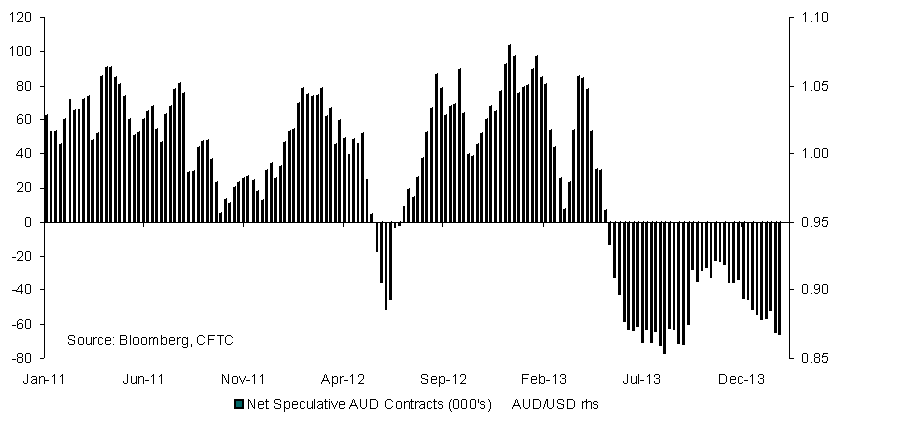
AUD has held up relatively well considering the pressure on risk currencies in general. The fact that speculative positioning in AUD has already fallen to extreme levels suggests 1) scope for further downside is limited and 2) AUD could bounce strongly in the event of good news.
In the event, the RBA unsurprisingly left policy rates unchanged but focussed attention on the recent rise in inflation. The RBA highlighted in its accompanying statement that inflation has been higher than forecast. Moreover, the RBA does not appear to be actively talking the AUD down but highlighting the benefits of past AUD weakness if sustained.
Overall, the statement is bullish for the AUD especially as it appears to confirm that the policy easing cycle is over. Consequently the bounce in AUD following the rate decision is likely to be strong.
AUD/USD technical support is seen around 0.8660, with resistance at 0.8889.
Some respite for emerging market assets
January 29, 2014 — Mitul KotechaLarge gains in many emerging market currencies have been registered in the wake of policy rate hikes in Turkey and to a lesser extent in India. Also some encouraging data in Asia in particular a widening in South Korea’s current account surplus helped to shore up confidence in regional currencies. Not wanting to throw cold water on the move but while everyone is lauding Turkey for its bold move the reality is that its aggressive rate hike will hit growth at a time when its economy is fragile.
The massive rate hike in Turkey (repo rate hiked from 4.5% to 10%) fuelled a bounce in risk appetite nonetheless, although most risk measures have only reversed part of the move registered over recent days. It is way too early to suggest that everything is returning back to normal and the rally in risk assets looks vulnerable to fading out over coming days.
While I am not a proponent of the nervousness in emerging markets turning into a renewed crisis, uncertainty about country specific issues such as slowing growth and deleveraging in China, fundamental and political uncertainties / elections in Thailand, India, Indonesia. Ukraine and countries in the “fragile 5” against the background of Fed tapering, suggest rocky times ahead.
Moreover, the market may have priced in another $10 billion of Fed tapering today but the reality is that the global liquidity injections provided by the Fed will be reduced over coming months. Additionally a likely renewed rise in US Treasury yields will add another layer of pressure on emerging market assets.
Although emerging market currencies have strengthened most G10 currencies remain in a tight range. G10 FX gains were led by the AUD and NZD while JPY came under renewed pressure. This pattern is likely to continue in the near term. Aside from the Fed FOMC there will be some attention on the Reserve Bank of New Zealand too. The RBNZ is expected to keep policy rates unchanged but there is a small chance of rate hike or at the least a hawkish accompanying statement which ought to keep the NZD supported.
AUD oversold, GBP running into resistance
January 21, 2014 — Mitul KotechaAUD/USD has faced a significant bout of pressure since testing a high of around 0.9087. A dismal jobs report in December piled on more pressure on the currency and since then it has failed to recover. Consequently short speculative positioning has increased as sentiment has deteriorated. Yesterday’s slate of Chinese data failed to dent the AUD however, with the currency encouragingly showing some resilience.
Attention will now turn to tomorrow’s CPI inflation data. The release of the TD Securities inflation gauge which printed higher than consensus, highlights upside risks to the release of Q4 CPI and in this respect I believe market expectations of any RBA policy rate cuts look overdone. My quantitative model estimate for AUD/USD suggests that the currency is oversold, with short term fair value seen at around 0.9226.
GBP/USD is edging back up to its year highs around 1.6526 recorded at the turn of the year, a level that is likely to prove to be a tough resistance level. In spite of softer data including manufacturing and service sector confidence readings as well as industrial production the currency was buoyed by a strong December retail sales report at the end of last week.
Jobs data and the Bank of England MPC minutes will be on tap on Wednesday providing more direction for the currency. The minutes are likely to reveal few surprises but there is no doubt that the Bank is moving towards some sort of change in language on its forward guidance. GBP will find little further support over coming days, with consolidation likely. However, market positioning does not appear to be particularly stretched, suggesting limited downside risks.
USD/JPY pulls back, AUD range bound
January 3, 2014 — Mitul KotechaUSD/JPY pulled back sharply overnight dropping swiftly below 105 as weaker global equities / higher risk aversion together with a pull back in US yields weighed on the currency pair. Nonetheless, its pull back is set to prove temporary and if anything provides better levels to initiate long positions. A Japanese holiday today will limit the scope for much movement in the currency.
Japan clearly has a lot of policy challenges in the months ahead (consumption tax hike, Prime Minister Abe’s third arrow, and hitting the 2% inflation target) which could prompt some volatility in the JPY but the risks remain skewed for more downside in the currency, especially given the potential for more aggressive BoJ policy action and of course the likelihood that the real yield differential between the US and Japan widens further.
AUD was undermined somewhat by the release of weaker than expected Chinese manufacturing and non manufacturing confidence data and softer commodity prices but overall the currency looks like it has found a new range around 0.8820- 0.8980 against the USD over the short term. This relative stability even in the wake of disappointing news in China marks a major shift compared to the selling pressure registered over much of Nov/Dec 13.
I am more constructive on AUD going forward and expect much more limited downside potential in the week ahead. Direction next week will come from trade data, building approvals and retail sales, but movement ahead of this will be limited.
Share this blog

 ECONOMETER