
The reaction to the US May jobs report shows that markets are particularly susceptible to negative US news at a time when growth fragilities in Europe are becoming increasingly apparent. Coupled with worries about Hungary, risk aversion has jumped.
Unsurprisingly the EUR took the brunt of pressure. Rhetoric over the weekend may help to assuage some fears but I suspect it is too late now that the cat is out of the bag. Hungary’s government maintained that it will meet this year’s budget deficit target of 3.8% of GDP. European Union officials also attempted to calm market concerns, downplaying any comparison of Hungary to Greece.
The overall EUR/USD downtrend remains intact. Renewed doubts about German participation in the EU/IMF rescue package, with the German constitutional court potentially blocking its contribution, will add to pressure as well as a UK press report titled EUR ‘will be dead in five years’ . The January 1999 EUR/USD introduction level around 1.1830 has now moved squarely into sight.
It is unlikely that data and events this week will do much to reverse the market’s bearish tone. Highlights include the ECB, BoE and RBNZ meetings in Europe, UK and New Zealand, respectively. The ECB (Thursday) is highly unlikely to shift its monetary policy stance. Given some opposition to bond purchases from within the ECB council the comments in the accompanying statement will be closely monitored. The BoE will also leave policy unchanged on the same day but the RBNZ is set to begin its hiking cycle with a 25bps move.
On the data front the US slate includes the Fed’s Beige Book, April trade data, May retail sales and June Michigan confidence. The Beige Book is likely to reveal some improvement in activity with little sign of inflation, whilst the trade deficit is set to widen further due to a higher oil import bill. Retail sales will reveal an autos led increase in the headline reading but more subdued core sales, whilst consumer confidence is set to rise for a second straight month.
There will be more attention on rhetoric from EU officials rather than eurozone data, with the Eurogroup of Finance Minister’s and Ecofin meetings garnering more interest. In Japan, politics will take centre stage, with the new cabinet line up in focus following the confirmation of Naoto Kan as Prime Minister. Comments by the new PM himself will be of interest, especially with regard to combating deflation and in particular any elaboration on his penchant for a weaker JPY.
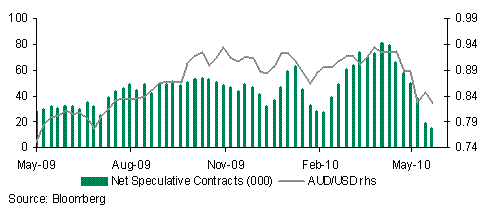
All-in-all, the week is unlikely to see a let up in pressure on risk trades and will start much as the last week ended. Although the market’s attention is on the EUR, it should be noted that the AUD has lost even more ground so far this month although the EUR remains the biggest loser in terms of major currencies so far this year (vs USD). In the case of the AUD the move reflects a massive unwinding of long positioning (as reflected in the latest CFTC IMM data which shows that speculative AUD positioning has dropped to its lowest since March 2009).
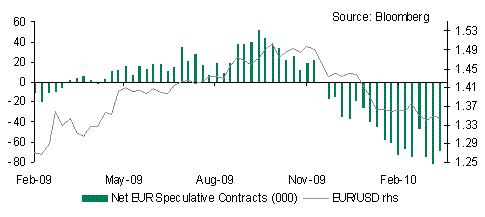
In contrast in the case of the EUR where positioning is already very negative, the move simply reflects deteriorating fundamentals. The fact that European officials are showing little concern about the decline in the EUR (why should they given that the currency is now trading around fair value) and in some cases encouraging it, suggests that there is little to stop EUR/USD from dropping much further and parity is looming a lot closer.

 ECONOMETER