USD in a lose-lose situation, AUD caution

News that Moody’s Investor service cut the debt ratings on six European countries while revising its outlook on the UK’s and France’s AAA rating to “negative” dampened sentiment for the EUR. Markets will likely trade cautiously ahead of tomorrow’s meeting of European Union Finance Ministers especially as it appears that at least Germany and Netherlands remain sceptical of Greece’s austerity plans, which could frustrate the approval of a second EUR 130 billion bailout package.

The USD is firmer overnight but still struggling to make headway in an environment of improving risk appetite. The fact that USD speculative positioning has dropped sharply to its lowest level since September last year highlights a major shift in USD sentiment. The USD is currently in a lose-lose situation helped neither by economic data or risk appetite. For example a healthy gain in January retail sales expected today, will help to boost risk appetite which in turn will help maintain pressure on the USD.

Encouragingly for the USD, 2 year bond yields have been rising since the start of February in line with firmer economic data. However, rather than giving the USD a boost (except vs. JPY) it has been outweighed by the fact that bond yields elsewhere have risen even more aggressively. The net result is that the prospects for the USD to strengthen further look somewhat restrained over the short term.

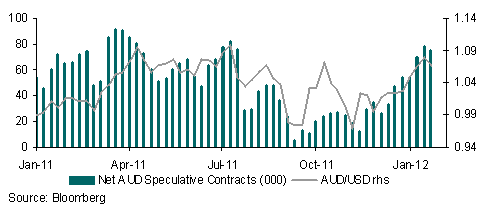
AUD has benefited from a firmer tone to risk appetite at the start of the week but for a currency in which speculative positioning is fast approaching all time highs I would be cautious of adding to long positions at current levels. Remaining one of the most sensitive currencies to gyrations in risk appetite the AUD will continue to be mainly driven by global events especially the Greek saga.

Nonetheless, there a few data releases at home that will capture market attention, in particular the January jobs report on Thursday. After a surprisingly large 29.3k fall in December a bounce is expected in January, with around a 15k increase likely. The report will provide clues to just how long the RBA will pause in its rate cutting cycle. I suspect that even a positive outcome will have a briefly positive impact on AUD, with the currency set to struggle to break above resistance around its 2012 high at 1.0845 versus USD.
Agreement at last!

Greek politicians finally agreed on further austerity cuts totalling EUR 3.3 billion in order to secure a second bailout package. European official discussions now centre on the details of the bail out package, targeting a cut in Greece’s debt to GDP ratio to 120%.

However, the fact European Finance Ministers have withheld more funds for Greece until the austerity measures begin to be implemented suggests further uncertainty on the horizon. A Greek parliamentary vote set to begin this weekend may see some progress but markets will trade cautiously ahead of the vote.

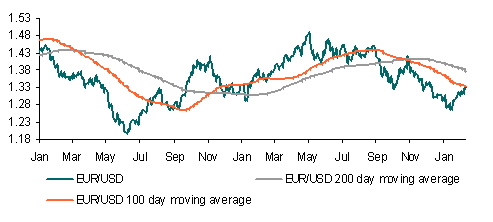
EUR/USD rallied to a high of around 1.3322 but failed to break above its 100 day moving average at 1.3332 following the agreement. As expected the ECB offered no help to the EUR, with market attention continuing to centre on the second 3-year LTRO on 29 February.

The fact that there are still various issues to be resolved means that upside for EUR will be limited in the short term. In any case the currency was already pricing in a lot of good news. EUR/USD will face major resistance around 1.3388.

Notably risk measures are edging higher once again, implying some pressure on risk assets in the near term. Markets today will digest the status Quo from the European Central Bank and an additional but expected injection of GBP 50 billion in quantitative easing from the Bank of England. December US trade data and February Michigan confidence are the only data of note suggesting limited price action ahead of the Greek parliamentary vote.

The Italian Job

Italy looks too big to rescue yet is too big to fail. The country has around EUR 1.9 trillion in public debt (around 5 times that of Greece) and is the third largest country in the eurozone. Therefore it cannot be as easily dealt with as Greece.

Italy needs to raise around EUR 18 billion per month to cover its budget deficit and bond redemptions and with a continued increase in yields (hitting close to 7.5% for 10 year bonds) borrowing costs are rising sharply and fast becoming unsustainable. Higher collateral haircuts on Italian debt are adding to the pressure.

Although Italian Prime Minister Berlusconi has said he will step down in the wake of reform measures to be voted on by the Italian parliament the vote on the measures may not take place for weeks. Moreover, Berlusconi may attempt to seek re-election after stepping down, which could bring the situation back to square one.

In the meantime speculation that Italy may be the next country to need to a bailout will intensify. However, with only around EUR 270 billion remaining in the EFSF bailout fund and details of how the fund will be leveraged to a planned EUR 1 trillion still lacking, doubts about whether it will have sufficient resources will grow. Press reports that Germany and France have begun talks to break up the eurozone due to fears that Italy will be too big to rescue will only add to the malaise.

Focus over the short term will turn to today’s 12 month auction of EUR 5 billion in Italy. Last month’s 12 month auction saw an average yield of 3.57% but this time around yields could rise above 6%. Worryingly it appears that even with the European Central Bank (ECB) buying Italian debt it has been insufficient to prevent yield rising.

In any case, given the ECB’s reluctance to become lender of the last resort to European peripherals, any support from this direction will be limited. Against this background the EUR remains highly vulnerable to a further drop. Indeed, the EUR’s recent resilience looks all the more misplaced. A test of the 4 October low around EUR/USD 1.3146 is on the cards over coming days.

Dollar firmer, Euro vulnerable, Yen wary

multitude of market moving events last week led to severe gyrations in risk appetite but with no clear direction for currencies. Indeed, currency markets were whipsawed as the news flow shifted back and forth. Major events such as the European Central Bank (ECB) and US Federal Reserve meetings, and US jobs data provided plenty of volatility points for markets. This week’s US data slate is less littered with first tier data, with trade data and Michigan confidence, the highlights of the week. Against this background the USD will take direction from events in the eurozone and in our view will likely trade with a firmer bias given that eurozone tensions will not ease quickly.

The EUR was relatively resilient despite a referendum (later cancelled) that could have spelled the beginning of the end of Greece’s membership in the eurozone. Nonetheless, the currency still dropped over the week. This week will be no different as markets sift through various pieces of news regarding Greece and the EU rescue plan. Although the Greek Prime Minister survived a confidence vote the EUR will remain vulnerable to a lack of detail about the EU rescue plan including but not limited to how the mechanism for leveraging the EFSF bailout fund. The longer the delay in providing such details the bigger the risk to the EUR. Data releases will be unhelpful for the EUR, with hard data such as German industrial production confirming a slowdown in activity.

Japan’s FX intervention at the beginning of last week has all but been forgotten among the plethora of other market moving news. Expectations that it would be followed up by more intervention proved incorrect as the Japanese authorities refrained from more action. Perhaps the onset of the G20 meeting stayed their hand but markets will be wary of more intervention this week. However, as the strengthening current account data in Japan will likely reveal this week, Japan’s strong external position continues to feed the underlying upward pressure on the JPY for the time being.

Interestingly FX markets appear to be reacting to growth orientated central bank policy rather than yield as reflected in the fact that EUR and GBP both strengthened despite additional quantitative easing from Bank of England at its last meeting and a rate cut from the ECB last week. This week however, inaction from the BoE will provide little direction to GBP while a likely drop in industrial production will raise fears that the economy continues to be in need of more remedial action from the central bank. GBP continues to be favoured but after having made up a lot of ground versus EUR it could lose some steam this week.

Euro looking rich at current levels

Markets continue to be rumour driven with little concrete news to provide direction. The news that a comprehensive deal by European officials at this Sunday’s EU Summit is now very unlikely has come as a further blow to hopes of a swift resolution to the crisis.

So it seems that Sunday’s meeting will provide a forum to thrash out ideas before a second summit next Wednesday. As a reminder the issues at hand are leveraging the EFSF, banking sector recapitalisation and the extent of private sector participation in Greek debt write downs.

The main disagreement appears to be between Germany and France on method of additional funding the EFSF bailout fund (which has EUR 280billion of firepower left), with Germany and the European Central Bank (ECB) opposed to French demands to utilise the ECB to help back the EFSF with France wanting the facility being turned in a bank. In terms of write downs for Greek bond holders there is a push for at least a 50% reduction compared to the 21% agreed in July.

Separately speculation of the amount of new capital needed for banking sector recapitalisation now revolves around a figure of EUR 80 billion. One spanner in the works is that Chancellor Merkel will have to gain approval from the German parliament before agreeing on further changes to the EFSF, which may delay the process further.

Clearly as this week has gone on the air has continued to seep out of the balloon as the market braces for disappointment. Surprisingly the EUR has held up well and while it has failed to extend gains, hitting a high earlier in the week around 1.3915 but still pricing in some scope for success, at current levels.

Helping the EUR was the fact that the market was very short, and while it could still move higher next week if European officials agree on a plan it still looks like a sell on rallies, with the scope for further gains limited from current rich levels. Good news from Europe next week could see a test of EUR/USD 1.40 but this will prove to be a good selling area further out.

At least there was some good news from Greece for a change as the Prime Minister won a vote to pass further austerity measures to help secure the next tranche (delayed from September) of the bailout despite ongoing protests in the country. The near term focus will be on a meeting of Finance Ministers today ahead of Sunday’s summit.