Another Day, Another Drop In The US Dollar.

The USD index is now close to breaching its November 2009 low around 74.17, with little sign of any turnaround in prospect. A surprise jump in weekly jobless claims to 412k (380k expected) did little to help the USD’s cause whilst higher commodity prices, and in particular energy prices played negatively.

Indeed, many USD crosses have experienced an increase in sensitivity to oil price movements over recent weeks, with the USD on the losing side when oil prices move higher. Commodity currencies including CAD and NOK are the key beneficiaries but EUR/USD is also highly correlated with the price of oil.

Various Fed comments overnight including supportive comments on the USD’s role as a reserve currency have done little to boost USD sentiment despite the generally hawkish slant to comments. A host of US data releases will keep markets busy.

The data are unlikely to deliver any strong surprises but given the growing FX attention on Fed policy, CPI data may take on more importance than usual. Our expectation of a trend like 0.2% increase in core CPI, which is unlikely to cause any consternation within the Fed, suggests that the USD will garner little support.

The ability of the EUR to withstand a torrent of bad news regarding the eurozone periphery is impressive. In particular, peripheral bond yields continue to rise especially Greek yields as expectations of debt restructuring grow. Comments from Germany’s finance minister have added to such expectations. News that the Bank of Spain approved the recapitalisation of 13 bank and that Spanish banks borrowed only EUR 44 billion last month, the lowest since Jan 2008, may have provided some relief.

However, given that markets are already relative hawkish about eurozone interest rates and given growing peripheral worries as well as overly long EUR market positioning, the upside for EUR/USD is looking increasingly restrained, with a break above technical support around 1.4580 likely to be difficult to achieve over the short-term.

AUD and NZD have registered stellar performances over recent weeks as yield attraction has come back to the fore and risk appetite has strengthened. The gains since their post Japan earthquake lows have been in the region of 7.3% and 10.5%, respectively for AUD and NZD.

The additional element of support, especially for AUD has come from central bank diversification, an increasingly important factor for both currencies. The gains in both currencies have been impressive and neither is showing signs of reversing but there are clear risks on the horizon.

One indication of such risks is the fact that market positioning is stretched especially in terms of AUD positioning, with CFTC IMM contracts registering an all time high. The move in AUD especially has been well in excess of what interest rate / yield differentials imply. Whilst I would not suggest entering into short AUD and NZD positions yet, the risks to the downside are clearly intensifying.
What To Watch This Week

The end of last week proved to be a calmer affair than the preceding few days. There was some encouraging news on the Greek front, with Germany finally approving its share of the European Union (EU) aid package whilst Greece appeared to be on track with its budget deficit reduction as the country recorded a cash deficit of EUR 6.3billion in the first four months of the year, a 42% reduction compared to a year earlier. EU officials also agreed on tougher sanctions for countries breaching austerity rules.

There were plenty of negatives to offset the good news however, as European business surveys including the German IFO index and flash eurozone purchasing managers indices (PMIs) revealed some loss of momentum in growth as well as increased divergence. European banking sector concerns intensified as the Bank of Spain was forced to take control of CajaSur, a small savings bank holding 0.6% of total Spanish banking assets, which faced difficulties due to distressed real estate exposure. Its woes highlighted the problems faced by many Spanish savings banks due to property market exposure.

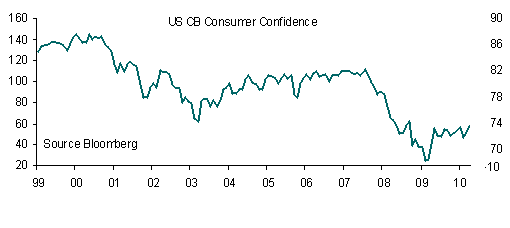
US data releases this week will confirm that economic recovery gathered steam in Q2. May consumer confidence data is likely to record a small gain, due in large part to improving job market conditions, whilst the Chicago PMI is set to retrace slightly in May, albeit from a healthy level. Both new and existing home sales are set to record gains in April, the former following a sizeable gain in March although the drop in house prices likely to be revealed by the Case-Shiller index will continue to fuel doubts about the veracity of the turnaround in the US housing market.

In Europe there is not much in terms of first tier releases and highlights include sentiment data such as German Gfk and French consumer confidence indices, and the May French business confidence indicator. The data are likely to be mixed, and as indicated by last week’s surveys will reflect a relatively healthy Q2 2010, but a worsening outlook for the second half of the year.

In the absence of UK data today there will be plenty of attention on the details of plans by Chancellor Osborne to cut GBP 6 billion from the budget deficit. The measures will be small change ahead of the emergency budget package on June 22nd when much bigger cuts are expected. Nonetheless, the first step today will be a crucial test of the new government’s ability to convince ratings agencies and markets that it is serious about reducing the burgeoning fiscal deficit.

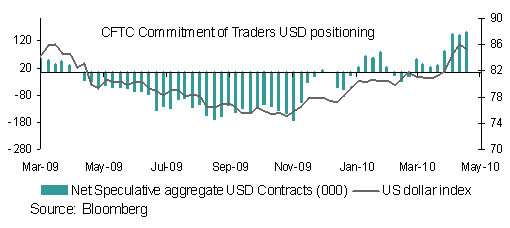
Following the massive positioning adjustments of the last week markets will look somewhat calmer over coming days but risk aversion is likely to remain elevated, suggesting little respite for most currencies against the USD. The recent moves have left net aggregate USD positioning registering an all time high according to the CFTC Commitment of Traders data, in the latest week, but after the slight retracement lower in the USD index, it is set to make further gains over coming days.

It was notable that EUR and GBP looked more composed at the tail end of the week whilst attention turned to the liquidation of long positions in CHF, AUD, NOK and SEK. These risk currencies are set to remain under pressure but there will be little respite for EUR which is set to drift lower, albeit a less aggressive pace than over recent weeks and a re-test of EUR/USD technical support around 1.2296 is likely. GBP/USD has showed some resilience over recent days but remains vulnerable to further downside pressure, with 1.4310 immediate support.