Italy downgrade adds to EUR woes

The USD index remains firm but it remains unlikely that the USD is being bought on its own merits but rather on disappointments in the eurozone. Nonetheless, speculative USD sentiment has turned positive for the first time since June 2010 according to the CFTC IMM data, reflecting a major shift in appetite for the currency. Clearly there are risks to the USD including the potential for more QE3 being announced at this week’s FOMC meeting but this risk is likely to be small.

In contrast, the reversal in speculative sentiment for the EUR has been just as dramatic but in the opposite direction as the net short EUR position has increased over recent weeks, with positioning now at its lowest since June 2010. Sentiment is likely to have soured further overnight following news that Italy’s credit rating was cut by S&P to A from A+ despite the recent passage of an austerity package.

This outweighed any boost to sentiment from what was noted by the Greek Finance Minister as “productive” talks yesterday. Another conference call today is scheduled but the longer markets wait for approval of the next loan tranche the bigger the risk to the EUR. In addition Greek and Spanish T-bill auctions and European Central Bank (ECB) cash operations will be in focus. The EUR remains vulnerable to a test of support around 1.3500.

GBP has continued to slide over recent weeks, having fallen by around 5% since its high just above 1.66 a month ago. However, it has managed to hold its own against the EUR which looks in even more of a sorry state than the pound. The fact that GBP has been unable to capitalise on the EUR’s woes is largely attributable to growing expectations of further UK quantitative easing.

The minutes of the last Bank of England meeting on September 8 to be released on Wednesday will give more clues as to the support within the Monetary Policy Committee for further QE but its likely that the MPC will want to see the next Quarterly Inflation Report in November before committing itself to any further easing. In the meantime, GBP will find it difficult to sustain any recovery, with its drop against the USD likely to extend to around 1.5583 in the short term.

Japan returns from its Respect for the Aged holiday today but local market participants will have missed little action on the JPY, with the currency remaining confined to a very tight range. The inability of USD/JPY to move higher despite the general bounce in the USD index reflects 1) the fact that USD/JPY is very highly correlated with 2 year bond yield differentials and 2) the fact that US yields continue to be compressed relative to Japan. Additionally, risk aversion continues to favour the JPY and combined, these factors suggest little prospect of any drop in the JPY versus USD soon.
Greece Bailed Out, Euro Unimpressed

After much debate eurozone ministers along with the International Monetary Fund (IMF), finally announced an emergency loan package for Greece amounting to  EUR 110 billion. In return for the bailout Greece agreed to enhanced austerity measures. The good news is that the package covers Greece’s funding requirements until 2012, and is sufficient to avoid debt restructuring and default. The loan package has also removed uncertainty ahead of bond redemption on May 19th.

One aim of the package was to prevent contagion to other eurozone countries, especially Portugal and Spain, where there has been growing pressure on local bond and equity markets. However, the path ahead is strewn with obstacles and it is too early to believe that the package has ensured medium term stability for the EUR.

The challenges ahead are two-fold, including both the implementation of the measures in Greece in the face of strong domestic opposition and the approval of the loans by individual country parliaments within the eurozone, both of which are by no means guaranteed.

The toughest approval process is likely to be seen in Germany where the government will face a grilling in parliament and a challenge in the constitutional court ahead of official approval of the package. European Union leaders are scheduled to meet on May 7th to discuss the parliamentary approval of loans to Greece whilst German officials meet on the same day.

Implementation risk is also high. Although the Greek government appears to be sufficiently committed, opposition within Greece is growing; various strikes planned over coming days. Aside from union opposition, the scale of the budgetary task ahead is enormous, having never been undertaken on such a large scale in recent history. The sharp decline in growth associated with the austerity measures will make the task even harder.

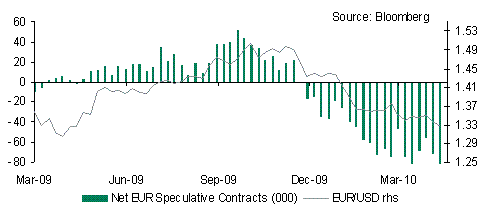
The EUR bounce on the news has been limited, with the currency failing to hold onto gains. The announcement seems to have triggered a “buy on rumour, sell on fact” reaction, with the size of the loan package falling within the broad estimates speculated upon over the last week. The lack of EUR bounce despite the fact that going into this week the CFTC Commitment of Traders report revealed record net short speculative positioning in EUR/USD, reveals the extent of pessimism towards the currency.

The EUR may benefit from a likely narrowing in bond spreads between Greece and Germany. Given that sovereign risk is being increasingly transferred from the periphery to the core, the net impact on bond markets may not be so positive for the EUR. Over the short-term there will be strong technical resistance on the upside around EUR/USD 1.3417 but more likely the currency pair will target support at around 1.3114.

The Herculean task ahead for the Greek government suggests that markets will not rest easy until there are credible signs of progress. Investors would be forgiven for having a high degree of scepticism given the degree of “fudging” involved in the past, whilst Greek unions will undoubtedly not make the government’s task an easy one by any means. Such scepticism will prevent a sustained EUR recovery and more likely keep the EUR under pressure.

As noted above the divergence in growth for the eurozone economy between Northern and Southern Europe will make policy very difficult. Moreover, the EUR is set to suffer from an overall weak trajectory for the eurozone economy, relative to the US and other major economies. The widening growth gap with the US will also fuel a widening in bond yield differentials, a key reason for EUR/USD to continue to decline to around or below 1.25 by the end of the year.