Money Printing

It was a day of surprises on Tuesday as the Bank of Japan (BoJ) not only created a JPY 5 trillion fund to buy domestic assets including JGBs but also cut interest rates to zero. Expect more measures to come in the fight against a stronger JPY and deflation. The Reserve Bank of Australia (RBA) also surprised markets by leaving its policy rate unchanged at 4.5% delaying another rate hike yet again despite expectations by many including ourselves of a 25bps rate hike.

The easier policy stance from the BoJ and RBA taken together with firmer service sector purchasing managers indices – including the September US ISM non-manufacturing survey, which came in at 53.2 from 51.5 – gave risk appetite a solid lift. Even the AUD which dropped sharply following the RBA decision, managed to recoup all of its losses and more overnight.

Japan’s decision could have set the ball rolling for a fresh round of quantitative easing (QE) from central banks as they combat sluggish growth prospects ahead and ongoing deflation risks. The US Fed as has been much speculated on and the Bank of England (BoE) are likely candidates for more QE. Whilst the European Central Bank (ECB) is unlikely to adopt such measures there are reports that board members are split over the timing of exit policy. The BoE decision on Thursday may provoke more interest than usual against this background although the Bank is unlikely to act so quickly. The Fed on the other hand appears to be gearing up for a November move.

Growing prospects of fresh QE looks likely to provide further impetus for risk trades. Notably commodity prices jumped higher, with the CRB commodities index at its highest level since the beginning of the year. Although there is plenty of attention on the gold price which yet a fresh record high above $1340 per troy ounce as well as tin which also hit new highs, the real stars were soft commodities including the likes of sugar, coffee and orange juice up sharply.

The main loser once again is the US dollar and this beleaguered currency appears to be finding no solace, with any rally continuing to be sold into, a pattern that is set to continue. Although arguably a lot is in the price in terms of QE expectations, clearly the fact that the USD continues to drop (alongside US bond yields) highlights that a lot does not mean that all is in the price.

The USD is set to remain under pressure against most currencies ahead of anticipated Fed QE. The fact that the USD has already dropped sharply suggests a less pronounced negative USD reaction once the Fed starts buying assets but the currency is still set to retain a weaker trajectory once the Fed USD printing press kicks into life again as a simple case of growing global USD supply will push the currency weaker.

USD weakness will only spur many central banks including across Asia to intervene more aggressively to prevent their respective currencies from strengthening. A “currency war” looms, a fact that could provoke some strong comments at this weekend’s IMF and World Bank meetings. In the meantime intervention by central banks will imply more reserves recycling, something that will continue to benefit currencies such as EUR and AUD.
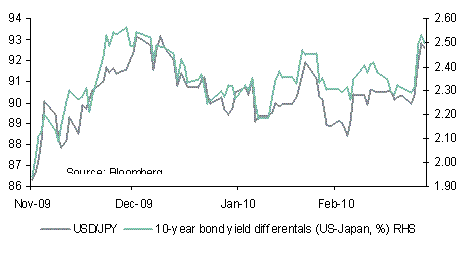
US Dollar Back On Top As Yields Rise

Two issues are driving markets and both are playing negatively for sentiment; the rise in G7 bond yields and the outcome of the EU summit. At a time when G7 bond yields have been pushing higher the poor response to the US $32 billion 7-year note sale contributed to a further increase in yield. The sale resulted in a yield of 3.374%, which was higher than expected, and a bid/cover ratio of 2.61. A combination of large US Treasury supply, medium term funding issues and signs of improving growth suggest no let up for US Treasuries.

The most reactive currency to yield differentials is currently USD/JPY. The 1-month correlation between USD/JPY and US/Japan bond yield differentials is a high 0.85. The spike in US 10-year Treasury yields especially relative to JGB yields (by around 21 basis points this week) is the main contributor to the jump in USD/JPY over recent days. Given the bearish outlook for US bonds in the near term, it suggests more upside for USD/JPY but also increasingly for other currencies against the USD as the importance of yield increases. Immediate USD/JPY technical resistance is seen around 93.21, with support at 91.87.

The other event of note yesterday was developments surrounding Greece in the European Union summit though in truth it was probably the strong comments by ECB President Trichet that had the bigger impact on EUR sentiment. The final EU communiqué noted the readiness for bilateral loans to Greece and substantial International Monetary Fund (IMF) financing in a Greek aid mechanism. Importantly and a likely sop to Germany, any aid will not contain a subsidy for Greece. Aid by the EU and IMF will only be provided in the event of “very serious difficulties”.

The EU agreement means that no money will be forthcoming immediately, but at least there will be a back stop should Greece have financing difficulties over coming weeks, which will act as an important safety net ahead of substantial Greek debt rollovers. This news was supplemented by the fact that ECB will not raise its minimum collateral requirements at the end of the year, which means that Greek debt will not be excluded in the event of a ratings downgrade. This is good news for Greece.

The combination of the fact that Greece will have to borrow money only at market rates, ongoing worries about other EU countries fiscal problems and European Central Bank (ECB) President Trichet putting somewhat of a dampener on sentiment by criticizing IMF involvement in the deal, will keep the EUR under pressure. Although Trichet later reversed his comments, the damage was already done and any relief to EUR/USD will be short-lived. The currency pair is increasingly poised for a further downside move, with the next target at 1.3213 on the path towards an eventual test of 1.3000.

Contrasting messages from bonds, gold and equities

There is an interesting divergence developing between bond yields, gold prices and the trend in equity markets.  Whilst equities continue to go up, bond yields are falling and gold prices are rising.  Indeed the usually strong relationship between the S&P 500 and US 10 year yields has collapsed to an insignificant correlation around -0.09 over the past month compared to a high correlation of 0.84 in the month to 8 August.  

Rising equities appear to signify an improvement in risk appetite whilst bonds (US 10-year yield around 3.4%) and gold (around $1000 per troy ounce) are giving the opposite message.  So which indicator is correct and why the breakdown in the usually solid relationship?  

Growing optimism about economic recovery and the run of better than forecast data releases suggest that equities are correct but there is growing risk that so much good news is now priced in that we should pay attention to what bond yields and gold prices are telling us.  

Some of the move lower in bond yields can probably be attributed to the wall of liquidity sloshing around due to central banks’ unconventional policy measures.  However, it is still remarkable that despite the plethora of better than expected data releases, bond yields have actually declined.  This may reflect the success of quantitative easing but could also be associated with sustained economic and market fears.    

The commitment by G20 officials last weekend not to reverse stimulus policies prematurely may also have given more confidence in the view that interest rates will not be raised quickly.  Reflecting this 2 year German bund yields dropped to a record low level at the beginning of the week although longer term bond yield have pushed higher in the 30 year area.  The G20 commitment could turn out to be a double edged sword, however.  If there is no commitment to reduce burgeoning deficits, bonds could ultimately take fright.  

If bonds and gold prices are really reflecting safe haven demand then it will pose a risk to the sustainability of any equity rally over coming months.  As equity valuations begin to look increasingly stretched – the P/E ratio on the S&P 500 has reached 18.76 (according to Bloomberg calculations) compared to a low of around 10.00 at the beginning of March 2009 – it will need more to keep the rally going and high amongst the factors needed is some clarity about the pace and shape of growth once stimulus is reversed. 

For currency markets I think it will be difficult to see a trend until there is more clarity about the economic outlook and in the meantime currency markets will continue to stock watch for direction even if the influence of risk appetite is declining.  Even so, the dollar appears to be reacting more to equities than bond movements and is coming under growing pressure as equities rise.  

Many currencies are poised to break out of recent ranges to the topside versus the dollar led by risk currencies such as the AUD, NZD and CAD.  If it turns out that the equity story rather than the bond message is the correct one then the real message is a bullish one for risk appetite and given the dollar’s usually negative reaction to improved risk appetite, it could face further pressure over coming weeks.

Chinese stocks enter bear market

Markets can only be described as fickle as they gyrate back and forth depending on the latest news or earnings report and as a result direction is changing not just daily but also intra-day.  Investors in most asset classes will continue to focus on stocks especially the recently underperforming Chinese equity market (Shanghai A share index) which officially moved into bearish territory after falling by over 20% from its early August high. 

Various reasons for the drop can be cited including regulator’s curbs on the stock market, high valuations, absence of new fund launches, limits on institutional buying,  high level of new accounts adding to volatility, tighter regulations on real estate, etc, but whatever the reason the direction has been clearly downwards and the impact is being felt across markets.

The turnaround in equity markets during Wednesday’s sessions was dramatic and was led by the turnaround in Chinese stocks which dragged other Asian bourses down with it.   This outweighed any positive sentiment from Market positives so far this week including a strong reading for the German August ZEW survey which surpassed forecasts by a large margin.  This followed the extension of the TALF by the Fed, and a jump in the US Empire manufacturing survey at the beginning of the week.  

Aside from weaker equities the usual FX beneficiaries including the dollar and yen strengthened on the back of the Chinese stock rout.   S&P’s affirmation of China’s credit ratings and positive comments from China’s stats office about the economic outlook in the months ahead  failed to support sentiment.  This would have been expected to provide a positive backdrop for Asian markets but Chinese stock market jitters provided a strong headwind to local markets. 

Overall most measures of risk have seen a substantial improvement over the past few months but there is no doubt that nerves are creeping back into the market.   This time the nervousness is coming from China and worryingly it is swamping the effect of any good news on the global economy and earnings.   This may prove to be a blip on the long road to recovery in risk appetite but it is difficult to ignore such a sharp fall in Chinese stocks without looking at the potential contagion to other equity markets.  

On the FX front those currencies that are most correlated with risk aversion such as the Australian dollar, New Zealand dollar, South African rand, Indonesian rupiah, Brazilian real and Mexican peso will gyrate in relation to the moves in risk appetite.   These currencies have had the highest correlations with risk aversion over the past month and in the current environment will come under some pressure at least until risk sentiment changes again, which in this market could happen at any moment and without warning.