Risk trade rally fizzles out

The risk trade rally spurred by China’s decision to de-peg the CNY fizzled out. The realization that China will only move very gradually on the CNY brought a dose of reality back to markets after the initial euphoria. The fact that unlike in July 2005 China ruled out a one off revaluation adds support to the view that China will move cautiously ahead with CNY reform. In addition, renewed economic worries have crept back in, with particular attention on a potential double dip in the US housing market following a surprise 2% drop in existing home sales in May.

European banking sector woes have not disappeared either with S&P raising the estimate of writedowns on Spanish bank losses, whilst Fitch ratings agency noted that there is an increased chance of the eurozone suffering a double-dip recession. The net impact of all of these factors is to dampen risk appetite and the EUR in particular.

The UK’s announcement of strong belt tightening measures in its emergency budget did not fall far outside of market expectations. The budget outlined a 5-year plan of deficit reduction, from 11% of GDP in 2009-10 to 2.1% of GDP in 2014-15. The main imponderable was the response of ratings agency and so far it appears to have been sufficient not to warrant a downgrade of the UK’s credit ratings. Fitch noted that the “ambitious” plan ensured that the UK would keep its AAA credit rating. The emergency budget and reaction to it has been mildly positive for GBP, which has shown some resilience despite the pull back in risk currencies.

The recent rally in Asian currencies is looking somewhat overdone but direction will come from gyrations in risk appetite and the CNY rather than domestic data or events. Encouragingly equity capital flows into Asia have picked up again over recent weeks, with most countries with the exception of the Philippines registering capital inflows so far this month, led by India and South Korea.

China’s CNY move may attract more capital inflows into the region, suggesting that equity capital flows will continue to strengthen unless there is a relapse in terms of sovereign debt/fiscal concerns in Europe. Nonetheless, central banks in the region will continue to resist strong FX gains via FX interventions, preventing a rapid strengthening in local currencies.

Although India and Korea have registered the most equity inflows this month, both the INR and KRW have had a low correlation with local equity market performance over recent weeks. In fact the most highly sensitive currencies to their respective equity market performance have been the MYR and IDR both of which have reversed some of their gains from yesterday. USD/MYR will likely struggle to break below its 26th April low around 3.1825 whilst USD/IDR will find a break below 9000 a tough nut to crack.
Volatility Within Ranges

Most investors will likely be happy to see the tail end of May given the sharp losses in many asset classes over the month. At least over the last few days there was a sense of some healing, particularly in risk assets though it is questionable how long this can continue given the still many and varied uncertainties afflicting markets. A reminder of this came late on Friday, with Fitch downgrading Spain’s sovereign credit ratings despite the passage of austerity measures.

The Fitch decision highlights that Spain is rapidly becoming the new epicenter of the crisis; focus on the savings banks or Cajas is intensifying ahead of the June 30 deadline for mergers to qualify for government money, the minority government’s popularity is in further decline, whilst unions are threatening more strikes across the country. Unions in Greece and Italy are also pushing for coordinated strikes, highlighting the difficulties in pushing through austerity measures.

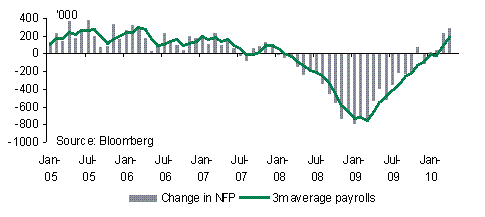
At least economic data is providing some solace to markets. Releases last week in the US highlighted the fact that consensus expectations are underestimating the pace of recovery; consumer confidence, durable goods orders and new home sales all came in above expectations. The same story is likely this week, but there is really only one piece of data that attention will focus on and that’s the May jobs report. The consensus is for a strong 508k increase in non-farm payrolls following a 290k increase in April, though around three-quarters of this will be related to census hiring. The unemployment rate is likely to dip slightly to 9.8%.

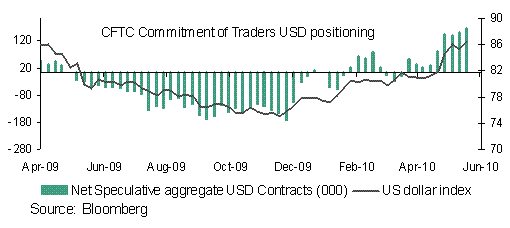
Markets are likely to be in limbo, with volatility in ranges likely this week. USD sentiment remains strong as reflected in the CFTC IMM data where net aggregate positioning is at an all time high, but further USD gains may be harder to come by ahead of the US jobs report and G20 meeting this weekend. Stretched USD positioning has proven no barrier to USD strength over recent weeks but the fact that markets are very long USDs could at the least result in a slower pace of further appreciation.

EUR speculative sentiment remains close to all time lows although there are signs of some relative stability over recent weeks. EUR/USD is likely to range between 1.2134 and 1.2475 this week. There was a sharp drop in net short JPY positions over the week (ie short-covering) though this appears at odds with the fall in the JPY. GBP speculative positions showed little improvement, languishing close to all time lows, whilst net longs in commodity currencies were pared back sharply, especially in AUD where net longs were cut by around half though sharp declines in positioning were also registered for NZD and CAD.

GBP could suffer due to worries about the UK government’s plans to reduce its burgeoning budget deficit following the resignation of Treasury Minister David Laws, following an expense scandal. The resignation hits the coalition just three weeks before the emergency budget and could result in complications on the negotiations between the Liberal Democrats and Conservatives on the substance of the deficit cutting measures. GBP/USD is likely to find support around 1.4260 and resistance around 1.4612 this week.

Switching risk on and off

There are several words that can be used to describe current highly risk averse market dynamics including panicked, nervous, fickle, tense, jittery, risky, volatile etc, all of which spark negative thoughts in the minds of investors. Aside from real worries such as renewed banking sector concerns, especially in Europe and in particular with regard to Spanish savings banks, there are also plenty of rumours afflicting market sentiment. In this environment deriving fact from fiction is not particularly easy whilst battling against the heavy weight of negative sentiment.

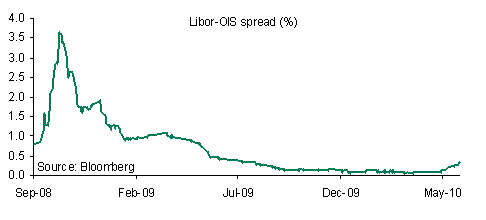
Although the pull back in risk appetite over recent weeks looks small compared to the peak in risk aversion during the financial crisis, the pace of the drop in markets has been dramatic and the withdrawal of risk seeking capital has been particularly aggressive. For example, in less than one month Asian equity markets have registered an outflow of around half of the total equity capital flows so far this year. Worryingly and despite the backstop in terms of central bank liquidity provision there are signs of renewed tensions in the money markets, with the libor-OIS spread and TED spread widening over recent days.

One of the most interesting observations in the current environment is that risk aversion has been increasing despite encouraging economic data. Not only has economic data been positive but in general has been coming in above consensus, showing that the market has underestimated the bounce in growth in the second quarter. Why is positive data not soliciting a more positive market reaction? Recent data is perhaps being seen as backward looking, and there is growing concern about the likely downdraft on economic activity in H2 2010, especially in Europe as deficit cutting measures bite.

News on the budget front in Europe has been relatively positive too, with Greece registering a sharp decline in its deficit, as well as announcing plans to tighten tax administration procedures. Meanwhile, the Italian cabinet reportedly approved a package of measures to reduce its deficit. On the flip side budget cuts across Europe are leading to growing public opposition, testing the resolve of eurozone governments to pass austerity measures. The public opposition means that the real test is in the implementation and execution of austerity measures. Signs of progress on this front will be key to turn confidence in the EUR around.

The USD remains king in the current environment and any pull back is likely to be bought into though Moody’s ratings agency’s warnings that the US AAA sovereign rating may come under pressure if there was no improvement in the US fiscal position, highlights the risks over the medium term to this currency. The EUR is set to remain under pressure though it is worth noting that the pace of its decline appears to be slowing, leaving open the potential for some consolidation. Near-term technical support for EUR/USD is seen at 1.2142 but a broader range of around 1.18.23-1.2520 is likely to develop over coming weeks.

Greek Saga Rumbles On – Does Anybody Care?

The debate over Greece continues to rumble on. France and Spain requested a separate summit meeting of the 16 heads of eurozone countries immediately before the full 27-member EU summit starting tomorrow but this was met with resistance. Meanwhile, Germany has called for “a substantial contribution” from the IMF towards a Greek aid package, whilst maintaining that no EU deal will be reached for Greece at the summit.

Frankly, the whole Greek saga has become extremely boring, with the lack of agreement about how to fix it doing little to inspire confidence. In particular the fractured opinion amongst EU leaders highlights the difficulties in reaching an agreement in a union made up of so many conflicting interests. At most the summit may agree on the conditions for a rescue package for Greece rather than a package itself. This will leave markets unimpressed,

US new home sales data today is likely to paint a slightly better picture with a small gain expected, albeit following the 11.2% plunge in the previous month. Sales will be helped by the extension of the home buyer tax credit. The US February durable goods orders report is also released today, with a small increase expected. A smaller gain in transport orders suggests that the 2.6% jump last month will not be repeated.

In Europe, the key release is the March German IFO business climate survey and a rebound is likely following February’s decline, helped by warmer weather and a weaker EUR. Flash readings of Eurozone March purchasing managers indices (PMIs) are also released but these are unlikely to extend gains from the previous month. Despite expectations of firmer data the EUR/USD is vulnerable to a further decline, with support around 1.3432 in sight for an imminent test.

Attention in the UK will turn to the pre-election Budget and particularly the government’s plans to cut spending and reduce the fiscal deficit. Failure to provide a credible blue print to restore fiscal credibility will damage confidence, heightening the risks of an eventual sovereign ratings downgrade and more pressure on GBP which appears destined for another drop below 1.50 versus USD.

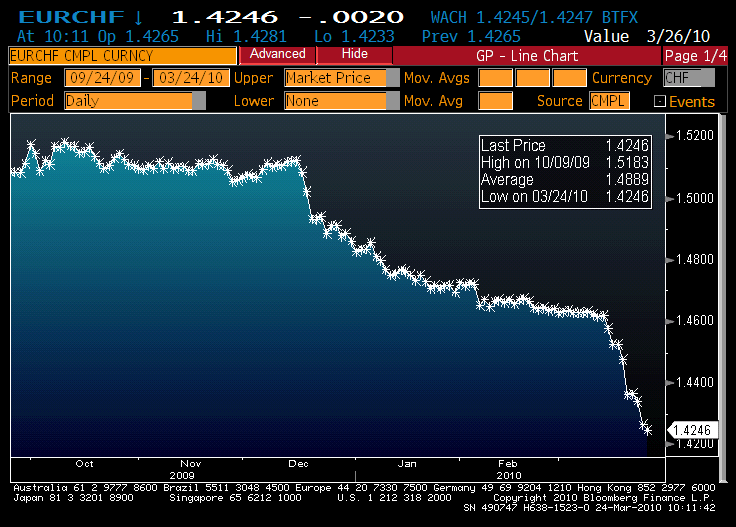
Most currencies have remained within ranges and the most interesting currency pair is EUR/CHF having failed to react to verbal warnings from the Swiss National Bank (SNB) about excessive CHF strength. EUR/CHF looks vulnerable to a further decline unless the SNB follows up rhetoric with action. Even if there is FX intervention by the SNB it may prove to be a temporary barrier to a market with an eye on the psychologically important 1.4000 level.

Despite the pressure on the Japanese government and Bank of Japan (BoJ) to engineer a weaker JPY, export performance has proven resilient, with exports jumping 45.3% on the year in February, helped by the strength of demand from Asia. Unfortunately this is doing little to end Japan’s deflation problem and even if there is less urgency for a weaker JPY to boost exports, JPY weakness will certainly help to reduce deflationary pressures in the economy. USD/JPY is stubbornly clinging to the 90.00 level, with little inclination to move in either direction.

Greek Confusion, India Tightening

It is highly interesting that markets could take fright from a rate hike in India but this appears to be what has happened. India’s surprise 25bps rate hike has provoked another bout of risk aversion whilst the lack of any concrete agreement on a framework for a Greek bail out dealt a further blow to confidence. FX tensions between the US and China have not helped, with China threatening retaliation to any US move to name the country as a currency manipulator in the mid April US Treasury report.

Should we really be worried by a rate hike in India or China? Whilst the India rate move reflects the fact that emerging market central banks are moving far more aggressively to raise rates than their G7 counterparts, global fears that India’s move will dampen recovery prospects are unfounded. Monetary tightening in India and China and other economies is taking place against the backdrop of economic strength not weakness.

As such the global impact on growth should be limited. Rising inflation pressure in Asia is reflection of the much quicker economic recovery, relatively low rates and undervalued currencies in the region. Not only will central banks in Asia have to raise interest rates but will also have to allow further currency appreciation.

There is still plenty of confusion about a bail out for Greece ahead of the 25-26th March EU summit. German Chancellor Merkel dampened expectations of a bailout by stating that it was not even on the agenda for the summit. In contrast, EU President Barroso has pushed EU members to agree on an explicit stand-by aid agreement for Greece as soon as possible.

There is also disagreement about whether there should be any IMF involvement, with Germany favouring some help from the Fund whilst France opposes it. Meanwhile, the Greek Prime Minister has reportedly given an ultimatum that should no aid plan be forthcoming at the EU summit, Greece will turn to the IMF for assistance.

All of this suggests more downside for EUR/USD, with a test of support around 1.3422 looming. In the event that the EU summit offers good news for Greece, EUR/USD sentiment could turn quickly so a degree of caution is warranted. Speculative sentiment for the EUR has improved according to the latest CFTC Commitment of Traders (IMM) data for the week to 16th March, with net short EUR positions at their lowest since the beginning of February. Nonetheless, the short covering seen over the past week could come to an abrupt end should there be no aid package for Greece.

The most volatile currency over the past week was GBP/USD and after hitting a high of around 1.5382 it has slid all the way back to around the 1.5000 level. Much of this was related to the gyrations in EUR/USD but GBP took on a life of its own towards the end of the week and has not been helped by comments by BoE MPC member Sentence who highlighted the risk of a “double-dip” recession in the UK.

GBP is highly undervalued and market positioning is close to a record low but a sustainable recovery looks unachievable at present. Attention this week will centre on the 2010 UK Budget announcement and markets will scrutinise the details of how the government plans to cut the burgeoning budget deficit. Failure to restore some credibility to the government’s plans will dent GBP sentiment further and lead to a sharper decline against both the EUR and USD.