FX Winners and Losers

There has been a sense of mean reversion in FX markets so far this year as some of last year’s winners have become losers. Namely NZD, CHF, JPY and AUD have all lost ground whilst EUR and GBP have gained ground. The odd one out is the SEK which has strengthened over 2010 and in 2011 versus USD. I expect this pattern to change and the likely winners over the next 3- months are NZD, AUD and CAD, with CHF and JPY the likely losers.

EUR held up reasonably well in the wake of slightly disappointing growth data, with eurozone GDP rising less than expected in Q4, and a smaller than expected gain in the February German ZEW investor confidence survey (economic sentiment component). My sense is that the net long EUR speculative position has already been pared back somewhat over recent days reducing the potential selling pressure on the currency in the near term.

Given that EUR/USD is one of the only major currency pairs being influenced by interest rate differentials, its direction will hinge more on policy expectations but in the near the announcement by the German Finance Minister this morning of a restructuring plan for WestLB may give the currency some support.

Perhaps one explanation for the stability of EUR/USD around the 1.3500 level is that US data was also disappointing yesterday. January retail sales rose less than forecast whilst revisions to back months suggest less momentum in Q4 consumer spending than previously envisaged. As with the eurozone data weather likely played a role in contributing to the outcome.
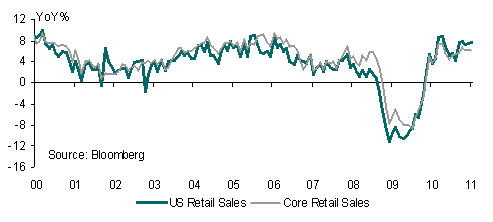
The net impact on currencies is that they are largely stuck within tight ranges. Further direction will come from the release of the Fed FOMC minutes for the January 26th meeting. The minutes may undermine the USD if a likely dovish slant continues to be expressed but given that the FOMC decision at that meeting to hold policy setting unchanged had no dissenters this should not come as a surprise.

Whilst the battle between the USD and EUR ended in a stalemate GBP outperformed in the wake of the increase in UK January CPI inflation and in particular the letter from the BoE governor to the Chancellor keeping open the door to a rate hike. The Quarterly Inflation Report (QIR) today will be particularly important to determine whether the bounce in GBP is justified.
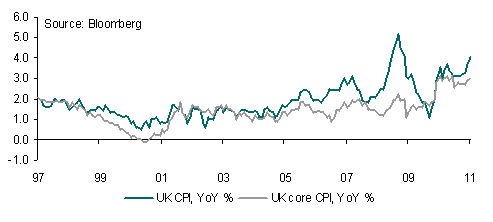
I remain hesitant to build on long GBP positions given the net long speculative overhang in the currency. The risks following yesterday’s jump in GBP are asymmetric, with a hawkish QIR likely to have less impact on the currency than the negative impact from a more dovish than expected report.

Econometer.org has been nominated in FXstreet.com’s Forex Best Awards 2011 in the “Best Fundamental Analysis” category. The survey is available at http://www.surveymonkey.com/s/fx_awards_2011

Talking about currencies

It’s always the same story.  Ahead of the G7 (or G8 and now more important G20) meetings speculation of decisive action on currencies intensifies.  Traders and investors become cautious on the off chance that something significant will happen but the majority of times nothing of note emerges.

There was no difference this time around.  The G7 Finance Ministers meeting in Istanbul failed to deliver anything substantive on currencies, repeating the usual mantra about the adverse impact of “excess volatility and disorderly movements”.  Although the group pledged to monitor FX markets there was no indication of imminent action. 

The lack of action is perhaps surprising in one respect as there were plenty of central bankers and finance officials talking about currencies in the run up to the G7 meeting, most of which were attempting to talk the dollar higher against their respective currencies.  Given the increase in rhetoric ahead of the meeting, the relatively weak statement now leaves the door open to further dollar weakness.

The strongest indication of any FX action or intervention came from the country that was supposedly the least concerned about currency strength; Japanese Finance Minister Fujii warned that Japan “will take action” if “currencies show some excessive moves”.  The shift in stance from Japan since the new government took power has been stark (considering that the new government was supposedly in favour of a stronger yen).  Markets will likely continue to test the resolve of the Japanese authorities and buy yen anyway.

Although the G7 statement said little to support the dollar and the overall tone to the dollar likely remains negative over coming months, the softer tone to equity markets and run of weaker economic data in the US – the latest data to disappoint was the September US jobs report – may give some risk aversion related relief to the dollar this week. 

Weaker data and equities alongside the impact of official rhetoric is being reflected in CFTC Commitment of Traders’ data (a good gauge of speculative market positioning) which revealed a sharp drop in short dollar positions, by around a quarter, highlighting for a change, an improvement in dollar sentiment over the last week. 

The biggest losers in terms of speculative positioning were the British pound, where the net short position reached its most extreme since mid September 2008, and Canadian dollar where the net long position was cut by almost half.  Again this may reflect official views on currencies, with Canadian officials expressing concern about the strength of the Canadian dollar in contrast to the perception that UK officials favour a weaker pound.
Central bank meetings (BoE, ECB, RBA) will dominate the calendar this week and more comments on currencies are likely even if interest rates are left unchanged.  Meanwhile FX markets will continue to watch equities, and the start of the US Q3 earnings season will give important signals to determine the sustainability of the recent equity market rally.  Recent weak economic data has already cast doubt about a speedy recovery and if earnings disappoint risk aversion could once again be back on the table.

All eyes on Chinese stocks

Equity markets extended their declines overnight as European and US stocks were smacked across the board.  One of the biggest pull backs has occurred in the Chinese stock market where stocks are down by around 17% since early (3rd) August although stocks are still up close to 73% on the year.  Some of this could be on fears of monetary tightening in China as well as missed profit estimates. 

Risk trades were sold and the dollar and yen strengthened whilst bond markets continued to rally.  News that contributed to the move could have included a sharp 35.7% YoY decline in FDI flows to China in July as well as a broad tightening of lending standards in Q2 according to the latest Senior Loan Officer survey by the Fed.  In contrast there was some positive news on the manufacturing front as the US Empire manufacturing survey jumped 13 points to its highest reading since November 2007. 

The Fed announced that the TALF with a capacity of as much as $1 trillion will expire on June 30 rather than December 31 but for other asset backed securities and CMBS sold before January the plan was extended by three months.   This extension failed to prevent a drop in financial shares overnight with the S&P financials index down 4.2%. 

Commodity prices also extended their drop, with the CRB index now down by around 5.6% since 5 August.   This will continue to play negatively for commodity currencies including the Australian, NZ and Canadian dollars, with the currencies looking vulnerable to more downside today.   Expectations of rising oil inventories and a firmer dollar tone are also playing negatively for commodities. 

Some relief may come today from firmer economic data expected in the US and Eurozone.   US housing starts and building permits are set to reveal further signs of stabilisation in the US housing market whilst the German ZEW survey will rise in August on the back of better economic data and past stronger equity market performance.  It is debatable how much economic data can help counter the worsening in equity sentiment but it may at least provide a semblance of relief.  

The dollar index is trading around the top of its recent range and sentiment for the currency has clearly become less negative as reflected in the latest CFTC Commitments of Traders Report which showed a sharp pull back in net aggregate dollar short positions in the latest week.  

Nonetheless, the dollar is likely to show little inclination to break out of its recent ranges against most currencies.  Overall FX market attention will focus on the Shanghai composite to lead the way in terms of risk appetite and overall direction. Thin holiday trading will leave the markets prone to exaggerated moves over the near term.

US dollar under pressure

The US dollar has come under major pressure, with the US dollar index (a composite of the dollar against various currencies) falling to 4-month lows.   The weakness of the US dollar has been broad based and even the Japanese yen which normally weakens as risk appetite improves, has strengthened against the USD.  The euro has also taken advantage of dollar weakness despite ongoing concerns about the European economy. The main source of pressure on the dollar is the improvement in market appetite for risk.  

As I noted in a previous post, “What drives currencies?” risk appetite has been one of the biggest drivers of currencies in the past year.   This has pushed other drivers such as interest rate differentials into the background.   In the post I also stated that we would all have to watch equity markets to determine where currencies will move, with stronger equities implying a weaker dollar.

The dollar looks particularly sickly at present and it is difficult to go against the trend.  It will need a major reversal in equity markets or risk appetite to see a renewed strengthening in the dollar.   Although I still think it will require some positive news as opposed to less negative news to keep the momentum in equity markets going (see previous post) the prospects for a stronger dollar remain limited.   

Over the coming months the dollar is set to weaken further and those currencies that have suffered most at the hands of a strong dollar will benefit the most as risk appetite improves.  It is no coincidence that the UK pound has strengthened sharply over recent days, and this is likely to continue given its past undervaluation.  Other currencies which were badly beaten such as the Australian dollar and Canadian dollar will also continue to make up ground, helped too by a rebound in commodity prices.   

Aside from improving risk appetite the dollar may also come under growing pressure from the Fed’s quantitative easing policy, especially if inflation expectations in the US rise relative to other countries as a consequence of this policy.  It will be crucial that the Fed removes QE in a timely manner and many dollar investors will be watching the Fed’s exit strategy closely.  

Although the US trade deficit is showing improvement another concern for dollar investors is the burgeoning fiscal deficit.   The US administration revised up its estimate for the FY 2009 deficit to $1.84 trillion or about 12.9% of GDP, highlighting the dramatic deterioration in the US fiscal position.  Concerns about this were highlighted in an FT article warning about the risk to US credit ratings.

The deterioration in dollar sentiment has also been reflected in speculative market positioning, which has seen speculative appetite for the dollar drop to its lowest level in several months. The bottom line is that any recovery in the dollar over the coming weeks is likely to be limited offering investors to take fresh short positions as investors continue to move away from holding the dollar.