Italy downgrade adds to EUR woes

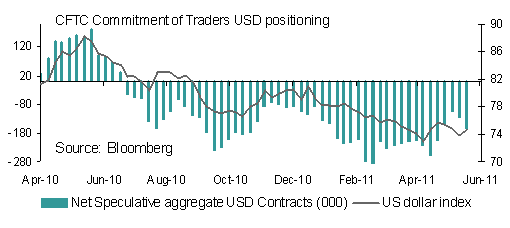
The USD index remains firm but it remains unlikely that the USD is being bought on its own merits but rather on disappointments in the eurozone. Nonetheless, speculative USD sentiment has turned positive for the first time since June 2010 according to the CFTC IMM data, reflecting a major shift in appetite for the currency. Clearly there are risks to the USD including the potential for more QE3 being announced at this week’s FOMC meeting but this risk is likely to be small.

In contrast, the reversal in speculative sentiment for the EUR has been just as dramatic but in the opposite direction as the net short EUR position has increased over recent weeks, with positioning now at its lowest since June 2010. Sentiment is likely to have soured further overnight following news that Italy’s credit rating was cut by S&P to A from A+ despite the recent passage of an austerity package.

This outweighed any boost to sentiment from what was noted by the Greek Finance Minister as “productive” talks yesterday. Another conference call today is scheduled but the longer markets wait for approval of the next loan tranche the bigger the risk to the EUR. In addition Greek and Spanish T-bill auctions and European Central Bank (ECB) cash operations will be in focus. The EUR remains vulnerable to a test of support around 1.3500.

GBP has continued to slide over recent weeks, having fallen by around 5% since its high just above 1.66 a month ago. However, it has managed to hold its own against the EUR which looks in even more of a sorry state than the pound. The fact that GBP has been unable to capitalise on the EUR’s woes is largely attributable to growing expectations of further UK quantitative easing.

The minutes of the last Bank of England meeting on September 8 to be released on Wednesday will give more clues as to the support within the Monetary Policy Committee for further QE but its likely that the MPC will want to see the next Quarterly Inflation Report in November before committing itself to any further easing. In the meantime, GBP will find it difficult to sustain any recovery, with its drop against the USD likely to extend to around 1.5583 in the short term.

Japan returns from its Respect for the Aged holiday today but local market participants will have missed little action on the JPY, with the currency remaining confined to a very tight range. The inability of USD/JPY to move higher despite the general bounce in the USD index reflects 1) the fact that USD/JPY is very highly correlated with 2 year bond yield differentials and 2) the fact that US yields continue to be compressed relative to Japan. Additionally, risk aversion continues to favour the JPY and combined, these factors suggest little prospect of any drop in the JPY versus USD soon.
Greek Decision Delayed

European Union Finance Ministers have agreed that additional funding for Greece will come from both official and private investors, with the later likely through a voluntary rollover of existing Greek debt as per the ‘Vienna Initiative’ of 2009 applied at the time to Emerging Europe. Agreement was reached following the decision by Germany to ease its demands for private sector participation in a debt restructuring. The news brought some relief to markets on Friday.

However, the announcement today that a final decision on a further tranche of aid and a second bailout package will not take place until early July will come as a blow to markets and likely lead to a more cautious start to this week. The onus is now on Greek Prime Minister Papandreou to gain approval for further austerity measures following the recent government cabinet reshuffle and in the face of a no confidence vote tomorrow. Failure to pass the confidence motion could provoke a political crisis, leading to likely contagion across Europe.

Europe has given the Greek government until the end of this month to implement measures including budget cuts and asset sales, with failure to pass further austerity measures likely to lead to a delay of any further aid. There will be plenty of noise surrounding Greece over coming days, with the issue likely to dominate the EU summit in Brussels on June 23-24. In the meantime the EUR/USD looks like it will settle into a range over the short-term, with support around the 100 day moving average of 1.4165.

EUR speculative positioning is currently around its 3-month average, with the market continuing to hold a sizeable long position in EUR/USD according to the CFTC IMM data. The risks remain skewed to the downside as nervousness about a Greek deal grows. Should the Greek Prime Minister pass a no confidence motion there will be some short term relief but tensions are likely to persist for a long while yet. Moreover, other eurozone countries are not in the clear yet as reflected by Moody’s announcement that Italy’s AA2 government bond rating is on review for possible downgrade.

US Dollar Finding Support

The US dollar is finding growing relief from the fact that the Fed is putting up a high hurdle before more quantitative easing (QE3) is even considered. As highlighted by Federal Reserve Chairman Bernanke last week he is not considering QE3 despite a spate of weak US data. Of course until US bond yields move higher the USD will fail to make much of a recovery and in turn this will need some improvement in US economic data.


The May retail sales release is unlikely to provide this with headline sales likely to undergo an autos related drop while core CPI released on Wednesday is set to remain benign in May. There will be better news on the US manufacturing front, with surveys and hard data likely to bounce back.

There is still plenty of scope for USD short covering as reflected in the fact that IMM USD positions fell further as of the 7th June, with the market still heavily short USDs. The USD index has likely found a short term bottom, with a break above the 50-day moving average level around 74.6874 in focus.

EUR has lost momentum , with the European Central Bank’s (ECB) confirmation of a July policy rate hike prompting a major sell off in the currency, even with interest rate markets barely flinching. The EUR is susceptible to developments regarding Greece and the news on this front is not good. Divisions between policy makers including the ECB about the extent of private sector involvement in a second bailout package threaten to prolong the pain.

Similarly divisions within the Greek parliament about further austerity measures needed to secure a second bail could also derail the process. Further negotiations this week will be closely scrutinised, likely taking more importance than data releases, with only the final reading of May inflation and industrial production of note this week.

As revealed by the CFTC IMM data, EUR long positions jumped early last week leaving plenty of scope for unwinding, something that is likely to take place this week. Nonetheless, support around the 30 May low of EUR/USD 1.4256 is likely to prove difficult to break on the downside this week.

GBP took a hit in the wake of yet more weak activity data in the form of May industrial and manufacturing production data. The economic news will be no better this week, with retail sales set to drop in May and CPI inflation set to rise further in April. The data will only add further to the confusion about UK monetary policy as the dichotomy between weak data and persistently high inflation continues.

Admittedly the weak data releases can at least partially be explained away by the Royal wedding and Easter holidays but this will provide little solace to GBP bulls. GBP will likely struggle against a firmer USD this week although its worth noting that GBP speculative position has been negative for 3-straight weeks, suggesting that at least there is less room for GBP position unwinding. GBP/USD is likely to hold above support around 1.6055 this week.

Greece’s trials and tribulations

Two main influences on markets continue to weigh on sentiment. Firstly the trials and tribulations of the eurozone periphery remain centre of attention. The failure of Greek Prime Minister Papandreou to win cross party support for austerity measures at the end of last week highlights the problems Greece is facing both domestically and externally.

Reports that European officials are negotiating tough bailout conditions including major external intervention in terms of tax collection and privatisation suggest that gaining further aid will not be easy. The second weight on market sentiment is global growth concerns, with a string of disappointing data releases over recent weeks leading to an intensification of concerns about the pace of recovery.

Markets will likely remain nervous in this environment and it is difficult to see risk appetite improving to any major degree. This has proven bullish for bond markets, with the tone set to continue this week. Currencies remain in ranges and holidays today in the US and UK will likely result in thin trading. The resilience of the EUR to peripheral concerns has been impressive but at the same time Greek concerns will limit any gains. Meanwhile, gold and precious metals look to remain well supported, with gold’s safe haven bid remaining solid.

USD sentiment has improved sharply according to the latest CFTC IMM report which reveals that net USD short positions have been cut in half over the last two weeks with positioning well above the 3-month average. Conversely net EUR longs continue to shrink as speculative investors off load the currency. The fact that the EUR is not weaker than it is points to the influence of official demand for the currency, especially from Asia.

This week will likely be dominated by ongoing discussions about Greece and given the opposition to austerity measures and potentially strict bailout terms, forging an agreement will not be easy. Reports suggest that around half of Greece’s financing needs until the end of 2013 could be accounted for without new loans via privatisation and changes in terms for private bondholders, with Europe and the IMF needed to lend an additional EUR 30-35 billion on top of the EUR 110 already slated.

Data releases are likely to take a back seat but there will still be plenty of attention on the key release of the week, namely the May US jobs report. The market looks for a 185k increase in payrolls, with the unemployment rate edging lower to 8.9%. This would mark the lowest payrolls reading in 4 months. Clues to the jobs data will be garnered from the May ADP jobs report, ISM manufacturing survey and consumer confidence data earlier in the week.

Risk off mood

A ‘risk off’ tone is quickly permeating its way through the market psyche as tensions surrounding the eurozone periphery reach fever pitch. This is reflected in the sharp jump in equity volatility as indicated by the VIX ‘fear’ gauge. Equity markets and risk trades in general look set to remain under pressure in the current climate.

Moreover, the EUR which is finally succumbing to bad news about the periphery will continue to face pressure over the short-term. Against this background economic data will likely be relegated to the background this week but it worth noting that what data there is on tap, is likely to send a weaker message, with data such as durable goods orders in the US as well as various purchasing managers indices (PMI) data in the eurozone today likely to show some slippage.

The Greek saga remains at the forefront of market attention, with restructuring speculation remaining high despite various denials over the weekend by Greek and European Central Bank (ECB) officials. News that Norway has frozen payments to Greece, whilst Fitch ratings agency’s downgrades of Greece’s ratings by 3 notches and S&P’s downgrade of Italy’s ratings outlook to negative, have all contributed to the malaise afflicting the periphery.

This weekend’s local election in Spain in which Prime Minister Zapatero and his Socialist Party suffered its worst defeat in more than 30 years leading to a transfer of power in the Spanish regions, will lead to concerns about the ability of the government to carry out much needed legislative changes.

It is difficult to see any improvement in sentiment towards the peripheral Europe and consequently the EUR over the short-term. In Greece, Prime Minister Papandreou will attempt to push through further unpopular austerity measures through parliament this week in advance of a 5th bailout tranche of EUR 12 billion scheduled for next month. This comes at a time when opinion polls show the government losing more support and 80% of those surveyed saying they would not accept more austerity measures.

The deterioration in sentiment for the EUR has been rapid as reflected in the CFTC IMM data, with net long speculative positions now at their lowest since 15 February and heading further downhill. Conversely, USD short covering has been significant though there is still a hefty USD short overhang, which points to more USD short covering as EUR sentiment sours.

Nonetheless, the USD still has plenty of risks hanging over it including the fact that it still suffers from an adverse yield differential (note that 2-year Treasury yields have fallen to the lowest since 6 December 2010). Safe haven currencies in particular CHF are the key beneficiaries and notably EUR/CHF touched a record low around 1.2354 and is showing little sign of any rebound.