ECB, BoE and RBA in the spotlight

Double-dip fears are the pervading influence on market psychology at present even as European sovereign concerns appear to be easing. Friday’s release of the June US jobs report did little to alleviate such concerns but the headline payrolls number was less negative than the indications provided by other jobs data.

Growth fears have in particular been centred on the US in the wake of a run of disappointing data, These new found concerns have somewhat tarnished the USD’s ability to benefit from safe haven buying as risk aversion increases, as reflected in the 4.5% drop in the USD index since its high on 7th June. The prospects for the USD do not look too much better this week, but the drop is more likely a correction rather than a renewed weakening trend.

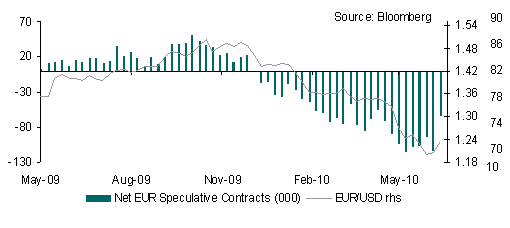
Having navigated its way through the European Central Bank’s (ECB) 12-month liquidity payback, various debt auctions, and Germany’s presidential election last week the EUR may find itself with less obstruction in its path but will nonetheless, likely struggle to make much headway this week. EUR speculative positioning, as indicated by the CFTC IMM data, reveals that there has been little short covering over the last couple of weeks, suggesting speculative sentiment remains negative.

Nonetheless, the rebound in EUR/USD has been impressive since its low around 1.1876 about a month ago and not just against the USD, with EUR making up ground on various crosses too including CHF and GBP. Easing sovereign concerns will have helped but there are plenty of downside risks ahead as austerity measures begin to bite and growth divergence becomes more apparent.

The ECB council meeting on Thursday is unlikely to give much direction for the EUR, with the meeting likely to pass with an unchanged rate decision and no change in economic assessment. There will be more attention on whether EUR/USD can maintain a toe hold above the psychologically important 1.2500 level, which I suspect may prove tough to hold this week.

The Reserve Bank of Australia (RBA) also announces its rate decision (Tuesday) and will likely pause in tightening cycle. Recent data have remained positive, especially with regard to the labour market. The RBA will wait for the Q2 CPI data on July 28th before deciding on the next policy move, with jobs data on Thursday also likely to provide further clues. AUD/USD may struggle in the current environment where growth worries are prevalent, and the currency is likely to find it tough going over the coming weeks.

Finally, the Bank of England (BoE) meets this week too but like the ECB and RBA no change is likely. Although we will have to wait a couple of weeks for the minutes of the meeting it seems highly unlikely that MPC members will vote for a hike aside from Sentance who has espoused a more hawkish stance. Notably GBP speculative short positions have been scaled back over recent weeks as sentiment for the currency turns less negative but GBP gains against the USD will be more limited this week, with renewed GBP upside against the EUR more likely.
China’s gradual renminbi move

China’s decision to “proceed further with reform” of the CNY exchange rate regime will dictate market activity at the turn of the week. The decision to act now reflects the fact that China is no longer in crisis mode policy. Although the eurozone sovereign crisis may have delayed China’s move, the authorities in China clearly felt that conditions had improved sufficiently enough to act. The decision will pre-empt some of the criticism that China would have faced at the G20 meeting next weekend, leaving attention firmly on Europe.

Before we all get too excited it should be noted that it is unlikely that China’s announcement presages aggressive action on the CNY. Stability appears to be the name of the game, a fact that has already drawn criticism from some in the US Senate who may still push for legislation over China’s exchange rate.

China will likely allow some, albeit gradual appreciation of the CNY. In this respect, it’s worth noting that the CNY appreciated by around 6.6% against the USD during 2007 and around the same amount in 2008 prior to the formal peg with the USD. Appreciation at a similar pace of coming months is unlikely.

The initial impact on the USD was an echo of the July 2005 move but to a far smaller degree. The USD was sold off across the board as market players reacted to the likelihood of the USD playing a less important role in China’s exchange rate mechanism. The USD rallied when China maintained its CNY fixing but lost ground as the CNY appreciated against the fixing.

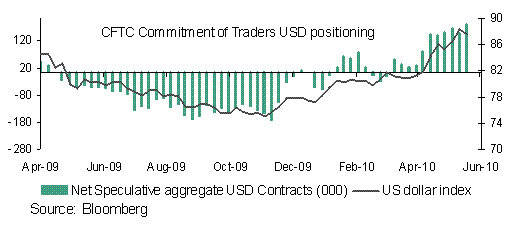
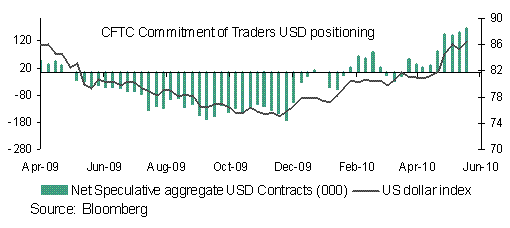
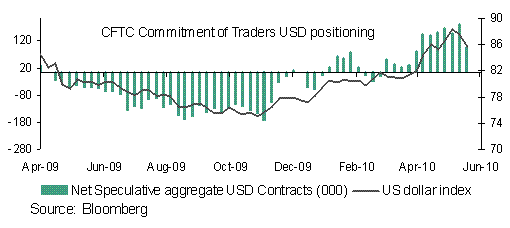
The fact that net USD speculative positions halved over the past week according to the CFTC IMM data, suggest that the USD is far less vulnerable this week to selling pressure from a positioning perspective. In other words there will be no repeat of the sharp FX moves that were seen post the July 2005 CNY revaluation. Whilst the major currency impact is likely to prove muted, Asian currencies are set to benefit more significantly, with further strengthening likely this week.

China’s announcement will play into the tone of firmer risk appetite at the beginning of the week but the move in some risk currencies, especially the EUR is looking increasingly stretched. The EUR and risk appetite may have benefited from recent positive news flow including the announcement of European bank stress tests and the relatively positive reception to Spain’s bond auction, but speculative positioning (IMM) data reveals that there was already a strong short-covering rally over the past week, which saw net EUR short positions almost halve.

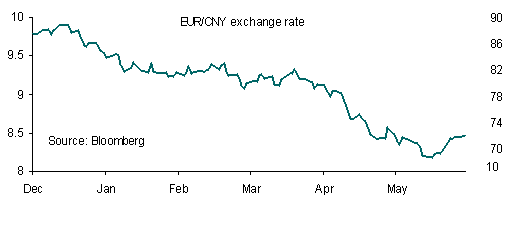
Further EUR/USD gains will be harder to come by, with an immediate obstacle around 1.2500. Perhaps another reason for China to be cautious about the pace of CNY appreciation is the likelihood of further EUR weakness and the impact that this would have on China’s trade with Europe. As it is EUR/CNY has already dropped by over 13% so far this year and China will not want to enact measures that will accelerate the pace of the move in the currency pair.

World Cup FX Positioning/Data Highlights

The market tone felt decidedly better over the course of the last week although it was difficult to tell if this was due to position squaring ahead of the World Cup football or a genuine improvement in sentiment. There was no particular event or data release that acted as a catalyst either, with the European Central Bank (ECB) and Bank of England (BoE) meetings passing with little fanfare.

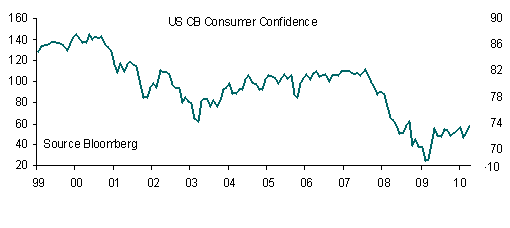
US data ended the week mixed, with retail sales disappointing in May but in contrast June consumer confidence beating expectations. Although questions about the pace of recovery remain, other data such as the Fed’s Beige Book suggest that recovery remains on track, sentiment echoed, albeit cautiously by Fed Chairman Bernanke last week.

Attention this week will centre on inflation data. Expected benign CPI readings will support the view that the Fed will take its time to raise interest rates. Speeches by the Fed’s Bullard, Plosser and Bernanke this week will be eyed for further clues on Fed thinking.

Central banks in Brazil and New Zealand hiked rates last week but this is not likely to be echoed this week. No change is likely from both the Bank of Japan and Swiss National Bank although there will be plenty of attention on the SNB’s comments on the CHF following recent data showing a surge in FX reserves due to currency intervention. The BoJ is unlikely to announce anything new but perhaps some further detail on the loan support plan could be forthcoming.

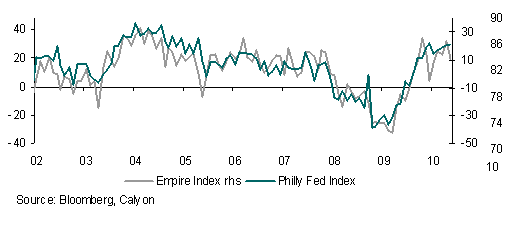
Manufacturing data will also garner some attention, with the US June Empire and Philly Fed surveys and May industrial production on tap. All three reports will confirm the improving trend in manufacturing activity in the US. Housing data will look weaker, with starts set to pull back in starts in May following the expiry of government tax incentive programmes though permits are set to rise.

In Europe, the June German ZEW (econ sentiment) investor sentiment survey will likely slip slightly due to ongoing fiscal/debt worries but this will be countered by stronger domestic data. In any case the index remains at a high level and a slight drop is unlikely to derail markets.

GBP may find some support form upgrade of UK growth forecasts by the CBI to 1.3% for 2010 and relatively hawkish comments from the BoE’s Sentance in the weekend press warning that inflation is higher than expected, indicating that the Bank may need to hike rates sooner than expected.

Further GBP/USD direction will come from CPI and retail sales data this week as well as public borrowing figures and a report by the new Office of Budget Responsibility on the UK’s fiscal position ahead of the June 22 budget. A break above GBP/USD resistance around 1.4760 is unlikely to materialise.

Despite the many data releases this week, the overall tone is likely to be one of consolidation and reduced volatility in the days ahead. This may allow EUR/USD to gain some ground due to short covering, with the CFTC commitment of traders (IMM) report revealing a further increase in net short speculative positions last week, close to the record set a few weeks back, though we suspect that there will be strong resistance around 1.2227.

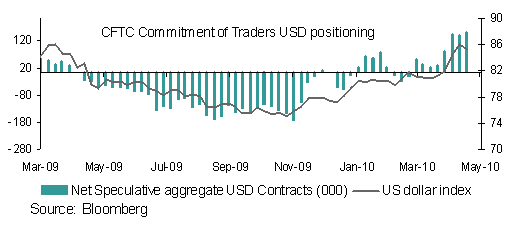
The fact that the IMM data revealed that net aggregate net USD long positions reached an all time high last week, highlights the potential for profit taking this week. USD/JPY will look to take out resistance around 92.55 but this looks unlikely unless the BoJ dishes up anything particularly dovish from its meeting.

Volatility Within Ranges

Most investors will likely be happy to see the tail end of May given the sharp losses in many asset classes over the month. At least over the last few days there was a sense of some healing, particularly in risk assets though it is questionable how long this can continue given the still many and varied uncertainties afflicting markets. A reminder of this came late on Friday, with Fitch downgrading Spain’s sovereign credit ratings despite the passage of austerity measures.

The Fitch decision highlights that Spain is rapidly becoming the new epicenter of the crisis; focus on the savings banks or Cajas is intensifying ahead of the June 30 deadline for mergers to qualify for government money, the minority government’s popularity is in further decline, whilst unions are threatening more strikes across the country. Unions in Greece and Italy are also pushing for coordinated strikes, highlighting the difficulties in pushing through austerity measures.

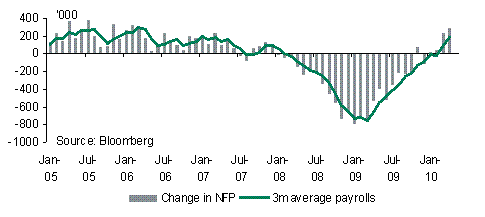
At least economic data is providing some solace to markets. Releases last week in the US highlighted the fact that consensus expectations are underestimating the pace of recovery; consumer confidence, durable goods orders and new home sales all came in above expectations. The same story is likely this week, but there is really only one piece of data that attention will focus on and that’s the May jobs report. The consensus is for a strong 508k increase in non-farm payrolls following a 290k increase in April, though around three-quarters of this will be related to census hiring. The unemployment rate is likely to dip slightly to 9.8%.

Markets are likely to be in limbo, with volatility in ranges likely this week. USD sentiment remains strong as reflected in the CFTC IMM data where net aggregate positioning is at an all time high, but further USD gains may be harder to come by ahead of the US jobs report and G20 meeting this weekend. Stretched USD positioning has proven no barrier to USD strength over recent weeks but the fact that markets are very long USDs could at the least result in a slower pace of further appreciation.

EUR speculative sentiment remains close to all time lows although there are signs of some relative stability over recent weeks. EUR/USD is likely to range between 1.2134 and 1.2475 this week. There was a sharp drop in net short JPY positions over the week (ie short-covering) though this appears at odds with the fall in the JPY. GBP speculative positions showed little improvement, languishing close to all time lows, whilst net longs in commodity currencies were pared back sharply, especially in AUD where net longs were cut by around half though sharp declines in positioning were also registered for NZD and CAD.

GBP could suffer due to worries about the UK government’s plans to reduce its burgeoning budget deficit following the resignation of Treasury Minister David Laws, following an expense scandal. The resignation hits the coalition just three weeks before the emergency budget and could result in complications on the negotiations between the Liberal Democrats and Conservatives on the substance of the deficit cutting measures. GBP/USD is likely to find support around 1.4260 and resistance around 1.4612 this week.

What To Watch This Week

The end of last week proved to be a calmer affair than the preceding few days. There was some encouraging news on the Greek front, with Germany finally approving its share of the European Union (EU) aid package whilst Greece appeared to be on track with its budget deficit reduction as the country recorded a cash deficit of EUR 6.3billion in the first four months of the year, a 42% reduction compared to a year earlier. EU officials also agreed on tougher sanctions for countries breaching austerity rules.

There were plenty of negatives to offset the good news however, as European business surveys including the German IFO index and flash eurozone purchasing managers indices (PMIs) revealed some loss of momentum in growth as well as increased divergence. European banking sector concerns intensified as the Bank of Spain was forced to take control of CajaSur, a small savings bank holding 0.6% of total Spanish banking assets, which faced difficulties due to distressed real estate exposure. Its woes highlighted the problems faced by many Spanish savings banks due to property market exposure.

US data releases this week will confirm that economic recovery gathered steam in Q2. May consumer confidence data is likely to record a small gain, due in large part to improving job market conditions, whilst the Chicago PMI is set to retrace slightly in May, albeit from a healthy level. Both new and existing home sales are set to record gains in April, the former following a sizeable gain in March although the drop in house prices likely to be revealed by the Case-Shiller index will continue to fuel doubts about the veracity of the turnaround in the US housing market.

In Europe there is not much in terms of first tier releases and highlights include sentiment data such as German Gfk and French consumer confidence indices, and the May French business confidence indicator. The data are likely to be mixed, and as indicated by last week’s surveys will reflect a relatively healthy Q2 2010, but a worsening outlook for the second half of the year.

In the absence of UK data today there will be plenty of attention on the details of plans by Chancellor Osborne to cut GBP 6 billion from the budget deficit. The measures will be small change ahead of the emergency budget package on June 22nd when much bigger cuts are expected. Nonetheless, the first step today will be a crucial test of the new government’s ability to convince ratings agencies and markets that it is serious about reducing the burgeoning fiscal deficit.

Following the massive positioning adjustments of the last week markets will look somewhat calmer over coming days but risk aversion is likely to remain elevated, suggesting little respite for most currencies against the USD. The recent moves have left net aggregate USD positioning registering an all time high according to the CFTC Commitment of Traders data, in the latest week, but after the slight retracement lower in the USD index, it is set to make further gains over coming days.

It was notable that EUR and GBP looked more composed at the tail end of the week whilst attention turned to the liquidation of long positions in CHF, AUD, NOK and SEK. These risk currencies are set to remain under pressure but there will be little respite for EUR which is set to drift lower, albeit a less aggressive pace than over recent weeks and a re-test of EUR/USD technical support around 1.2296 is likely. GBP/USD has showed some resilience over recent days but remains vulnerable to further downside pressure, with 1.4310 immediate support.