Stressing About European Stress Tests

Equities and risk appetite were bolstered by the relative success of the Spanish bond auction on Thursday. The results of the auction in which Spain sold EUR 3 billion in 10 year notes helped to stem some of the pressure on eurozone bond spreads, which despite the generalized improvement in market sentiment over recent days, had been continuing to widen.

Another key indicator that has been suggested that all is not well moving in the opposite direction to the improvement in many risk indicators is the Baltic Dry Index which has dropped by around a third since 26th May 2010.

Perhaps more significant in terms of providing sustainable support for markets was the news that the European Union agreed to publish the results of bank stress tests, slated for the second half of July. This could turn out to be a key stepping stone towards increasing the transparency of the eurozone banking sector.

However, doubts will remain until there is some clarity on the terms of the tests such as whether they include details of sovereign debt exposure. Also, if the stress tests reveal shortcomings in the banks in question it is unclear if government funding will be provided for them. Although the publishing of stress test results is a step in the right direction until these and other questions are answered it is difficult to see markets getting too excited.

It’s not all plain sailing for equity markets despite the relatively positive news in Europe as disappointing US data in the form of a surprise jump in weekly jobless claims and a bigger than expected drop in the June Philly Fed survey weighed in on the side of those expecting both a slow and jobless recovery in the US.

The CHF has been a key mover following the Swiss National Bank policy decision. The decision to leave interest rates unchanged was no surprise, but the change in rhetoric towards a less aggressive stance towards CHF strength opens up the floodgates for CHF buyers. will look to test its all time low around 1.3720.

Another central bank that has shown concern about a strengthening currency is the Bank of Japan but unlike the SNB Japan’s central bank has not intervened for several years. The BoJ in the minutes of its May meeting noted that it will “watch if Europe’s crisis strengthens JPY”, indicating some concern about JPY strength.

This sentiment that was echoed by the Japanese government in the release of Economic Growth Strategy aimed at avoiding an excessive rise in the JPY via fiscal and monetary steps to beat deflation. The JPY barely reacted to both the minutes and the growth strategy, with market players likely sceptical until concrete measures are actually implemented.

It still look like an environment of sell on rallies for the EUR and other risk currencies, with their gains likely to run out of steam over coming days. The next key technical level for EUR/USD is around 1.2454, a level that will prove a tough nut to crack.
Euro Rally To Fade

It is not an easy time to forecast currencies. Just as many forecasters fought for the accolade of being the most bearish on the EUR and many others were forced to capitulate or risk falling behind the curve, EUR/USD has started to perk up. Similarly, commodity currencies and many emerging market currencies have bounced.

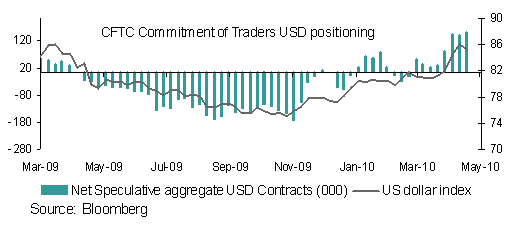
Perhaps the explanation of these moves is merely position adjustments as traders and investors square positions as they keep one eye on the World Cup or maybe its just fatigue after weeks of selling pressure. Either way, the fact that speculative USD market positioning is at a very high level, suggests there is plenty of scope to take profits on long USD positions.

There are various reasons to expect the calm to give way to renewed tensions, however. Public opposition to austerity plans in Europe, added to the prospects for slowing growth as the plans are implemented, in addition to banking sector concerns, suggest that the outlook for the EUR remains downbeat. These factors also point to the prospects of risk aversion rising over the coming weeks, reversing the recent rally in risk currencies.

Further out, the EUR’s travails will not be over quickly and in the wake of the implementation of austerity plans the EUR will struggle from the impact of relatively slower growth in the eurozone compared to the US and other countries. The EUR will continue to remain under pressure even as risk appetite improves and many risk currencies appreciate.

The interruption of risk as an FX determinant is likely to fade towards the end of the year and investors will then go back to differentiating on the basis of relative growth and interest rate dynamics, which will play well for the USD as US growth strengthens.

Relative growth differentials will also bode well for commodity currencies and there will be scope for plenty of upside in the AUD and NZD as growth strengthens. Both countries have benefited from firm demand in Asia and China in particular and this source of support will likely continue to be beneficial.

Funding currencies including JPY and CHF will likely weaken this year against the USD based on the likely improvement in risk appetite later this year. The outlook for the JPY will be particularly interesting in the wake of the change in Prime Minister in Japan, especially given the new PM’s preference for a weaker JPY and reflationary policies. USD/JPY will likely reach 100 by the end of the year.

GBP should not be seen in the same context as the EUR. Although the UK has got its own share of fiscal problems the new government appears to be moving quickly to mollify both investor and ratings agency concerns. The test will come with the reaction of the emergency budget on June 22nd but I suspect that the downside risk to GBP will be limited.

Unlike the EUR which is trading around “fair value”, GBP is highly undervalued. Arguably past GBP weakness puts the UK economy on a stronger recovery footing. Moreover, problems that Europe will face in implementing multi country austerity plans and widening growth divergence, will not be repeated in the UK. Overall, there is likely to be significant outperformance of GBP versus EUR over coming months

What To Watch This Week

The end of last week proved to be a calmer affair than the preceding few days. There was some encouraging news on the Greek front, with Germany finally approving its share of the European Union (EU) aid package whilst Greece appeared to be on track with its budget deficit reduction as the country recorded a cash deficit of EUR 6.3billion in the first four months of the year, a 42% reduction compared to a year earlier. EU officials also agreed on tougher sanctions for countries breaching austerity rules.

There were plenty of negatives to offset the good news however, as European business surveys including the German IFO index and flash eurozone purchasing managers indices (PMIs) revealed some loss of momentum in growth as well as increased divergence. European banking sector concerns intensified as the Bank of Spain was forced to take control of CajaSur, a small savings bank holding 0.6% of total Spanish banking assets, which faced difficulties due to distressed real estate exposure. Its woes highlighted the problems faced by many Spanish savings banks due to property market exposure.

US data releases this week will confirm that economic recovery gathered steam in Q2. May consumer confidence data is likely to record a small gain, due in large part to improving job market conditions, whilst the Chicago PMI is set to retrace slightly in May, albeit from a healthy level. Both new and existing home sales are set to record gains in April, the former following a sizeable gain in March although the drop in house prices likely to be revealed by the Case-Shiller index will continue to fuel doubts about the veracity of the turnaround in the US housing market.

In Europe there is not much in terms of first tier releases and highlights include sentiment data such as German Gfk and French consumer confidence indices, and the May French business confidence indicator. The data are likely to be mixed, and as indicated by last week’s surveys will reflect a relatively healthy Q2 2010, but a worsening outlook for the second half of the year.

In the absence of UK data today there will be plenty of attention on the details of plans by Chancellor Osborne to cut GBP 6 billion from the budget deficit. The measures will be small change ahead of the emergency budget package on June 22nd when much bigger cuts are expected. Nonetheless, the first step today will be a crucial test of the new government’s ability to convince ratings agencies and markets that it is serious about reducing the burgeoning fiscal deficit.

Following the massive positioning adjustments of the last week markets will look somewhat calmer over coming days but risk aversion is likely to remain elevated, suggesting little respite for most currencies against the USD. The recent moves have left net aggregate USD positioning registering an all time high according to the CFTC Commitment of Traders data, in the latest week, but after the slight retracement lower in the USD index, it is set to make further gains over coming days.

It was notable that EUR and GBP looked more composed at the tail end of the week whilst attention turned to the liquidation of long positions in CHF, AUD, NOK and SEK. These risk currencies are set to remain under pressure but there will be little respite for EUR which is set to drift lower, albeit a less aggressive pace than over recent weeks and a re-test of EUR/USD technical support around 1.2296 is likely. GBP/USD has showed some resilience over recent days but remains vulnerable to further downside pressure, with 1.4310 immediate support.

“Risk On”- Which Currencies Will Benefit?

It was a “risk on” beginning of the week as equity markets rallied, commodities prices rose, and G10 bonds and USD came under pressure. Stronger manufacturing PMIs helped to boost confidence in the global economic recovery, with solid PMIs revealed in China, and across the rest of Asia, UK, and the US. The US ISM manufacturing which rose to its highest since April 2006 also revealed a rise in the unemployment component, consistent with view of an unchanged reading for December payrolls.

In the Eurozone the PMI matched the flash release and remained in expansion territory though there was some slippage in Germany, Spain, and Italy, underscoring the likely underperformance of the Eurozone economy relative to expectations of faster recovery in the US. Nonetheless, the PMIs continued to show a picture of expansion, with the Eurozone PMI at its highest in 21-months.

The USD lost ground against the background of improved risk appetite and looks set to fall further abruptly ending its short covering rally. The USD appears to be finding little support from interest rate expectations, with the correlation between most currencies and relative interest rate differentials remaining relatively low for the most part (just -0.04 over the past 3-months between the USD index and US rate futures).  The correlation between the USD and US 10-year bond yields looks somewhat stronger however, and could offer some relief to the USD if yields continue to push higher.

Speculative (CFTC Commitment of Traders) data reveals just how massive the shift in USD positioning has been over recent weeks, with net aggregate USD positioning (vs EUR, JPY, GBP, AUD, NZD, CAD, CHF) registering its first net long USD position since May 2008. The swing in positioning has been dramatic, from -167k contracts on 15 September 2009 to +8.7k in the week ending 29th December 2009. The data also reveals the sharp deterioration in sentiment for the EUR to its lowest since September 2008. Likewise net JPY positions have shifted to their biggest net short since August 2008.

What does this imply? The market is very short EUR and JPY but the JPY has much further to go on the downside as it increasingly retakes the mantle of funding currency.  In any case compared to historical positioning JPY shorts are not so big suggesting more room to increase short positions.   

The EUR has moved into a short term uptrend, with the MACD (12,26,9) having crossed its signal line and positioning supports further upside. EUR/USD will need to take out strong resistance at 1.4459 (December 29) before it can embark on a more significant move higher. Asian currencies also look set to take more advantage of a resumption of USD weakness, especially in the wake of strong risk seeking capital flows into the region. KRW, TWD, IDR and PHP look bullish technically.

Speculative data points to USD struggle

The latest CFTC Commitment of Traders (IMM) data shows just how massive the shift in speculative USD positioning has been over recent weeks.  Net aggregate USD short positions (vs. EUR, JPY, GBP, AUD, NZD, CAD, CHF) have shifted from -172k at the beginning of December to -11k in the week ending Dec 22nd.   This corresponds with the sharp rally in the USD versus various currencies over the same period.  

The net speculative USD position is now at its highest since May 2009 and at this pace of improvement the market will be net long USD very quickly.  However, the data also suggests that there should be a degree of cautiousness in buying the USD from here.  The USD may simply be repeating the pattern seen in 2006 and 2007 when the USD strengthened into year end only to drop sharply in the weeks after. 

If the rally in the USD has largely been due to short covering into year end then this source of support for the USD is looking exhausted. Indeed it is difficult to argue that interest rate moves have helped the USD as correlations are still low between the USD index and US rate futures. The shift in USD speculative positioning may explain the inability of the USD to make much further headway over recent days and suggests difficulty for the USD in the days ahead, with the USD index likely to struggle to get above last week’s high o 78.449.