Italy downgrade adds to EUR woes

The USD index remains firm but it remains unlikely that the USD is being bought on its own merits but rather on disappointments in the eurozone. Nonetheless, speculative USD sentiment has turned positive for the first time since June 2010 according to the CFTC IMM data, reflecting a major shift in appetite for the currency. Clearly there are risks to the USD including the potential for more QE3 being announced at this week’s FOMC meeting but this risk is likely to be small.

In contrast, the reversal in speculative sentiment for the EUR has been just as dramatic but in the opposite direction as the net short EUR position has increased over recent weeks, with positioning now at its lowest since June 2010. Sentiment is likely to have soured further overnight following news that Italy’s credit rating was cut by S&P to A from A+ despite the recent passage of an austerity package.

This outweighed any boost to sentiment from what was noted by the Greek Finance Minister as “productive” talks yesterday. Another conference call today is scheduled but the longer markets wait for approval of the next loan tranche the bigger the risk to the EUR. In addition Greek and Spanish T-bill auctions and European Central Bank (ECB) cash operations will be in focus. The EUR remains vulnerable to a test of support around 1.3500.

GBP has continued to slide over recent weeks, having fallen by around 5% since its high just above 1.66 a month ago. However, it has managed to hold its own against the EUR which looks in even more of a sorry state than the pound. The fact that GBP has been unable to capitalise on the EUR’s woes is largely attributable to growing expectations of further UK quantitative easing.

The minutes of the last Bank of England meeting on September 8 to be released on Wednesday will give more clues as to the support within the Monetary Policy Committee for further QE but its likely that the MPC will want to see the next Quarterly Inflation Report in November before committing itself to any further easing. In the meantime, GBP will find it difficult to sustain any recovery, with its drop against the USD likely to extend to around 1.5583 in the short term.

Japan returns from its Respect for the Aged holiday today but local market participants will have missed little action on the JPY, with the currency remaining confined to a very tight range. The inability of USD/JPY to move higher despite the general bounce in the USD index reflects 1) the fact that USD/JPY is very highly correlated with 2 year bond yield differentials and 2) the fact that US yields continue to be compressed relative to Japan. Additionally, risk aversion continues to favour the JPY and combined, these factors suggest little prospect of any drop in the JPY versus USD soon.
Euro’s Teflon Coating Wearing Thin

EUR has suffered a setback in the wake some disappointment from the European Union summit at the end of last week and the major defeat of German Chancellor Merkel and her ruling Christian Democratic Union party in yesterday’s election in Baden-Wuerttemberg. The EUR had been fairly resistant to negative news over recent weeks but its Teflon like coating may be starting to wear thin.

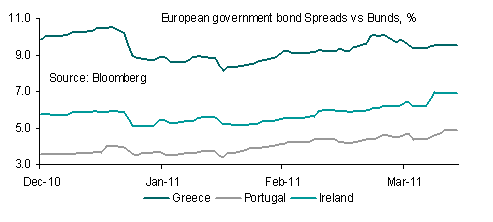
The setbacks noted above + others (see previous post) follow credit rating downgrades for Portugal by both S&P and Fitch ratings and growing speculation that the country is an imminent candidate for an EU bailout following the failure of the Portuguese government to pass its austerity measures last week and subsequent resignation of Portugal’s Prime Minister Socrates.

For its part Portugal has stated that it does not need a bailout but looming bond redemptions of around EUR 9 billion on April 15 and June 15 against the background of record high funding costs mean that the pressure for a rescue is intense. Complicating matters is the fact that fresh elections cannot be held earlier than 55 days after being announced, meaning that policy will effectively be in limbo until then. A June vote now appears likely.

After what was perceived to be a positive result of the informal EU leaders summit a couple of weeks ago, the outcome of the final summit last week failed to deliver much anticipated further details whilst more negatively the EU bailout fund’s paid-in capital was scaled back to EUR 16 billion (versus EUR 40 billion agreed on March 21) due to concerns expressed by Germany.

Ireland is also in focus ahead of European bank stress tests results on March 31. Ireland is pushing for increased sharing of bank losses with senior bondholders as part of a “final solution” for financial sector. Meanwhile the new government remains unwilling to increase the country’s relatively low corporation tax in exchange for a renegotiation of terms for the country’s bailout. This point of friction also threatens to undermine the EUR.

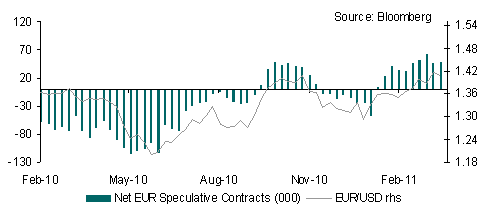
The bottom line is that the bad news is building up and the ability of the EUR to shake it off is lessening. Considering the fact that the market long EUR, with positioning well above the three-month average the EUR is vulnerable to position adjustment. After slipping over recent days EUR/USD looks supported above 1.3980 but its upside is looking increasingly restricted against the background of various pieces of bad news.

Split personality

Markets are exhibiting a Strange Case of Dr Jekyll and Mr Hyde, with a clear case of split personality. Intensifying risk aversion initially provoked USD and JPY strength, with most crosses against these currencies under pressure. Both USD/JPY and EUR/JPY breezed through psychological and technical barriers, with the latter hitting a nine-year low. However, this reversed abruptly in the wake of extremely poor US existing home sales, which plunged 27.2% in July, alongside downward revisions to prior months, a much bigger drop than forecast.

Obviously double-dip fears have increased but how realistic are such fears? Whilst much of the drop in home sales can be attributed to the expiry of tax credits, investors can be forgiven for thinking that renewed housing market weakness may lead the way in fuelling a more generalized US economic downdraft. The slow pace of jobs market improvement highlights that the risks to the consumer are still significant, whilst tight credit and weaker equities, suggests that wealth and income effects remain unsupportive.

FX markets will need to determine whether to buy USDs on higher risk aversion or sell USDs on signs of weaker growth and potential quantitative easing. I suspect the former, with the USD likely to remain firm against most risk currencies. The only positive thing to note in relation to the rise in risk aversion is that it is taking place in an orderly manner, with markets not panicking (yet).

European data in the form of June industrial new orders delivered a pleasant surprise, up 2.5%, but sentiment for European markets was delivered a blow from the downgrade of Ireland’s credit rating to AA- from AA which took place after the close. The data suggests that the momentum of European growth in Q3 may not be as soft as initially feared following the robust Q2 GDP outcome.

Japan has rather more to worry about on the growth front, especially given the weaker starting point as revealed in recently soft Q2 GDP data. Japan revealed a wider than expected trade surplus in July but this was caused by a bigger drop in exports than imports, adding to signs of softening domestic activity. The strength of the JPY is clearly making the job of officials harder but so far there has been no sign of imminent official FX action.

Japan’s finance minister Noda highlighted that recent FX moves have been “one sided” and that “appropriate action will be taken when necessary”. The sharp move in JPY crosses resulted in a jump in JPY volatility, a factor that will result in a greater probability of actual FX intervention but the prospects of intervention are likely to remain limited unless the move in the JPY accelerates. USD/JPY hit a low of 83.60 overnight but has recovered some lost ground, with 83.50 seen as the next key support level. JPY crosses may see some support from market wariness on possible BoJ JPY action, but the overall bias remains downwards versus JPY.