Volatility Within Ranges

Most investors will likely be happy to see the tail end of May given the sharp losses in many asset classes over the month. At least over the last few days there was a sense of some healing, particularly in risk assets though it is questionable how long this can continue given the still many and varied uncertainties afflicting markets. A reminder of this came late on Friday, with Fitch downgrading Spain’s sovereign credit ratings despite the passage of austerity measures.

The Fitch decision highlights that Spain is rapidly becoming the new epicenter of the crisis; focus on the savings banks or Cajas is intensifying ahead of the June 30 deadline for mergers to qualify for government money, the minority government’s popularity is in further decline, whilst unions are threatening more strikes across the country. Unions in Greece and Italy are also pushing for coordinated strikes, highlighting the difficulties in pushing through austerity measures.

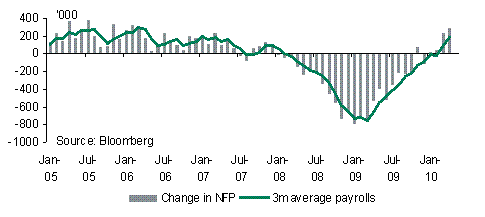
At least economic data is providing some solace to markets. Releases last week in the US highlighted the fact that consensus expectations are underestimating the pace of recovery; consumer confidence, durable goods orders and new home sales all came in above expectations. The same story is likely this week, but there is really only one piece of data that attention will focus on and that’s the May jobs report. The consensus is for a strong 508k increase in non-farm payrolls following a 290k increase in April, though around three-quarters of this will be related to census hiring. The unemployment rate is likely to dip slightly to 9.8%.
Markets are likely to be in limbo, with volatility in ranges likely this week. USD sentiment remains strong as reflected in the CFTC IMM data where net aggregate positioning is at an all time high, but further USD gains may be harder to come by ahead of the US jobs report and G20 meeting this weekend. Stretched USD positioning has proven no barrier to USD strength over recent weeks but the fact that markets are very long USDs could at the least result in a slower pace of further appreciation.
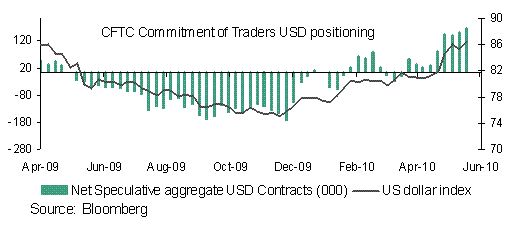
EUR speculative sentiment remains close to all time lows although there are signs of some relative stability over recent weeks. EUR/USD is likely to range between 1.2134 and 1.2475 this week. There was a sharp drop in net short JPY positions over the week (ie short-covering) though this appears at odds with the fall in the JPY. GBP speculative positions showed little improvement, languishing close to all time lows, whilst net longs in commodity currencies were pared back sharply, especially in AUD where net longs were cut by around half though sharp declines in positioning were also registered for NZD and CAD.

GBP could suffer due to worries about the UK government’s plans to reduce its burgeoning budget deficit following the resignation of Treasury Minister David Laws, following an expense scandal. The resignation hits the coalition just three weeks before the emergency budget and could result in complications on the negotiations between the Liberal Democrats and Conservatives on the substance of the deficit cutting measures. GBP/USD is likely to find support around 1.4260 and resistance around 1.4612 this week.

Q1 Economic Review: Elections, Recovery and Underemployment

I was recently interview by Sital Ruparelia for his website dedicated to “Career & Talent Management Solutions“, on my views on Q1 Economic Review: Elections, Recovery and Underemployment.

Sital is a regular guest on BBC Radio offering career advice and job search tips to listeners. Being a regular contributor and specialist for several leading on line resources including eFinancial Careers and Career Hub (voted number 1 blog by ‘HR World’), Sital’s career advice has also been featured in BusinessWeek online.

As you’ll see from the transcript of the interview below, I’m still cautiously optimistic about the prospects for 2010 and predicts a slow drawn out recovery with plenty of hiccups along the way.

Sital: Mitul, when we spoke in December to look at your predictions for 2010, you were cautiously optimistic about economic recovery in 2010. What’s your take on things after the first quarter?

Click here to read the rest…

US dollar beaten by the bears

Since I wrote my last post on the US dollar a week ago, US dollar under pressure, the slide in the dollar has accelerated against most currencies. Rather than being driven by an improvement in risk appetite however, it appears that the dollar is being hit by a major shift in sentiment. Indeed currency market dynamics appear be changing rapidly.

In particular, there has been a major breakdown in the relationship between the dollar and equity markets, suggesting that the influence of risk on FX markets is waning. For example, rather than rallying on the back of weaker equity markets over recent days, dollar weakness has actually intensified.

More likely this is becoming a pure and clear slide in sentiment for the dollar. There was some indication of this from the latest CFTC IMM Commitment of traders’ report which is a good gauge to speculative market positioning, showing that net dollar positioning has become negative for the first time in several months.

More evidence of this is the fact that the dollar / yen exchange rate has fallen even as risk appetite has improved. This is at odds with the usual relationship between the Japanese yen and risk appetite. The yen benefited the most from higher risk aversion since the crisis began, strengthening sharply against many currencies. As risk appetite improves and equity markets rally the yen would be expected to weaken the most as risk appetite improves.

I had looked for dollar weakness to accelerate into the second half of 2009 but against some currencies the drop in the dollar has come earlier than anticipated. I also thought that the dollar may stand a chance at a bit of a recovery in the near term if equity markets slipped and risk aversion increased. I was wrong about this. Despite the drop in equities over recent days the USD has also lost ground. Nor has the USD benefited from higher bond yields in the US.

The evidence is clear; USD bearishness is becoming more entrenched and the likelihood of a risk related rebound is becoming more remote even as risk aversion picks up once again. There appears to be a general shift away from US assets in general particularly Treasuries and most likely by foreign official investors who appear to be accelerating their diversification away from the dollar over recent weeks.

The importance of foreign buying of US Treasuries should not be underestimated in terms of its influence on the USD. Foreign purchases of US Treasuries made up 77% of total foreign buying of US securities in 2008. If there is a growing chance of a downgrade to the US’s AAA credit rating in the wake of a budget deficit that will be around $1.85 trillion this year and a rising debt/GDP ratio, the drop in the dollar seen so far may prove to be small compared to downside risks in the months ahead.