Q2 Economic Review: Double-Dip Recession or Prolonged Recovery?

I was recently interviewed by Sital Ruparelia for his website dedicated to “Career & Talent Management Solutions“, on my views on my view on the Q2 Economic Review: Double-Dip Recession or Prolonged Recovery?

Sital is a regular guest on BBC Radio offering career advice and job search tips to listeners. Being a regular contributor and specialist for several leading on line resources including eFinancial Careers and Career Hub (voted number 1 blog by ‘HR World’), Sital’s career advice has also been featured in BusinessWeek online.

Please see below to read my article

Since we last discussed the economic outlook at the end of quarter 1, much has happened and unfortunately there has not been a great deal of positive news. I retained a cautiously optimistic outlook for economic recovery for the Q1 Economic Review: elections, recovery and underemployment discussion article, but highlighted that recovery would be a long and drawn-out process, with western economies underperforming Asian economies.

The obstacles to recovery discussed then continue to apply now, including consumers paying down debt, high unemployment, tight credit conditions and weak confidence.

Click here to read the rest…

World Cup FX Positioning/Data Highlights

The market tone felt decidedly better over the course of the last week although it was difficult to tell if this was due to position squaring ahead of the World Cup football or a genuine improvement in sentiment. There was no particular event or data release that acted as a catalyst either, with the European Central Bank (ECB) and Bank of England (BoE) meetings passing with little fanfare.

US data ended the week mixed, with retail sales disappointing in May but in contrast June consumer confidence beating expectations. Although questions about the pace of recovery remain, other data such as the Fed’s Beige Book suggest that recovery remains on track, sentiment echoed, albeit cautiously by Fed Chairman Bernanke last week.

Attention this week will centre on inflation data. Expected benign CPI readings will support the view that the Fed will take its time to raise interest rates. Speeches by the Fed’s Bullard, Plosser and Bernanke this week will be eyed for further clues on Fed thinking.

Central banks in Brazil and New Zealand hiked rates last week but this is not likely to be echoed this week. No change is likely from both the Bank of Japan and Swiss National Bank although there will be plenty of attention on the SNB’s comments on the CHF following recent data showing a surge in FX reserves due to currency intervention. The BoJ is unlikely to announce anything new but perhaps some further detail on the loan support plan could be forthcoming.

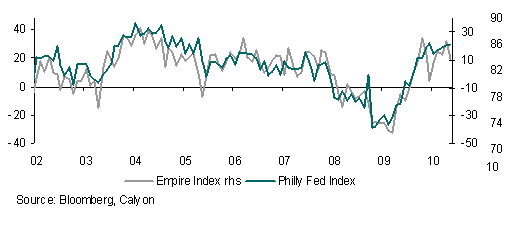
Manufacturing data will also garner some attention, with the US June Empire and Philly Fed surveys and May industrial production on tap. All three reports will confirm the improving trend in manufacturing activity in the US. Housing data will look weaker, with starts set to pull back in starts in May following the expiry of government tax incentive programmes though permits are set to rise.
In Europe, the June German ZEW (econ sentiment) investor sentiment survey will likely slip slightly due to ongoing fiscal/debt worries but this will be countered by stronger domestic data. In any case the index remains at a high level and a slight drop is unlikely to derail markets.

GBP may find some support form upgrade of UK growth forecasts by the CBI to 1.3% for 2010 and relatively hawkish comments from the BoE’s Sentance in the weekend press warning that inflation is higher than expected, indicating that the Bank may need to hike rates sooner than expected.

Further GBP/USD direction will come from CPI and retail sales data this week as well as public borrowing figures and a report by the new Office of Budget Responsibility on the UK’s fiscal position ahead of the June 22 budget. A break above GBP/USD resistance around 1.4760 is unlikely to materialise.

Despite the many data releases this week, the overall tone is likely to be one of consolidation and reduced volatility in the days ahead. This may allow EUR/USD to gain some ground due to short covering, with the CFTC commitment of traders (IMM) report revealing a further increase in net short speculative positions last week, close to the record set a few weeks back, though we suspect that there will be strong resistance around 1.2227.
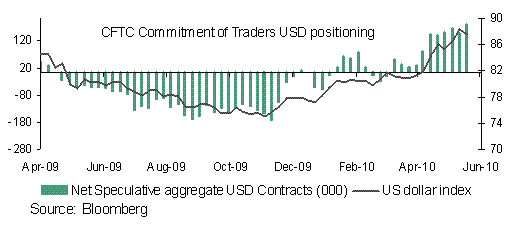
The fact that the IMM data revealed that net aggregate net USD long positions reached an all time high last week, highlights the potential for profit taking this week. USD/JPY will look to take out resistance around 92.55 but this looks unlikely unless the BoJ dishes up anything particularly dovish from its meeting.

What A Disappointment!

Ok so after talking up US data releases over recent weeks the big one namely the May jobs report, came as a disappointment. To recap, payrolls rose 431k, which was less than market consensus. Hiring due to the census which by its nature will be transitory was however, in line with expectations, at 411k, leaving ex-census hiring at a measly +20k.

Believe it or not, the trend in payrolls is one of improvement but the May outcome came as a blow to a market with bullish expectations, especially following earlier comments from the US administration hinting at a robust outcome. The disappointment was compounded by talk of a +700k payrolls outcome, which proved widely off the mark. The unemployment rate did drop more than expected, by two ticks to 9.7%, but this was due to disaffected workers dropping out of the labor force rather than an inherent pick up in job conditions.

Combined with worries about a new target in the sovereign debt crisis in Europe, this time Hungary, markets quickly tanked and risk aversion jumped. So much for relative stability! The concerns were sparked by Hungarian officials themselves, with a spokesman for the Prime Minister warning about the fiscal mess inherited from the previous government. The real blow came when the spokesman compared Hungary to Greece and reportedly said that talk of a default was “not an exaggeration”.

Suffice to say, markets are set up for tense and nervous week in which risk trades are set to suffer further. EUR/USD once again proved to be the weak link dropping below the psychologically important level of 1.20 and the EUR introduction rate around 1.1830 has moved sharply into focus.

For A Few Dollars More…

…or should I say a few EUR more.   This is what the Greek authorities must be wondering.  Once again Greek worries weighed on equities and risk appetite as a whole.  Although the saga is turning into one big yawn, markets have not had their fill with the bad news coming from this small eurozone economy.  Talks between Greek officials, International Monetary Fund (IMF), European Central Bank (ECB) and European Union (EU) began yesterday but are expected to go on for several days or weeks until a joint text is issued on May 15, just days ahead of a EUR 8.5 billion bond redemption by Greece. 

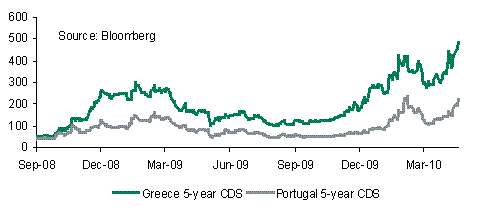
The talks have done nothing to prevent Greece’s bond yields moving higher, with the yield on 10-year bonds pushing well over 8% whilst the spread with Germany debt also blew out to over 500bps.  The main fear in the market is that Greece will ultimately end up restructuring its debt.  Moreover, contagion fears have dealt a blow to southern European sovereign CDS especially Portugal.  It wasn’t plain sailing for German bonds either, with yesterday’s auction of EUR 3 billion of 30-year Bunds failing to sell the full amount. 

Another casualty of ongoing Greece concerns is the EUR, with the currency under performing other majors and still on its path towards EUR/USD 1.3300 in the near term and onto 1.3150 after.   EUR also looks vulnerable on the crosses and EUR/GBP in particular is one to watch, with the 28 January low around 0.86029 likely to be targeted over the near term.  UK employment data gave some relief to GBP yesterday, with further direction coming from retail sales data today and the next televised leaders’ debate.  

At some point the market will become fatigued with consensus beating earnings and the positive impact on equities will become less marked.  This point is approaching but we’re not quite there yet.  Apple, Morgan Stanley and Boeing did not disappoint, with earnings easily beating forecasts.  Boeing’s earnings in particular helped industrials to be the best performing sector on the S&P 500 although the overall index closed marginally lower.

Earnings today include Amazon.com, American Express, Credit Suisse, Microsoft, Nokia, and PepsiCo.  It is becoming plainly obvious that market expectations for earnings are too pessimistic but as noted above the positive market impact of good earnings is likely to wane. 

On the data front, highlights include March existing home sales, jobless claims and Producer Price Index (PPI).   There will be less focus on PPI given that the Consumer Price Index (CPI) over the month has already been released whilst claims are likely to resume a path lower following the jump over the past couple of weeks.   Existing home sales are likely to post an impressive gain as indicated by firm pending home sales data.   

Overall, it appears that risk appetite is creeping back into the market psyche but the ongoing battle between positive earnings/data versus European/Greek woes suggests that there will be no clear direction for markets.  Improving risk appetite will ultimately win but current conditions will leave currencies trading within well worn ranges, with the exception of the underperforming EUR. In contrast the USD index is likely to remain supported, taking solace from positive data releases.