EUR slips, Yen gains

There has been good and bad news in Europe, with leaders’ rubber stamping the permanent bailout mechanism (ESM) and 25 out of 27 EU countries agreeing on the fiscal discipline treaty. Finally, EU leaders agreed that it was not all about austerity, with growth orientated policies as yet undefined, also required.

The bad news is that there has still been no final agreement on Greek debt restructuring and in turn a second Greek aid package said to total around EUR 130 billion while Portugal is increasingly moving into focus as the next casualty. Unsurprisingly the EUR has lost steam so far this week but markets remain short and any downside looks limited at technical support around 1.3077.

A cautious tone will prevail today, with risk assets likely to remain under mild pressure. Developments in Greece and the Eurozone will continue to garner most attention although US data in the form of the January Chicago PMI manufacturing survey and consumer confidence data will also be in focus.

Both surveys will reveal further improvement in confidence as the US economy continues to show signs of gradual recovery. This was supported overnight by a relatively positive Federal Loan Officers survey which revealed an increase in demand for business loans at banks in Q4 2011. Although the USD has been somewhat restrained by a dovish Fed stance the risk off tone to markets will likely bode well for the currency over the short term.

JPY is benefiting from the risk off market tone despite comments by Japanese Finance Minister Azumi who warned about action being taken to combat JPY strength. The JPY has benefited from the Fed’s dovish tone last week which has weighed on US bond yields relative to Japan. While FX intervention risks have increased, officials will remain wary given the underlying upward pressure on the JPY. The near term risk is for USD/JPY to retest the 2011 low around 75.38.
Strengthening risk appetite hitting the dollar

Strengthening risk appetite is taking its toll on the USD, with the USD index now down around 3.5% from its 4 October peak. Although equity markets probably liked the news the USD was dealt another blow from the FOMC minutes which revealed that some Fed officials were keen on embarking on further large-scale asset purchases after recognizing that the impact of Operation Twist will not be so potent.

Earnings will have some impact on risk and in turn the USD, with Q3 earnings from JP Morgan and Google on tap today. However, risk appetite looks well supported and in a market that became long USDs very quickly, this suggests some scope for squaring long positions in the short term.

What comes next for the EUR? The currency has bounced from its lows and has made considerable ground against the USD over recent sessions. Markets quickly got over Slovakia’s initial rejection of the EFSF’s enhancement as agreement was reached by officials in the country to approve the mechanism in a second vote. However, there is not much news on the progress on issues such as European banking sector recapitalisation, ‘leveraging’ the EFSF or the any change in creditor participation in any Greek debt restructuring.

Although European Commission President Barroso gave some broad outlines of what should be done to recapitalise banks disagreement among officials meant that there was little detail. Perhaps no news is good news and in any case markets will have to wait for the delayed EU Summit for further news, but the longer the wait the greater the scepticism and attendant downside risks to EUR.

The Swiss National Bank must be content with their stance on the CHF. Since the imposition of a ceiling for CHF versus EUR at 1.2000, and after an initial sharp jump higher the currency pair has continued to edge upwards. Meanwhile, speculation that the SNB may even raise the ceiling to 1.30 has grown as domestic complaints such as those from the country’s largest telecoms operator yesterday about the ongoing strength in the currency, continue.

The SNB has not indicated that it favors such a move and may be content with a gradual decline in the CHF as is taking place now, but should the fragile market calm at present disintegrate the SNB may have another battle on their hands as appetite for the currency strengthens anew. On the top side resistance is seen around 1.2469 for EUR/CHF.

Like many other high beta currencies AUD is being influenced less by domestic factors and more by risk aversion. Even more influential to the direction of AUD/USD is the movement in commodity prices and like risk aversion this had a negative influence on AUD as commodity prices dropped sharply over September.

Due to a bounce in both risk and commodities AUD has bounced sharply from its recent lows back above parity with the USD. AUD will have found further support from the firm September jobs report today. It is difficult to go against rising risk appetite at present but there is still a significant risk that hopes of a solution to the eurozone’s woes do not materialise while growth expectations are pared back further. Against this background the AUD will remain susceptible to sharp

RBA on hold, RBI hikes rates

News of the death of Osama Bin Laden gave the USD a lift and its gains have extended for a second day. Extreme short market positioning as well as increasing risk aversion (perhaps due to worries about retaliation following Bin Laden’s death) have helped the USD.

However, the boost to the USD could be short-lived in the current environment in which it remains the preferred global funding currency. Indeed, the fact that US bond yields have dropped sharply over recent weeks continues to undermine the USD against various currencies.

The USD firmed despite the US ISM manufacturing index dropping slightly, albeit from a high level. The survey provided some useful clues to Friday’s US jobs report, with the slight decline in the employment component of the ISM survey to 62.7 consistent with a 200k forecast for April payrolls.

Ahead of the European Central Bank (ECB) meeting on Thursday hawkish rhetoric from new Council member and Bundesbank chief Weidmann (replacing Weber) and more reassurances from Greek and EU officials that there will be no debt restructuring or haircut on the country’s debt has helped the EUR although it is notable that it could not sustain a foot hold above 1.49. Eurozone bond yields have risen by around 20bps compared to US yields over the past month, a fact that suggests that the EUR may not fall far in the short-term.

USD/JPY is trading dangerously close to levels that may provoke FX intervention by the Japanese authorities. General USD weakness fuelled a drop in USD/JPY which has been exacerbated by a rise in risk aversion over recent days (higher risk aversion usually plays in favour of a stronger JPY). The biggest determinant of the drop in USD/JPY appears to a narrowing in bond yields (2-year bond yields have narrowed by around 20bps over the past month) largely due to a rally in US bonds.

Unsurprisingly the Reserve Bank of Australia (RBA) left its cash rate on hold at 4.75%. The accompanying statement showed little inclination to hike rates anytime soon, with credit growth noted as modest, pressure from a stronger exchange rate on the traded sector and temporary prices shocks which are expected to dissipate. The only indication that rates will eventually increase is the view that longer term inflation is expected to move higher.

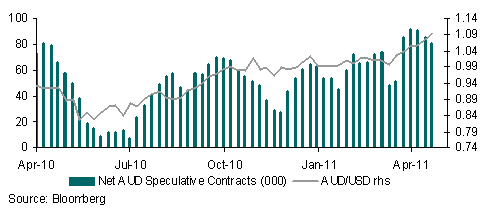
I look for further rate hikes over coming months even with the AUD at such a high level. AUD has lost a bit of ground after hitting a high just above 1.10 against the USD and on the margin the statement is slightly negative for AUD. A slightly firmer USD overall and stretched speculative positioning, with IMM AUD positions close to their all time high, points to some downside risks in the short-term.

In contrast India’s central bank the RBI hiked interest rates by more than many expected. Both the repo and reverse repo rates were raised by 50bps, with the central bank governor highlighting renewed inflation risks in his statement. The decision reveals a shift in RBI rhetoric to an even more hawkish bias in the wake of rising inflation pressures, which should be beneficial to the rupee.

Greece Bailed Out, Euro Unimpressed

After much debate eurozone ministers along with the International Monetary Fund (IMF), finally announced an emergency loan package for Greece amounting to  EUR 110 billion. In return for the bailout Greece agreed to enhanced austerity measures. The good news is that the package covers Greece’s funding requirements until 2012, and is sufficient to avoid debt restructuring and default. The loan package has also removed uncertainty ahead of bond redemption on May 19th.

One aim of the package was to prevent contagion to other eurozone countries, especially Portugal and Spain, where there has been growing pressure on local bond and equity markets. However, the path ahead is strewn with obstacles and it is too early to believe that the package has ensured medium term stability for the EUR.

The challenges ahead are two-fold, including both the implementation of the measures in Greece in the face of strong domestic opposition and the approval of the loans by individual country parliaments within the eurozone, both of which are by no means guaranteed.

The toughest approval process is likely to be seen in Germany where the government will face a grilling in parliament and a challenge in the constitutional court ahead of official approval of the package. European Union leaders are scheduled to meet on May 7th to discuss the parliamentary approval of loans to Greece whilst German officials meet on the same day.

Implementation risk is also high. Although the Greek government appears to be sufficiently committed, opposition within Greece is growing; various strikes planned over coming days. Aside from union opposition, the scale of the budgetary task ahead is enormous, having never been undertaken on such a large scale in recent history. The sharp decline in growth associated with the austerity measures will make the task even harder.

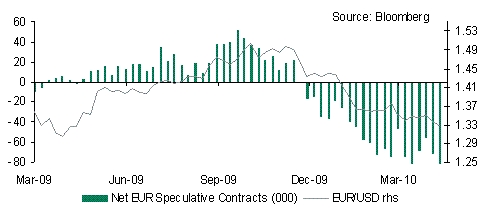
The EUR bounce on the news has been limited, with the currency failing to hold onto gains. The announcement seems to have triggered a “buy on rumour, sell on fact” reaction, with the size of the loan package falling within the broad estimates speculated upon over the last week. The lack of EUR bounce despite the fact that going into this week the CFTC Commitment of Traders report revealed record net short speculative positioning in EUR/USD, reveals the extent of pessimism towards the currency.

The EUR may benefit from a likely narrowing in bond spreads between Greece and Germany. Given that sovereign risk is being increasingly transferred from the periphery to the core, the net impact on bond markets may not be so positive for the EUR. Over the short-term there will be strong technical resistance on the upside around EUR/USD 1.3417 but more likely the currency pair will target support at around 1.3114.

The Herculean task ahead for the Greek government suggests that markets will not rest easy until there are credible signs of progress. Investors would be forgiven for having a high degree of scepticism given the degree of “fudging” involved in the past, whilst Greek unions will undoubtedly not make the government’s task an easy one by any means. Such scepticism will prevent a sustained EUR recovery and more likely keep the EUR under pressure.

As noted above the divergence in growth for the eurozone economy between Northern and Southern Europe will make policy very difficult. Moreover, the EUR is set to suffer from an overall weak trajectory for the eurozone economy, relative to the US and other major economies. The widening growth gap with the US will also fuel a widening in bond yield differentials, a key reason for EUR/USD to continue to decline to around or below 1.25 by the end of the year.