Gold / FX correlations

There is no shortage of cash rich investors in Asia even amidst the current troubles in Dubai. Indeed, sentiment in the gemstones market is particularly upbeat, with a rare five-carat pink diamond selling for a record HK$84.24 million in Hong Kong. Perhaps this is a good reflection of abundant liquidity and of course wealth in Asia and in particular China, with talk that mainland Chinese investors were strong participants in the diamond auction.

It’s not just diamonds that are selling for record prices; gold hit a fresh high above $1,200 and once again at least part of this is attributable to the appetite of Asian central banks as well as demand from China as the country tries to increase its gold reserves. The rise in gold prices has coincided with a bullish announcement from the world’s top gold producer that it has completely eliminated its market hedges earlier than forecast due to the positive outlook on prices and waning supply.

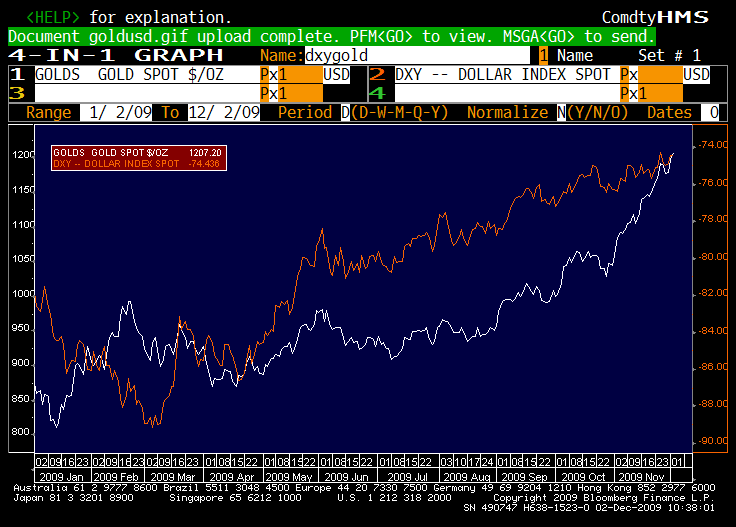
The correlation between gold prices and the USD remains very strong at -0.88 over the last 3-months, with firmer gold prices, implying further USD weakness. In fact, the gold / USD correlation has been consistently strong over the past few months and is showing little sign of diminishing.

Over the past 6-months the correlation has been -0.91 and over the past 1-month it was -0.75.  Assuming that anything above 0.70 can be considered statistically significant, the relationship shows that USD weakness has been well correlated with gold strength and that despite talk of a breakdown in the relationship it appears to remain solid. 

As long as the bullish trend in gold continues, the pressure on the USD will remain in place.  Adding to this pressure is the fact that risk is back on for now. Markets took the news of a fall in the ISM manufacturing index and in particular the drop in the employment component in its stride even though it supports the view of a weaker than consensus drop in payrolls in November when it is published on Friday.

There are still plenty of reasons to be cautious in the weeks ahead and although we appear to be back in a “risk on” environment markets are likely to gyrate between “risk on” and “risk off” over coming weeks. At least for now, the USD looks to remain under pressure but if risk aversion creeps back up as I suspect it may then the USD will see a bit more resilience into year end. 

Moreover, central banks globally are reaching the limits of their tolerance of USD weakness and will be tested once again, with EUR/USD back above 1.5000, EUR/CHF moving back below 1.5100 and the USD/JPY set to re-test 85.00 following the relatively benign measures announced by the BoJ in which the Bank did little to stem deflationary pressure or weaken the JPY.
Dubai’s aftermath

Dubai’s bolt out of the blue is hitting markets globally, with the aftershock made worse by the thin liquidity conditions in the wake of the US Thanksgiving holiday and Eid holidays in the Middle East.  The sell off followed news by government owned Dubai Holdings of a six month debt freeze.  Estimates of exposure to Dubai vary considerably, with European banks estimated to have around $40 billion in exposure though what part of this is at risk is another question. 

The lack of information surrounding the Dubai announcement made matters worse.  The aftermath is likely to continue to be felt over the short term, with further selling of risk assets likely.  Indeed, there is still a lot of uncertainty surrounding international exposure to Dubai or what risk there is to this exposure and until there is further clarity stocks look likely to face another drubbing.

The most sensitive currencies with risk aversion over the past month have been the JPY, and USD index, which benefit from rising risk aversion whilst on the other side of the coin, most Asian currencies especially the THB and KRW as well as the ZAR, and AUD look vulnerable to any rise in risk aversion.  JPY crosses look to be under most pressure, with the likes of AUD/JPY dropping sharply and these currencies are likely to drop further amidst rising risk aversion. 

The rise in the JPY has been particularly dramatic and has prompted a wave of comments from Japanese officials attempting to talk the JPY lower including comments by Finance Minister Fujii that he “will contact US and Europe on currencies if needed”.  So far, these comments have had little effect, with USD/JPY falling briefly through the key psychological level of 85.00, marking a major rally in the JPY from a high of 89.19 at the beginning of the week.  Unless markets believe there is a real threat of FX intervention by Japan the official comments will continue to be ignored.

It’s not all about risk aversion for the JPY, with interest rate differential playing a key role in the downward move in USD/JPY over recent weeks.  USD/JPY has had a high 0.79 correlation with interest rate differentials over the past month.  The US / Japan rate differential narrowed sharply (ie lower US rate premium to Japan) to just around 4.5bps from around 100bps at the beginning of August.  With both interest rate differentials and risk aversion playing for a stronger JPY the strong JPY bias is set to continue over the short term.

Is this the beginning of a new rout in global markets?  It is more likely another bump on the road to recovery, with the impact all the larger due to the surprise factor of Duba’s announcement as it was widely thought that Dubai was on the road to recovery.  The fact that the news took place on a US holiday made matters worse whilst the weight of long risk trades suggests an exaggerated fall out over the short term.