Draghi shakes things up

European Central Bank President Draghi shook things up overnight providing a major backstop for risk assets. Draghi effectively noted that the ECB “is going to do whatever is necessary to preserve the EUR”. The aggressiveness of his comments left no doubt that the ECB chief means business.

Whether this translates into renewed bond buying by the central bank is debatable but this is what the market is now hoping for at next week’s ECB policy meeting. Anything less would provoke disappointment.

At the least Draghi has helped to put a floor under the EUR ahead of the policy meeting. After dropping to a low around 1.2117 the currency bounced sharply but its gains were exhibited mainly against the USD rather than on the crosses. Further short covering could see EUR/USD move up to around the 1.2350 resistance level but much further gains are expected to be limited.

The biggest beneficiaries of Draghi’s comments were equity volatility which dropped sharply and Spanish stocks, which rallied by over 6% yesterday. Gold also rallied in the hope of central bank action next week. In terms of Asian currencies, those most sensitive to risk gyrations including KRW, MYR, INR and IDR will be the biggest beneficiaries.

Attention today will turn to data releases including July German inflation data and Q2 US GDP. A weak US GDP may put a bit of a dampener on sentiment especially as it will highlight the sharp slowing in growth over the quarter.

Nonetheless, markets are likely to move into consolidation mode ahead of next week’s ECB and Fed meetings, with risk assets generally supported by expectations / hopes of policy actions by both or either central bank. One index which remains on a downward trajectory is the Baltic Dry Index, which dropped further overnight, highlighting the growing risks to the global economy.
USD bulls restrained

Two events over recent days have managed to inflict a degree of pain to USD bulls over recent days. Firstly the report in the press this week that the Fed is actively considering further policy stimulus steps, which taken together with softer economic data such as the 8.4% drop in new home sales registered in June but more specifically declines in the June ISM manufacturing survey and weaker jobs data, have sharply increased the speculation that the Fed will deliver new policy steps at its FOMC meeting next week.

Secondly the comments overnight from ECB board member Nowotny putting the prospects of giving the ESM bailout fund a banking licence firmly back on the table, has given a lift to the EUR. A banking licence would allow the ESM to leverage the ECB’s balance sheet, massively increasing its firepower. No wonder the markets reacted positively! The only catch is that there is significant opposition from both within the ECB council and from outside especially from Germany, suggesting that it would not be an easy step to take.

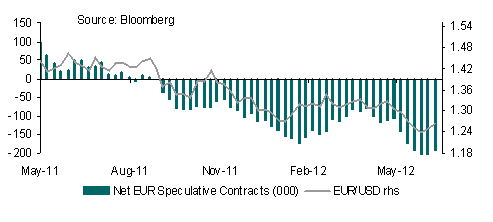
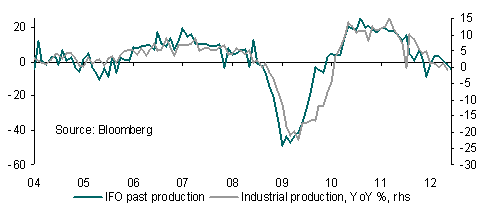
However, in a market that is extremely short EUR any slight positive news will act as a balm on the Eurozone’s wounds. Nowotny’s comments managed to overpower the impact of further drop in the German IFO survey in July which in fairness still remains at a relatively high level. The positive impact on the EUR is set to be short lived especially as a license for the ESM is a long way off while the ESM itself has yet to formally take over from the temporary bailout fund (EFSF).

Nonetheless, downside risks to the EUR will be limited ahead of the FOMC meeting next week and risks that a fresh round of Fed quantitative easing could weigh on the USD. Another complication is that there is also an ECB Council meeting next week, another factor that will play into a tone of consolidation for markets over coming days. EUR/USD is likely to face firm resistance around the 1.2181 level while downside is likely to be capped around 1.2040 in the near term. Assuming no major Fed action next week, EUR/USD remained destined for a drop below 1.2000.

Euro rallies on Greek election outcome but gains to be short lived

The Greek election outcome will be met with a sigh of relief across markets. However, there is still likely to be plenty of horse trading before a new government is formed and even then Greece’s fiscal/debt/growth problems will not just miraculously go away. Market pressure will resume after a brief delay.

At least for the early part of this week markets will likely find some support however, and with events including the FOMC meeting, G20 meeting and EU Summit coming up, hopes that some solutions may be forthcoming may at least prevent sentiment for risk assets from deteriorating too significantly.

The EUR garnered support following news that pro-bailout parties have gained sufficient votes to form a government in Greece. Negotiations will begin to form a coalition government between the first placed party New Democracy and third placed Pasok but the risk remains that prolonged discussions could quickly result in the EUR erasing its gains. Indeed, Pasok leaders are talking about the need to form a ‘government of national unity’, suggesting the process of forming a government will not be straightforward.

A slightly less negative shift in EUR sentiment has been apparent from the CFTC IMM data which revealed that net short positions dropped (ie there has been some short covering) even before the election outcome. The election result will encourage more short covering although data releases this week including the June German ZEW investor confidence and IFO business confidence surveys, both of which are set to decline, will caution against becoming overly bullish EUR. Short term EUR/USD resistance is seen around 1.2750 but a move back down to around 1.2515 is more likely as the week progresses.
a href=”https://econometer.org/wp-content/uploads/2012/06/gerifo.gif”>
One of the reasons the EUR has managed to garner support over recent days has been growing speculation of Fed action to boost the economy in the wake of a rash of softer data releases. Such expectations have put the USD under pressure, with last week’s data revealing disappointing retail sales, industrial production and consumer confidence. On Wednesday the markets will find an answer to speculation of more Fed action, with the Fed FOMC policy decision.

Expectations of more quantitative easing will be disappointed but the Fed will likely increase Operation Twist buying time to evaluate incoming data releases. A combination of a relatively positive Greek election outcome together with speculation of more QE will keep the USD under pressure ahead of Wednesday’s outcome but weakness ought to prove short lived, with USD gains expected following the Fed decision not to expand its balance sheet further.

EUR jumps on Spanish news, but Greek risks ahead

Spain’s request for a EUR 100 billion bailout for its banks has significantly shifted the bias for markets this week, with risk assets buoyed and safe haven assets pressured. The fact that Spain will receive a bailout ‘light’ in terms of the conditions of the loan, will also have come as good news as the stringent measures associated with bailouts of Greece, Portugal and Ireland, will be avoided. Taken together with mixed (but less bad than feared) Chinese data over the weekend, the scene is set for markets to rally early in the week.

However, plenty of event risk remains, not least of which is the outcome of Greek elections at the weekend and results of French parliamentary elections today, which could easily reverse the positive mood of markets.

The USD has continued to head lower a trend that has been established since the end of May, with its drop set to accelerate at the start of the week following news of Spain’s banking bailout and the subsequent bounce in risk assets.

Although Fed Chairman Bernanke provided some relief for the USD last week by not indicating a desire to embark on fresh quantitative easing, the reality is that US data has been disappointing of late, keeping the door open to such action, restaining the USD.

More damaging to the USD is the bounce in risk appetite even before the Spanish news. Softer US data this expected week including likely sluggish May retail sales, a small increase in industrial production and lower manufacturing and consumer confidence surveys, will keep the debate on QE firmly open, leaving the USD struggling in the days ahead.

EUR/USD lurched higher following Spain banking bailout request. However, the sum of EUR 100 billion is far higher than the EUR 40 billion anticipated and could add around 20% to Spain’s sovereign debt. While the size of the package is significant it is also worrying, a fact that could come back and haunt the EUR.

Undoubtedly the upside in EUR is being helped by the fact that speculative positioning reached a fresh record low last week (according to the CFTC IMM data) leaving plenty of scope for short covering. In the near term EUR/USD will remain buoyed but any gains will be restricted to technical resistance around the EUR/USD 1.2690 level where sellers will emerge, especially given uncertainty surrounding the outcome of Greek elections.

EUR rallies, AUD and CAD eye rate meetings

Some consolidation and even slightly more upbeat tone have helped risks assets to settle and the outlook today is for more of the same. The respite looks temporary unless followed by concrete measures out of the Eurozone to stem the crisis, however. Attention will focus on today’s emergency teleconference between G7 leaders in which they are expected to put more pressure on European leaders to act.

However, continuing stalemate in Europe, with Spain’s push for an injection of funds from the Eurozone bailout fund into its banks facing resistance from Germany who believe that any funding should come as part of a formal bailout package. Despite the lack of traction in Europe, the EUR has managed to eek out further gains, with the rebound from the lows around 1.2287 versus USD gaining traction. Near term resistance is seen around 1.2625.

There has been a change of heart by many ahead of today’s Reserve Bank of Australia (RBA) meeting. Weaker global data in particular in China, with both the manufacturing and non manufacturing purchasing managers indices (PMI) coming in weaker than expected, have added to worries about the path of the Australian economy.

Taken together with some deterioration in Australian money market conditions, weaker commodity prices and growing European contagion risks, the RBA will probably want to shield the domestic economy, with another 25bps rate cut. Talk of a 50bps easing today has done the rounds but this seems excessive given that it would fall hot on the heels of 50bps rate cut at the beginning of May.

The AUD has priced in some easing and a likely 25bps rate cut is unlikely to put much pressure on the currency but much will depend on the accompanying statement. In any case, downside risks remain in the current environment.

The Bank of Canada also meets today to decide on its policy rate settings. Unlike in Australia there has been no change of heart ahead of the meeting, with the BoC set to keep its policy rate on hold at 1%. The central bank has sounded more upbeat than most and the drop in the CAD over recent weeks has in any case acted to loosen monetary conditions.

Although somewhat resilient compared to its commodity counterparts such as AUD and NZD, the CAD is playing catch up, having been the worst performing currency so far this month. Speculative positioning has drifted lower too, although it is still close its three month average. This implies room for a further reduction in long positions as the CAD fails to outperform.

Recent weakness in US economic data highlights the risks ahead for Canada and the CAD, suggesting that investors will continue to take a cautious tone towards the currency over coming weeks. A more neutral statement from the BoC will likely keep CAD sentiment subdued.